

What size bike do you get a 4 year old
Most 4-year-olds should start by trying a 14-inch bike, but measured height and actual control decide the fit. Use 12 inches for a rider 34–40 in (86–102 cm), 14 inches for 37–45 in (94–114 cm), or 16 inches for 40–48 in (102–122 cm), then confirm fit in person.
Choose the starting size from height
Measure your child without shoes, standing straight against a wall. Record total height from the floor to the top of the head. Age only narrows the search: at four years old, a child can fall within the height range for a 12-, 14-, or 16-inch bike.
| Wheel size | XBikes starting range | What it means for a 4-year-old |
|---|---|---|
| 12 Inch | Ages 3–4; 34–40 in / 86–102 cm | Consider when the measured height remains within this range. |
| 14 Inch | Ages 3–6; 37–45 in / 94–114 cm | A sensible first size to try for many four-year-olds. |
| 16 Inch | Ages 4–7; 40–48 in / 102–122 cm | Consider only when height and the hands-on fit check support it. |
Overlapping ranges are intentional starting points, not proof that every listed size fits equally well. If your child is 40 inches tall, for example, all three ranges meet at that height; reach, stand-over clearance, braking and confidence must break the tie.
Measure inseam before comparing bikes
For inseam, have the child stand in socks with feet slightly apart. Place a firm, thin book between the legs and raise it gently to simulate a saddle. Measure vertically from the floor to the top edge of the book.
Compare that measurement with the bicycle’s stand-over clearance and usable saddle adjustment when the bike is physically available. The supplied sizing standard does not give a universal inseam number, so do not invent one or rely on wheel diameter alone. Follow the exact product manual for adjustment instructions, or ask a qualified bicycle mechanic.
Do a hands-on fit and control check
Have the child try the bicycle rather than buying a larger frame solely for future growth. This follows pediatric fit guidance and reveals problems that an age label or height chart cannot show.
- Stand-over: The child should be able to straddle the bike without the frame preventing a stable stance.
- Reach: While seated, the child should reach the handlebar naturally without stretching, locking the elbows or leaning excessively.
- Brake control: Check that the child can comfortably reach and operate the bicycle’s actual braking controls. Do not assume a particular brake type.
- Starting and stopping: The child should be able to get underway, steer and stop without the bike overwhelming them.
- Confidence: Choose the smaller workable option if the larger bike reduces control or makes the rider hesitant.
If either candidate compromises these checks, it is not the right fit today even when the height chart includes the child.
How the supplied sizes help you compare
The catalog option relevant to this question is the XJD Girls Bike for Kids Ages 3-8, 12/14/16 Inch with Training Wheels – Purple. It is offered in 12 Inch, 14 Inch and 16 Inch labels, so its variants cover all three XBikes starting points that can overlap age four. The age wording in its exact product title is only a catalog label; use measured height and an individual fit check as the evidence.
These particular catalog variants help you compare the likely 12-, 14- and 16-inch choices without treating age four as a single guaranteed size.
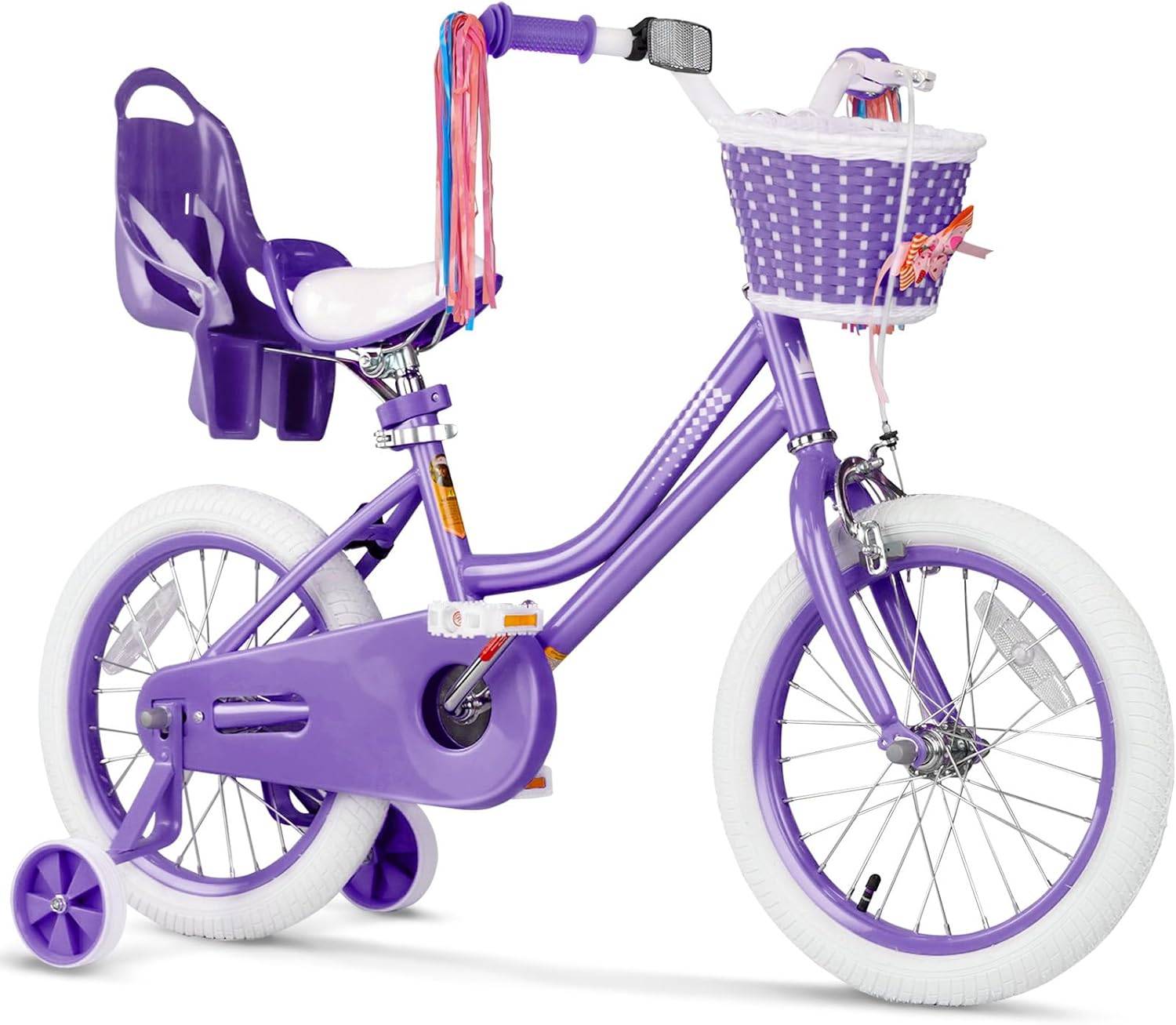
Begin with its 14 Inch variant when the child measures 37–45 in (94–114 cm). Compare the 12 Inch variant if the child is 34–40 in (86–102 cm), and the 16 Inch variant if the child is 40–48 in (102–122 cm). Training wheels are part of the supplied product description, but they do not correct a frame that is too large, a difficult reach or inaccessible braking controls.
When these options are not relevant
Do not use this product as fit evidence when the child falls outside the stated height range for the selected wheel size. It is also not enough when you cannot verify stand-over position, reach, brake operation and present confidence.
If the child is under 34 inches (86 cm), none of these three XBikes ranges applies. If the child is over 48 inches (122 cm), these supplied variants do not provide the next comparison point. In either case, remeasure and seek an appropriate bicycle that can be tried for fit rather than forcing one of the catalog choices.
Make the final decision
- Measure standing height and inseam.
- Use height to shortlist 12, 14 or 16 inches.
- Let the child straddle, reach, steer and operate the brakes on each viable candidate.
- Reject any size chosen mainly for growing room or any bike the child cannot confidently control.
Before riding, provide a bicycle helmet that fits properly, sits level and has straps adjusted according to its manufacturer’s instructions. For assembly, maintenance, compatibility, load limits or torque settings, follow the exact bicycle manual or use a qualified bicycle mechanic.
For a 4-year-old, try 14 inches first, then move to 12 or 16 inches only when measured height and the complete hands-on check clearly support that decision.
Bikes for your next adventure
-

Pink Girls' 12/14/16" Bike by XJD – Basket & Doll Seat
The XJD Pink Girls' Bike with Basket & Doll Seat is made for riders 71–122 cm ta…$75.99
$99.99 -

Light Purple XJD Toddler Bike Helmet, Adjustable, Size XS (46–51 cm)
This Light Purple XJD toddler bike helmet is made for the smallest riders — the …$20.39
-

Black XJD Toddler Bike Helmet, Adjustable – Kids' Protective Helmet
The XJD Toddler Bike Helmet in black is an adjustable protective helmet for kids…$20.39