

What size bike to get for a 4 year old
Most 4-year-olds should start by trying a 12-inch or 14-inch bike. Measure your child first: 12-inch suits 34–40 in (86–102 cm), while 14-inch suits 37–45 in (94–114 cm). A taller child may be ready to try a 16-inch bike at 40–48 in (102–122 cm), but only if the fit and controls are manageable.
Choose the starting size by measured height
Age narrows the search, but height gives you the more useful starting point. Measure your child without shoes, standing upright against a wall. Compare that measurement with the XBikes ranges below, then confirm the bicycle in person rather than ordering solely by the age label.
| Wheel size | XBikes age starting point | Rider height | Relevance at age 4 |
|---|---|---|---|
| 12 Inch | Ages 3–4 | 34–40 in / 86–102 cm | Start here for a smaller 4-year-old. |
| 14 Inch | Ages 3–6 | 37–45 in / 94–114 cm | Often worth comparing where the height ranges overlap. |
| 16 Inch | Ages 4–7 | 40–48 in / 102–122 cm | Consider only when the child is at least 40 in / 102 cm and passes the fit check. |
The overlap is intentional: two children of equal height can differ in leg length, reach and confidence. Do not automatically move up a size because the child has turned four.
Measure inseam as well as height
For inseam, have the child stand in socks with feet slightly apart. Place a firm, thin book between the legs and raise it gently to simulate the bicycle saddle. Measure vertically from the floor to the top edge of the book.
Use that result when trying the bike, but do not convert it into a wheel size with an unsupplied formula. Bicycle geometry varies. Instead, compare the measured inseam directly with the bike’s stand-over clearance and its saddle adjustment, following the exact product manual.
Perform the fit check before choosing
Have your child try each plausible size with close adult supervision. The American Academy of Pediatrics advises against buying an oversized bicycle merely for future growth. Check all of the following on the actual bike:
- Stand-over: the child can straddle the bicycle comfortably rather than being pressed against the frame.
- Starting and stopping: the child can get into position, set off and stop without the bicycle overwhelming them.
- Reach: the handlebars are reachable without stretching, locking the elbows or losing a stable posture.
- Brake control: the child can reach and operate the supplied controls reliably with small hands.
- Confidence: the child looks in control while turning and stopping, not merely able to sit on the saddle.
If the larger option causes difficulty in any of these checks, choose the smaller properly fitting bike. A future-growth margin does not compensate for poor control now.
How the supplied XBikes option helps
The Flower Pink XJD Girls Bike with Doll Seat & Basket is cataloged under Training Wheel Bikes and is offered with 12 Inch, 14 Inch and 16 Inch SKU labels. Those three choices let you compare the relevant starting sizes for a 4-year-old within one catalog option; the labels do not replace the individual height, inseam, reach, brake-control and confidence checks.
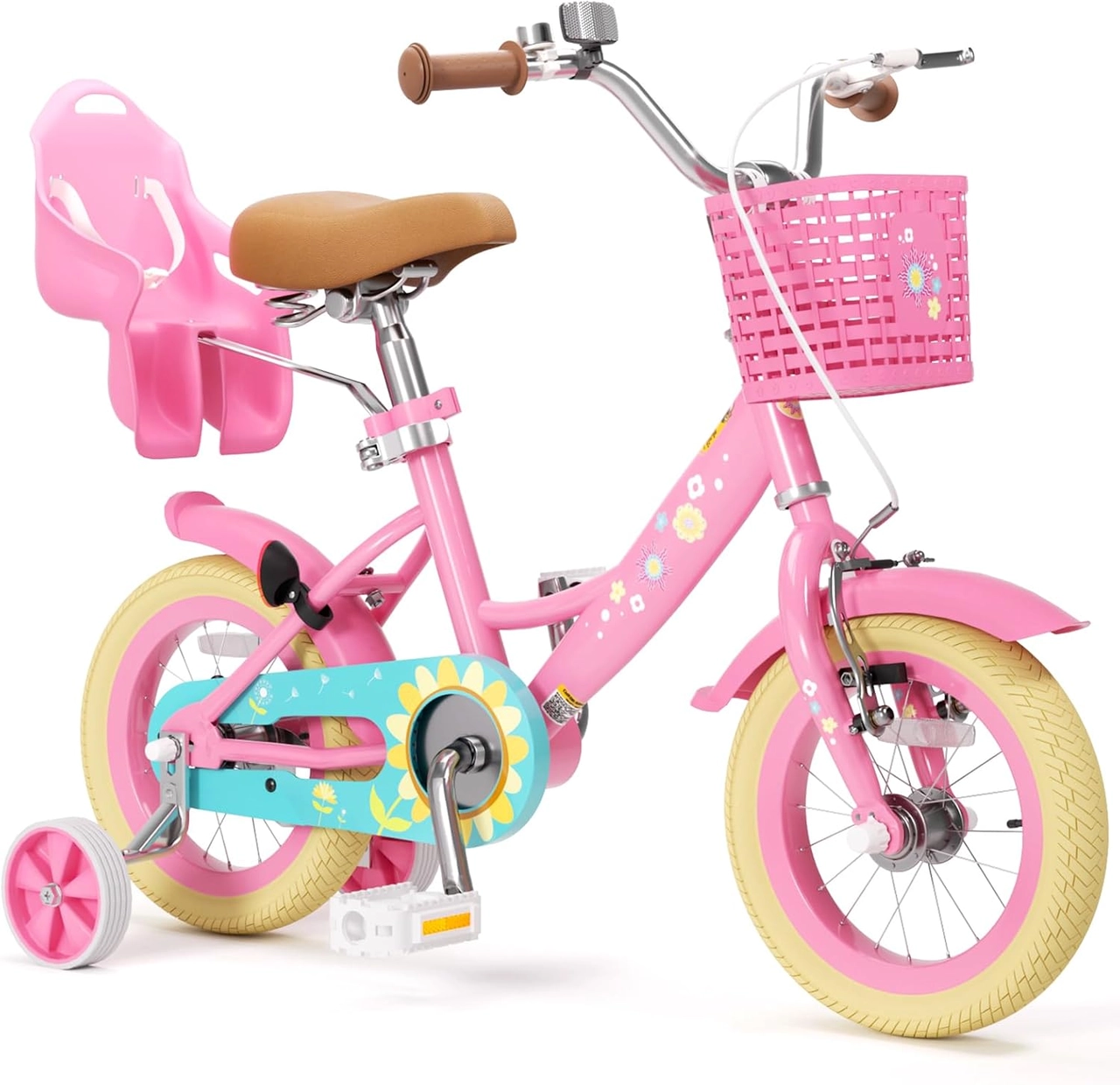
Begin with its 12 Inch label for a child measuring 34–40 in (86–102 cm), compare its 14 Inch label at 37–45 in (94–114 cm), and consider its 16 Inch label only from 40 in (102 cm). The catalog facts do not establish current availability, equipment specifications, load limits or assembly details. Check the exact product manual or ask a qualified bicycle mechanic where those details affect the fit or setup.
Resolve overlapping size ranges
If your child falls within both the 12-inch and 14-inch ranges, try both. Favor the bike on which stand-over, reach, braking and low-speed control are natural. If the child is exactly at the lower boundary for a larger size, that makes the larger bike eligible to try—not automatically the right choice.
The same rule applies between 14 and 16 inches. A 4-year-old who is 40 in (102 cm) may compare all three starting points, but the winning size is the one the child can control now. If no available bike passes every practical check, wait or compare a different model with suitable geometry rather than forcing a wheel-size decision.
Complete the decision safely
Once the bike fits, add a properly fitting bicycle helmet. The U.S. Consumer Product Safety Commission advises that it sit level and that its straps be used according to the helmet manufacturer’s instructions. Follow the bicycle’s exact manual for assembly, maintenance, compatibility, load limits and torque; when anything is unclear, use a qualified bicycle mechanic.
For your 4-year-old, measure height and inseam today, shortlist 12 and 14 inches from the stated ranges, add 16 inches only at 40 in (102 cm) or taller, and buy only after the child passes the stand-over, reach, braking and confidence checks.
Bikes for your next adventure
-

Pink Girls' 12/14/16" Bike by XJD – Basket & Doll Seat
The XJD Pink Girls' Bike with Basket & Doll Seat is made for riders 71–122 cm ta…$75.99
$99.99 -

Light Purple XJD Toddler Bike Helmet, Adjustable, Size XS (46–51 cm)
This Light Purple XJD toddler bike helmet is made for the smallest riders — the …$20.39
-

Black XJD Toddler Bike Helmet, Adjustable – Kids' Protective Helmet
The XJD Toddler Bike Helmet in black is an adjustable protective helmet for kids…$20.39