

What size inch bike for a 4 year old
For most 4-year-olds, start by comparing a 12-inch and 14-inch bike. Use measured height—not age alone—and choose only after checking stand-over clearance, reach, brake control and confidence. A 16-inch bike may be relevant for a child at least 40 in / 102 cm tall, but it must not be bought oversized for growth.
Which wheel size should you check first?
The XBikes starting points place both 12-inch and 14-inch bikes within the possible range for a 4-year-old. A 12-inch bike corresponds to ages 3–4 and heights of 34–40 in / 86–102 cm. A 14-inch bike corresponds to ages 3–6 and heights of 37–45 in / 94–114 cm.
Because those height ranges overlap, age cannot settle the choice. Start with the child’s current standing height, then compare both sizes when the measurement falls between 37 and 40 in / 94 and 102 cm. The smaller or larger wheel label does not prove that the complete bicycle will fit.
| Measured height | Size to investigate | What to do |
|---|---|---|
| 34–36 in / 86–93 cm | 12 Inch | Begin with a 12-inch model and complete an individual fit check. |
| 37–40 in / 94–102 cm | 12 Inch and 14 Inch | Try both; choose by control, reach, stand-over and confidence. |
| 41–45 in / 103–114 cm | 14 Inch | Begin with a 14-inch model and verify the complete fit. |
| 40–48 in / 102–122 cm | 16 Inch may also enter the comparison | Consider it only when the child can comfortably control the actual bike. |
Measure before comparing bikes
Measure standing height without shoes, with the child upright against a wall. Then measure inseam from the floor to the crotch while the child stands naturally. Record both measurements in inches or centimetres so you can compare them consistently.
Height identifies a sensible wheel-size starting point. Inseam helps with the stand-over check, but no universal clearance number is supplied here. Compare the child’s inseam with the actual bicycle’s stand-over height, following its product information or manual rather than guessing.
Check the actual bicycle, not just its label
Have the child try the bicycle. While standing over it, the child should have usable clearance and should not be forced onto tiptoes merely to manage the frame. Seated, the child needs a comfortable reach to the handlebar without stretching, locking the arms or losing a stable posture.
Ask the child to show that they can steer, start, stop and keep the bike balanced at a controlled pace. They must also be able to reach and operate the bike’s braking controls confidently. Wheel size alone cannot confirm any of these points because frame geometry and adjustment can differ between bicycles.
Do not choose an oversized bicycle simply to leave growing room. If the child cannot comfortably stand over, reach or stop the bike now, move to a smaller option or a different model.
How the supplied XBikes option helps
The catalog includes XJD Boys & Girls BMX Bike with Training Wheels, 12/14/16" – Blue in 12 Inch, 14 Inch and 16 Inch SKU labels. Those three labels make it relevant for comparing the main sizes that may arise for a 4-year-old, but each SKU remains a different wheel size and still requires its own individual fit check.

Begin with the 12 Inch SKU for a child within 34–40 in / 86–102 cm. Compare the 14 Inch SKU when the child is within 37–45 in / 94–114 cm, especially in the overlap. Consider the 16 Inch SKU only from 40 in / 102 cm upward and only if stand-over, reach, braking and present confidence are all suitable. Training wheels in the exact catalog title describe the product; they do not establish fit.
When these sizes are not relevant
If the child is below 34 in / 86 cm, the supplied starting table does not identify an appropriate wheel size, so do not force a choice from these catalog options. If the child is taller than 48 in / 122 cm, the listed 12-, 14- and 16-inch SKUs fall below the supplied height starting points for larger riders. Re-measure and investigate the appropriate next range instead.
A child may also need a different option despite matching a height band. Reject any bike they cannot mount, control, steer or stop comfortably. Current ability matters more than reaching the edge of a numerical range.
Make the final 4-year-old size decision
- Measure standing height and inseam.
- Use height to shortlist 12 Inch, 14 Inch or, from 40 in / 102 cm, possibly 16 Inch.
- Have the child try each shortlisted bicycle.
- Confirm stand-over clearance, relaxed reach, steering control and confident brake operation.
- Choose the size that works now, without sizing up solely for future growth.
Before riding, provide a properly fitting bicycle helmet. It should sit level and its straps should be used according to the helmet manufacturer’s instructions. Follow the exact bicycle manual for assembly, adjustment, maintenance, compatibility, load limits and torque, or ask a qualified bicycle mechanic.
For a 4-year-old, the practical decision is therefore: measure first, usually compare 12 Inch with 14 Inch, add 16 Inch only at or above 40 in / 102 cm, and buy only the bicycle the child can control comfortably today.
Bikes for your next adventure
-

Pink Girls' 12/14/16" Bike by XJD – Basket & Doll Seat
The XJD Pink Girls' Bike with Basket & Doll Seat is made for riders 71–122 cm ta…$75.99
$99.99 -

XJD Girls Bike for Kids Ages 3-8, 12/14/16 Inch with Training Wheels – Purple
The XJD Girls Bike in Purple is a training-wheel bicycle for kids ages 3 to 8, f…$149
$169 -
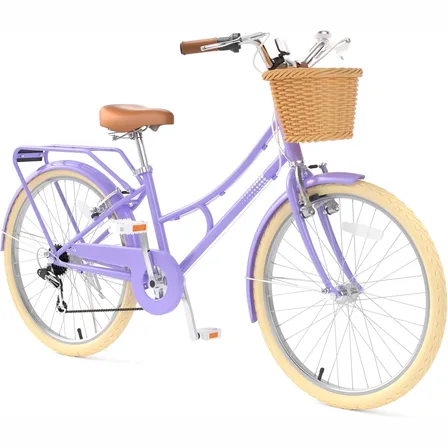
24-Inch Purple XJD Beach Cruiser Bike with U-Brake
The XJD 24-Inch Purple Beach Cruiser is built for girls and young women roughly …$159.99