

How to buy a bike helmet for a toddler
To buy a bike helmet for a toddler, measure the child’s head, match that measurement to the exact size range, and confirm a level, secure fit in person.
Measure before comparing helmets
Use a flexible tape measure around the widest part of the child’s head, keeping the tape level. Record the circumference in centimetres. Measure more than once so that a tilted tape or trapped hair does not push you toward the wrong size.
Compare that number with the size range printed for the exact helmet variant you are considering. A label such as toddler, XS or S is not enough: those terms can cover different measurements. If the child falls outside the stated range, choose another size rather than assuming an adjustment system will compensate.
If the measurement sits at a boundary between two ranges, have the child try both relevant options when possible. The better choice is the one that fits properly now without being forced tight or left loose. Do not select a larger helmet merely to allow for growth.
Use the centimetre range, not the age label
The word “toddler” in a product name is a catalog label, not evidence that the helmet fits every toddler. Children of the same age can have different head circumferences and head shapes. Bicycle wheel size is also not a helmet-sizing method: XBikes’ bicycle age and height starting points help with bicycle selection, but they do not replace measuring the head and checking the helmet on the individual child.
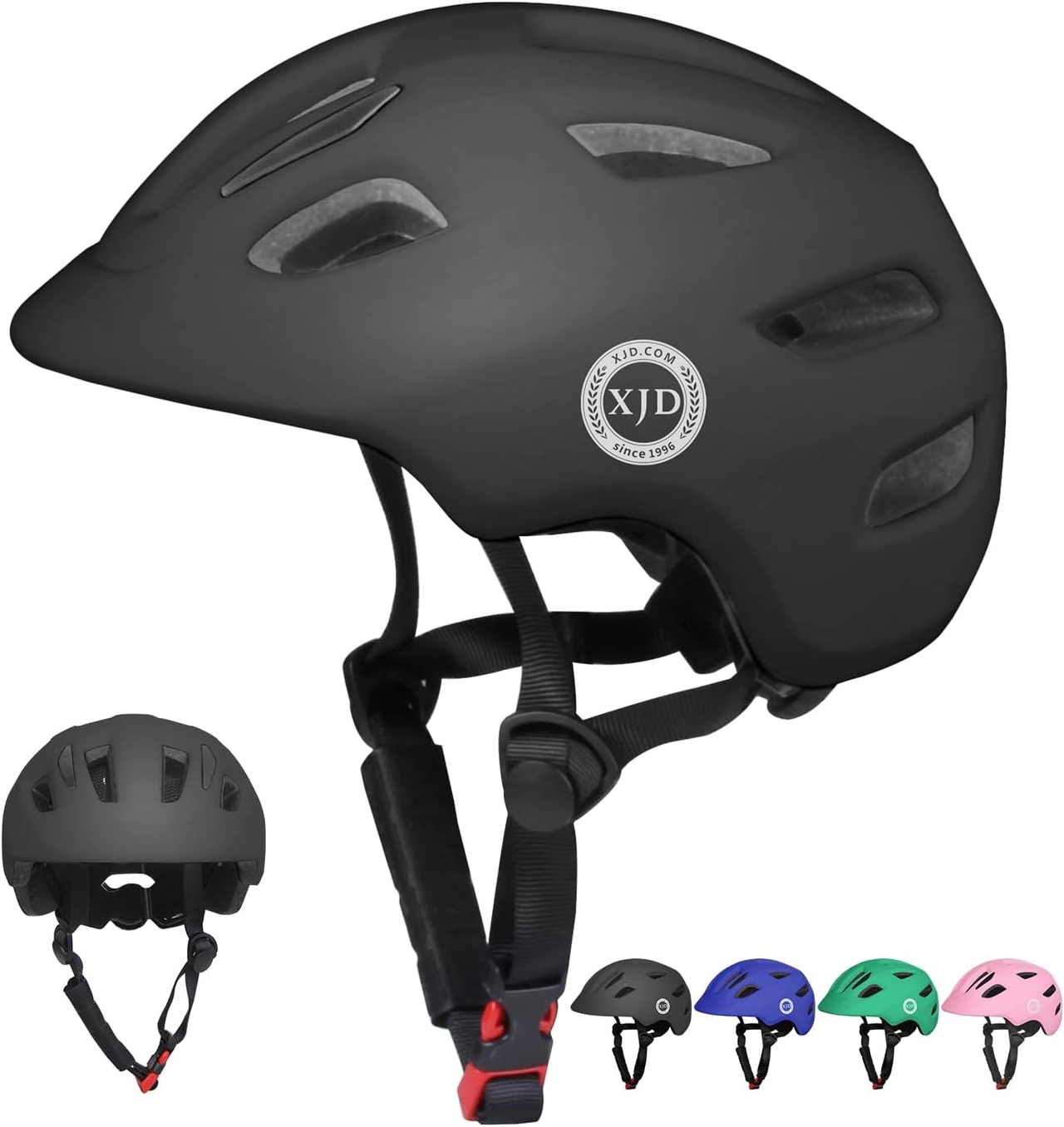
For the supplied catalog option, the useful comparison is between its available centimetre-labelled sizes. The exact product is Black XJD Toddler Bike Helmet, Adjustable – Kids' Protective Helmet. Its listed choices are XS (46–51 cm), XS (48–50 cm), S (51–54 cm) and S (52–56 cm). Because two choices share each letter while having different ranges, verify the complete SKU label rather than ordering by XS or S alone.
This catalog option helps answer the buying question because its four supplied size labels can be checked directly against a measured head circumference; it is relevant only when the child’s measurement falls within the range of the exact variant selected.
Check the helmet on the child
A matching measurement narrows the choice, but it does not prove a good fit. Have the child wear the helmet before committing when possible. It should sit level on the head rather than tipping backward or forward. Follow the manufacturer’s instructions to position and adjust every strap and fitted component.
With the retention system fastened and adjusted as directed, ask the child to move their head naturally. The helmet should remain correctly positioned rather than shifting out of place. Check that nothing pinches, creates an obvious pressure point or makes the child resist wearing it. If a helmet cannot be made level and secure while remaining wearable, reject that size or model even when the measurement appears to match.
Compare overlapping size choices carefully
The supplied ranges overlap in places, so circumference alone may leave more than one candidate:
| Measured circumference | Catalog ranges worth checking | What to do |
|---|---|---|
| 48–50 cm | XS (46–51 cm) and XS (48–50 cm) | Try the exact variants and keep only one that fits level and secure. |
| 51 cm | XS (46–51 cm) and S (51–54 cm) | Treat this as a boundary; compare actual fit rather than preferring a letter. |
| 52–54 cm | S (51–54 cm) and S (52–56 cm) | Confirm the complete range and evaluate both if available. |
| 55–56 cm | S (52–56 cm) | This is the only supplied range containing the measurement, but a fit check is still required. |
Below 46 cm or above 56 cm, none of the supplied size ranges is relevant. At 47 cm, only XS (46–51 cm) includes the measurement. These comparisons identify candidates; they do not establish compatibility with a particular child’s head shape.
Inspect the exact item and instructions
Before use, inspect the helmet and its retention parts for visible damage, missing pieces or anything that prevents adjustment. Confirm that the exact item is intended by its manufacturer for bicycling, then read and retain its manual. Use the straps and adjustments exactly as instructed.
The supplied catalog facts do not specify certification, materials, weight, maintenance intervals or replacement procedures, so do not infer them from the title or appearance. Consult the exact product label and manual for those details. If the instructions are absent, unclear or conflict with the item in hand, do not improvise; ask the manufacturer or a qualified bicycle professional.
Make the final toddler-helmet decision
- Measure the child’s head in centimetres and repeat the measurement.
- Shortlist only exact SKU ranges that contain that number.
- Try the helmet on the child and require a level, secure, comfortable fit.
- Adjust and fasten it solely according to the manufacturer’s instructions.
- Reject any option that shifts, cannot sit level, causes pressure or falls outside its stated range.
Buy the toddler’s helmet for the head and fit they have now: record the centimetre measurement, compare the complete size label, and proceed only after the exact helmet stays level and secure when adjusted as directed.
Bikes for your next adventure
-

Kids Bike Helmet by XJD for Boys & Girls – Black, Blue, Green, Pink, Purple
The XJD Kids Bike Helmet covers a wide 2-to-8-year age range thanks to two head-…$59.99
-

Blue XJD Kids Bike Helmet for Boys & Girls
The Blue XJD Kids Bike Helmet is a lightweight, adjustable multi-sport helmet fo…$59.99
$99 -

XJD Girls BMX Bike 12/14/16 Inch with Training Wheels – Pink Blue
The XJD Girls BMX Bike in Pink/Blue is built as a first pedal bike for kids roug…$99.99
$119.99