

What size 2 wheel bike for a 3 year old
For most 3-year-olds, start with a 12-inch two-wheel bike. Consider a 14-inch only if the child measures at least 37 inches (94 cm) and passes an individual fit and control check.
Choose between 12-inch and 14-inch wheels
Age is only a starting point. Under the XBikes sizing standard, a 12-inch bike covers ages 3–4 and rider heights of 34–40 inches (86–102 cm). A 14-inch bike covers ages 3–6 and heights of 37–45 inches (94–114 cm).
That overlap does not make the sizes interchangeable. Begin with the child's measured height, then confirm inseam clearance, reach, brake control and confidence on the exact bicycle. A short or hesitant 3-year-old will generally have a better starting point in the 12-inch range. A taller child may compare both sizes, but should move to 14 inches only when the larger bike remains easy to mount, balance, steer and stop.
| Wheel size | XBikes starting range | What it means at age 3 |
|---|---|---|
| 12 Inch | Ages 3–4; 34–40 in / 86–102 cm | The usual first size to try |
| 14 Inch | Ages 3–6; 37–45 in / 94–114 cm | Compare only for a child at least 37 in / 94 cm tall |
| 16 Inch | Ages 4–7; 40–48 in / 102–122 cm | Outside the stated age starting point; do not size up merely for growth |
Measure before comparing bikes
Measure the child without shoes, standing straight against a wall. Record total height from the floor to the top of the head. Then measure inseam from the floor to the crotch with the feet slightly apart. Use height to identify the starting wheel size and inseam to assess clearance on the actual bicycle.
Bring those measurements when shopping, but do not try to calculate fit from wheel diameter alone. Frame shape, saddle position and controls can make two bicycles with the same wheel label feel different. The decisive check must happen on the exact model.
Do this fit check on the exact bike
- Check stand-over clearance: with the child straddling the bicycle, confirm there is comfortable clearance rather than contact with the frame.
- Check the starting position: the child should be able to get on, settle into position and begin without the bicycle feeling unwieldy.
- Check reach: hands should reach the handlebar naturally without a strained stretch or cramped posture.
- Check steering: ask the child to turn the handlebar both ways while remaining balanced and in control.
- Check braking: the child must be able to reach and operate the fitted brake controls. Follow the exact product manual for their use and adjustment.
- Check confidence: watch for controlled movement rather than judging fit only by whether the child's feet can touch down.
If either size fails one of these checks, reject it. Do not buy an oversized bicycle in anticipation of growth; the child needs control now.
How the supplied catalog choices help
The two supplied products are Training Wheel Bikes, so they are useful catalog comparison points for wheel-size availability when considering a bike for a 3-year-old. They do not establish that training wheels are removable, and their category should not be treated as proof that either model matches a requested two-wheel setup.
 Girls' Training Wheel Bike by XJD with Basket – Purple
Available in 14, 16 and 20 Inch labels. Its 14-inch option is a comparison point only for a 3-year-old at least 37 inches (94 cm) tall who passes an exact-bike fit check.
 Flower Pink XJD Girls Bike with Doll Seat & Basket
Available in 12, 14 and 16 Inch labels. Its 12-inch option matches the usual age-three starting point, while 14 inches is relevant only after height measurement and an individual fit check.
Flower Pink XJD Girls Bike with Doll Seat & Basket is offered in 12 Inch, 14 Inch and 16 Inch labels. Its 12-inch option matches the usual XBikes starting point for age 3, while its 14-inch option gives taller children a size to compare after measurement and an in-person fit check.
Girls' Training Wheel Bike by XJD with Basket – Purple is offered in 14 Inch, 16 Inch and 20 Inch labels. It has no supplied 12-inch option, so its 14-inch version is relevant only as a larger comparison for a child at least 37 inches (94 cm) tall who can comfortably control that exact bicycle. Its 16-inch and 20-inch labels are not suitable choices based on age 3 alone.
Confirm configuration, assembly, maintenance, compatibility and adjustment details in the exact product manual or with a qualified bicycle mechanic; those facts are not supplied here.
Before the first ride
Use a bicycle helmet that fits the child properly, sits level on the head and has its straps positioned according to the helmet manufacturer's instructions. Choose a controlled practice area away from traffic and supervise closely while the child learns starting, steering and stopping.
The practical decision is simple: measure first, try a 12-inch bicycle first when height is 34–40 inches (86–102 cm), and compare a 14-inch only from 37 inches (94 cm) upward. Buy neither unless the child clears the frame, reaches the controls, operates the brakes and rides with present—not future—control.
Bikes for your next adventure
-

XJD Girls Bike for Kids Ages 3-8, 12/14/16 Inch with Training Wheels – Purple
The XJD Girls Bike in Purple is a training-wheel bicycle for kids ages 3 to 8, f…$149
$169 -

Pink Girls' 12/14/16" Bike by XJD – Basket & Doll Seat
The XJD Pink Girls' Bike with Basket & Doll Seat is made for riders 71–122 cm ta…$75.99
$99.99 -
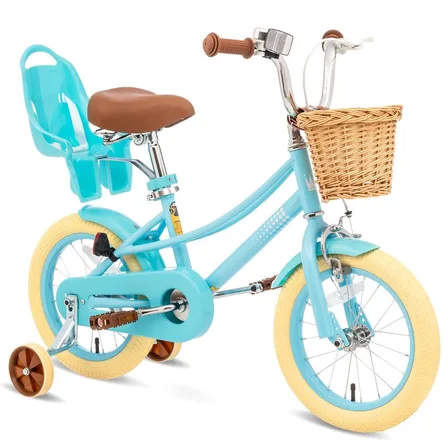
Girls' Training Wheel Bike by XJD, 12–20 Inch Wheels – Blue
This XJD girls' training wheel bike in Blue covers one of the widest fit ranges …$139
$159