

What size bicycle for 11 year old boy
Most 11-year-old boys should start by trying a 24-inch bicycle, but height and control decide the fit. Choose 20 inches at 48–60 in (122–152 cm), 24 inches at 54–64 in (137–163 cm), or consider 26 inches above 60 in (153 cm).
Choose the starting wheel size by height
Age places an 11-year-old within both the 20-inch and 24-inch starting ranges, so it cannot settle the choice. Measure the child without shoes, then compare his height with the XBikes ranges below.
| Wheel size | XBikes starting range | What it means for an 11-year-old |
|---|---|---|
| 20 Inch | Ages 7–12; 48–60 in / 122–152 cm | Start here when his measured height falls within this range, especially if he is still developing confidence. |
| 24 Inch | Ages 10–14; 54–64 in / 137–163 cm | This is the usual first size to try when his height is within the range. |
| 26 Inch | Youth and adults over 60 in / 153 cm | Consider only after he exceeds the height threshold and passes an individual control check. |
The ranges overlap deliberately: two children of equal height can have different leg length, arm reach and riding confidence. Wheel size is a starting point, not proof of fit.
Measure height and inseam before shopping
- Height: Have him stand upright against a wall without shoes. Mark the top of his head and measure from the floor.
- Inseam: With feet slightly apart, place a straight-edged book firmly upward between the legs to represent the saddle area. Measure vertically from the floor to the top edge.
- Current confidence: Note whether he starts, stops, turns and brakes calmly or still needs extra stability and easy control.
Use height to identify the first wheel size to try. Use inseam during the actual stand-over and saddle checks; frame shapes differ, so an inseam measurement alone does not guarantee that every bicycle with the same wheel size will fit.
Require a real fit check
Have the child try the bicycle rather than ordering solely by age. With the bicycle upright, confirm he can stand over it without the frame obstructing him. Seated in a normal riding position, he should not have to strain toward the handlebar or controls.
Ask him to demonstrate these points in a controlled area:
- mount and dismount without the bicycle becoming unmanageable;
- hold a steady riding position and turn the handlebar comfortably;
- reach and operate the brakes with reliable control;
- start, stop and place a foot down confidently.
If he is stretched forward, cannot operate the brakes reliably, or struggles to control the bicycle, it is too large or otherwise unsuitable even when his height appears in the published range. Do not buy an oversized bicycle merely for future growth.
How the supplied 24-inch bicycle is relevant
The catalog provides one useful 24-inch comparison: the 24-Inch Purple XJD Beach Cruiser Bike with U-Brake, categorized as a Beach Cruiser Bike. Because 24 inches is the common starting point for an 11-year-old measuring 54–64 in (137–163 cm), this model is relevant to compare when the rider falls in that range. Its title and category do not establish individual fit.
This particular catalog option helps answer the size question by showing the available 24-inch starting point; the child must still try it and pass the stand-over, reach, brake-control and confidence checks.
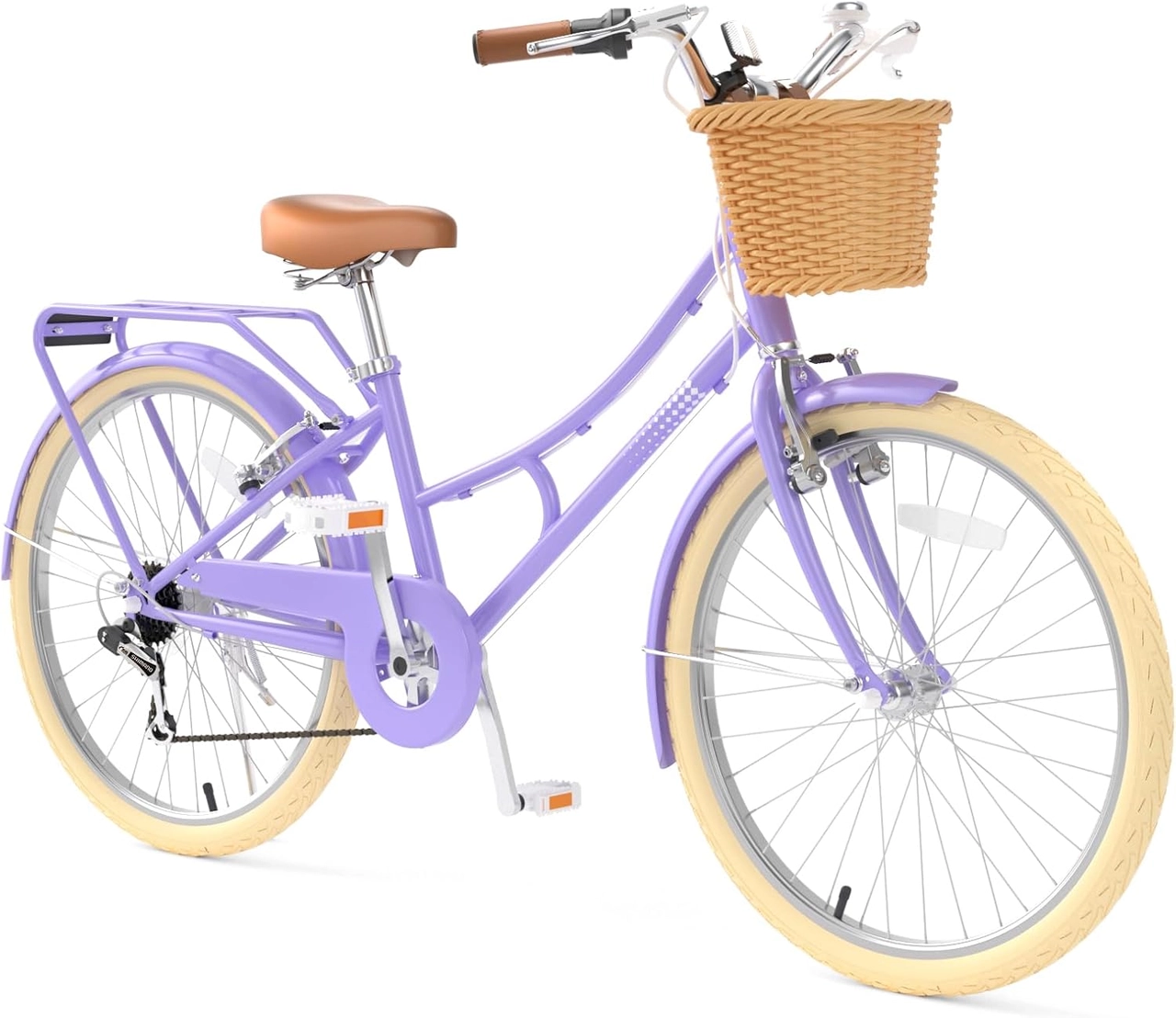
If the child measures within the 20-inch range but does not fit or control a 24-inch bicycle, this product is a larger comparison point, not a substitute for a correctly fitting 20-inch option. If he is over 60 in (153 cm), compare it with a 26-inch bicycle rather than assuming 24 inches remains appropriate.
Check setup and safety before riding
Once the size is chosen, follow the exact bicycle manual for assembly, adjustment, maintenance, load limits, compatibility and torque. If the instructions are missing or the setup is uncertain, use a qualified bicycle mechanic rather than guessing.
Provide a bicycle helmet that fits properly, sits level and has its straps adjusted according to the helmet manufacturer’s instructions. Recheck bicycle control after adjustments because a reachable saddle does not compensate for excessive handlebar reach or inaccessible brakes.
Make the decision
For an 11-year-old boy, measure height first: try 20 inches at 48–60 in (122–152 cm), begin with 24 inches at 54–64 in (137–163 cm), and consider 26 inches above 60 in (153 cm). Where ranges overlap, choose only after he demonstrates comfortable stand-over, reach, braking, starting and stopping; if the 24-inch catalog bicycle fails any check, do not size up for growth.
Bikes for your next adventure
-

Light Purple XJD Toddler Bike Helmet, Adjustable, Size XS (46–51 cm)
This Light Purple XJD toddler bike helmet is made for the smallest riders — the …$20.39
-

Black XJD Toddler Bike Helmet, Adjustable – Kids' Protective Helmet
The XJD Toddler Bike Helmet in black is an adjustable protective helmet for kids…$20.39
-

XJD Girls Bike for Kids Ages 3-8, 12/14/16 Inch with Training Wheels – Purple
The XJD Girls Bike in Purple is a training-wheel bicycle for kids ages 3 to 8, f…$149
$169