

What size bike frame for a 9 year old boy
For most 9-year-old boys, start by checking an 18-inch or 20-inch bike: measure his height first, then confirm inseam, reach, stand-over clearance, brake access and confident control on the actual bicycle. Do not choose by age alone or buy an oversized bike for future growth.
The short answer: compare 18-inch and 20-inch bikes
XBikes’ starting points place an 18-inch bike at ages 5–9 and heights of 43–52 in (109–132 cm). A 20-inch bike covers ages 7–12 and heights of 48–60 in (122–152 cm). Many 9-year-olds therefore fall near the overlap, but the rider’s measured height and real-world fit decide between them.
If he is below 48 in (122 cm), begin with an 18-inch model. From 48 to 52 in (122–132 cm), compare both sizes in person because either range may apply. Above 52 in (132 cm), start with a 20-inch bike. A 24-inch bike begins at ages 10–14 and heights of 54–64 in (137–163 cm), so consider it only when his height and an individual fit check support it—not simply because he is nearly ten.
Measure the rider before comparing bikes
Measure his height without shoes while he stands straight against a wall. Then measure his inseam from the floor to the crotch, using a firm, level object to represent the position of a saddle. Record both measurements rather than relying on clothing size or an estimate from his age.
Height lets you choose the most relevant wheel-size range. Inseam helps you judge stand-over clearance and whether he can get on, stop and dismount comfortably. Because frame shapes differ, an inseam measurement should be compared with the exact bicycle and its product manual rather than converted using an invented universal formula.
Check the actual frame fit
Have the child try the assembled bicycle. With him standing over the frame, confirm that he is not pressed against it and can move off the bike without struggling. When seated, he should be able to start and stop in control rather than stretching or tipping the bicycle to reach the ground.
Next, watch his upper body and hands. He should reach the handlebar without locking his elbows, leaning excessively forward or losing the ability to steer. Ask him to operate each brake control from his normal riding position. He needs to reach and use the controls securely without releasing his grip or twisting his hands into an awkward position.
A size is too large if he cannot stand over it comfortably, reach the controls, steer at low speed or stop with confidence. It may be too small if his position is cramped or the bicycle cannot be adjusted to an appropriate riding position under its manual. For uncertain setup or adjustment, follow the exact product manual or ask a qualified bicycle mechanic.
How the supplied 20-inch BMX compares
The supplied catalog option helps because it gives you a specific 20-inch comparison point within the range commonly relevant at age nine. The Blue XJD Freestyle BMX Bike, 20-Inch – No Pegs is listed as a Kids’ BMX Bike and has a 20-inch wheel size. Those facts make it relevant when the rider measures 48–60 in (122–152 cm) and wants a BMX-category bicycle, subject to the individual checks above.
These particular catalog options help answer the title by showing the available 20-inch starting point to compare against the child’s measurements and control. They do not establish fit from the product name alone.

The listed “Default” SKU label does not provide another size choice. If the child’s measurement points toward an 18-inch bike, this 20-inch product is a larger-size comparison point, not an equivalent substitute. Likewise, do not infer brake type, weight, material, load limit, assembly procedure or compatibility from the title; consult its exact manual or a qualified bicycle mechanic.
Use confidence as the final size test
A technically plausible size can still be wrong for a hesitant or inexperienced rider. In a controlled area, have him demonstrate a steady start, straight-line steering, a turn, braking and a controlled stop. Observe whether he looks relaxed and can repeat each action without fighting the bike.
Do not move up merely to leave growing room. An oversized bicycle can make mounting, steering, braking and stopping harder. If two wheel sizes overlap his height, prefer the bicycle on which he has comfortable stand-over space, natural reach, dependable access to the brakes and better present-day control.
Make the decision
- Measure height and inseam. Use height to identify the 18-inch, 20-inch or—only when supported—24-inch starting range.
- Try the exact bicycle. Check stand-over clearance, seated position, handlebar reach and access to every brake control.
- Watch him ride. Confirm that he can start, steer, brake and stop confidently.
- Reject growth-room sizing. If control is compromised, choose a better-fitting bicycle now.
Before riding, provide a bicycle helmet that fits properly, sits level and has its straps adjusted according to the helmet manufacturer’s instructions. For a 9-year-old boy, choose the frame attached to the wheel-size range his measured height supports—and buy only after he demonstrates comfortable reach, brake control and confident handling on that exact bike.
Bikes for your next adventure
-

Pink Girls' 12/14/16" Bike by XJD – Basket & Doll Seat
The XJD Pink Girls' Bike with Basket & Doll Seat is made for riders 71–122 cm ta…$75.99
$99.99 -

XJD Girls Bike for Kids Ages 3-8, 12/14/16 Inch with Training Wheels – Purple
The XJD Girls Bike in Purple is a training-wheel bicycle for kids ages 3 to 8, f…$149
$169 -
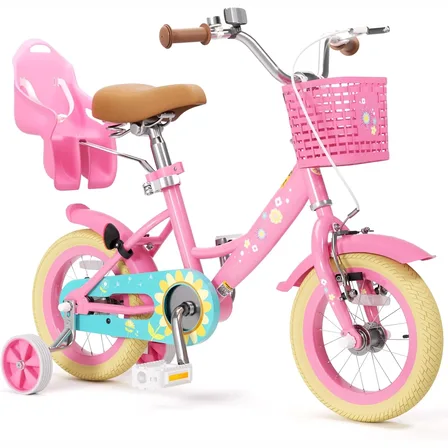
Flower Pink XJD Girls Bike with Doll Seat & Basket
The XJD Flower Pink girls' bike is made for riders 71–122 cm tall (roughly ages …$69.99