

What size bike is appropriate for a 5 tall boy
A boy who is 5 feet tall (60 in/152 cm) should compare 20-inch and 24-inch bikes in person. Both height ranges include him; fit and control decide.
Why two wheel sizes can fit
The XBikes starting range for a 20-inch bike is 48–60 in (122–152 cm), while the 24-inch range is 54–64 in (137–163 cm). A rider at exactly 5 feet is therefore at the upper boundary of the 20-inch range and within the 24-inch range.
That overlap does not make the sizes equivalent. Frame shape, saddle adjustment and handlebar position can change how two bicycles with the same wheel size feel. Treat wheel size as a shortlist, then choose the bicycle on which the boy can stand over, reach, steer and brake confidently.
A 26-inch bike is not the stated starting point at exactly 60 inches: the XBikes standard places it for youth and adults over 60 in (153 cm). If a fresh measurement shows he is taller than 60 inches, it can enter the comparison, but only after an individual fit check.
Measure before choosing
- Height: Have him stand barefoot against a wall, looking straight ahead, and measure from the floor to the top of his head. Do not rely on an old measurement or an estimate made while he is wearing shoes.
- Inseam: While he stands with feet slightly apart, place a firm book upward between his legs to represent the saddle area. Measure from the floor to the top edge of the book.
- Current control: Note whether he starts, stops, turns and uses the brakes without hesitation. Confidence matters because a theoretically suitable size can still be too difficult to manage.
Use the measured height to identify 20- and 24-inch candidates, then compare the inseam with each manufacturer’s fit information. Geometry and adjustment limits are not supplied here, so consult the exact product manual or a qualified bicycle mechanic rather than assuming wheel diameter determines clearance.
Perform the fit check
Have the child try the complete bicycle. He should be able to straddle it with comfortable clearance instead of pressing against the frame. Seated, he should reach the handlebars without an exaggerated stretch, turn them without losing balance and keep stable control at low speed.
Ask him to operate each brake control comfortably and firmly from his normal riding position. He should also be able to start, stop and put a foot down predictably. If he has to lean, stretch or shift his hand awkwardly to brake, reject that setup even when its wheel size matches the chart.
Do not buy an oversized bicycle merely to leave room for growth. A bicycle that is hard to mount, steer or stop now is not an appropriate present fit. Age is secondary: the decision should follow measured height, inseam, reach, brake control and current confidence.
How the supplied XBikes products relate
The three supplied catalog options help show the smaller 12-, 14- and 16-inch categories, but none offers the 20- or 24-inch sizes a 5-foot rider should compare. They are nearest-size catalog comparison points, not substitutes for the requested fit.
 XJD Boys & Girls BMX Bike with Training Wheels, 12/14/16" – Blue
This Kids’ BMX Bike is available in 12 Inch, 14 Inch and 16 Inch labels. Those sizes are comparison points only and do not replace the 20- and 24-inch fit checks appropriate for a 60-inch rider.
 Black XJD Kids Bike for Boys – 12, 14 & 16 Inch Sizes
This Training Wheel Bike has 12 Inch, 14 Inch and 16 Inch options. Because a 5-foot rider is outside the supplied 16-inch height range, it is not a substitute for an individually fitted larger bicycle.
 XJD Boys 12/14/16" Training Wheel Bike – Blue
This blue Training Wheel Bike is offered in 12 Inch, 14 Inch and 16 Inch sizes. It helps illustrate the smaller catalog range, but none of its listed sizes matches the starting comparison for a 60-inch rider.
XJD Boys & Girls BMX Bike with Training Wheels, 12/14/16" – Blue is listed under Kids’ BMX Bikes with 12 Inch, 14 Inch and 16 Inch options. Black XJD Kids Bike for Boys – 12, 14 & 16 Inch Sizes and XJD Boys 12/14/16" Training Wheel Bike – Blue are both Training Wheel Bikes with the same three available size labels.
Under the XBikes starting ranges, 16-inch bikes cover heights of 40–48 in (102–122 cm). A 60-inch rider is therefore outside that range. Do not select one of these products on the assumption that adjustment can turn a 16-inch bicycle into a 20- or 24-inch fit.
Make the final decision
- If he measures exactly 60 inches, try suitable 20- and 24-inch bicycles and choose by actual control and fit.
- If he is now over 60 inches, include 26-inch youth options for comparison, without skipping the same checks.
- If neither candidate provides comfortable stand-over, reach and brake operation, buy neither and ask a qualified bicycle mechanic for a fit assessment.
Before riding, provide a bicycle helmet that fits properly, sits level and has its straps adjusted according to the helmet manufacturer’s instructions. For assembly, maintenance, torque, load limits or compatibility, follow the exact bicycle manual or use a qualified mechanic. For this 5-foot rider, the next step is a fresh measurement followed by side-by-side 20- and 24-inch test fits—not choosing one of the supplied 12–16-inch products.
Bikes for your next adventure
-

XJD Boys & Girls BMX Bike with Training Wheels, 12/14/16" – Blue
The XJD Boys & Girls BMX Bike in Blue is a first pedal bike for kids roughly age…$99.99
$119.99 -

Pink Girls' 12/14/16" Bike by XJD – Basket & Doll Seat
The XJD Pink Girls' Bike with Basket & Doll Seat is made for riders 71–122 cm ta…$75.99
$99.99 -
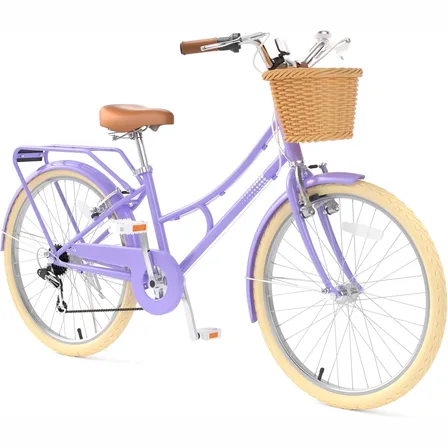
24-Inch Purple XJD Beach Cruiser Bike with U-Brake
The XJD 24-Inch Purple Beach Cruiser is built for girls and young women roughly …$159.99