

What size bike should a 10 year old boy ride
A 10-year-old boy will usually compare a 20-inch bike with a 24-inch bike. Choose by measured height and fit: 20-inch suits 48–60 in (122–152 cm), while 24-inch suits 54–64 in (137–163 cm).
Use height, not age, to choose the starting size
Age ten falls within both XBikes starting ranges: 20-inch bikes cover ages 7–12, and 24-inch bikes cover ages 10–14. That overlap is intentional. Two boys of the same age can differ greatly in height, leg length, reach and riding confidence.
Measure the child barefoot, standing straight against a wall. Record his total height. Then measure his inseam from the floor to the crotch, using a book held level between the legs to represent the saddle area. Height identifies the wheel sizes to compare; inseam helps determine whether a particular frame provides suitable stand-over clearance.
| Wheel size | XBikes age starting point | Rider height | When to compare it |
|---|---|---|---|
| 20 Inch | 7–12 | 48–60 in / 122–152 cm | For a 10-year-old within this height range, especially if he is shorter or less confident |
| 24 Inch | 10–14 | 54–64 in / 137–163 cm | For a rider at least 54 in / 137 cm who can comfortably control the actual bike |
| 26 Inch | Youth and adults | Over 60 in / 153 cm | Only when the rider exceeds this height threshold and passes an individual fit check |
What to check on the actual bicycle
A wheel-size range narrows the search, but it does not guarantee that every frame with that wheel size will fit. Have the child try the complete bicycle rather than choosing from the number alone.
- Stand-over: He should be able to straddle the frame with useful clearance and remain balanced, rather than being forced onto his toes or against the frame.
- Reach: From the saddle, he should reach the handlebar without stretching, locking his elbows or leaning so far forward that steering becomes awkward.
- Brake control: He must reach and operate the brake controls securely while maintaining his grip and steering position.
- Confidence: He should start, stop, turn and dismount without the bicycle feeling cumbersome or intimidating.
If either size fits his measured height, compare both in person. Prefer the one he controls naturally now. Do not buy an oversized bicycle merely to allow room for growth.
How the supplied XBikes options help
The catalog provides one 20-inch BMX comparison and two 24-inch beach cruiser comparisons. These particular options help a parent examine the two wheel sizes that commonly overlap at age ten, while also showing that riding style and individual frame fit still need consideration.
 24-Inch Purple XJD Beach Cruiser Bike with U-Brake
A supplied 24-inch beach cruiser comparison for riders who meet the 54–64 in XBikes starting range and pass individual stand-over, reach, brake-control and confidence checks.
 Blue XJD Freestyle BMX Bike, 20-Inch – No Pegs
The supplied 20-inch kids’ BMX option, labeled without pegs, is relevant to the 48–60 in rider-height range but still requires an individual fit check.
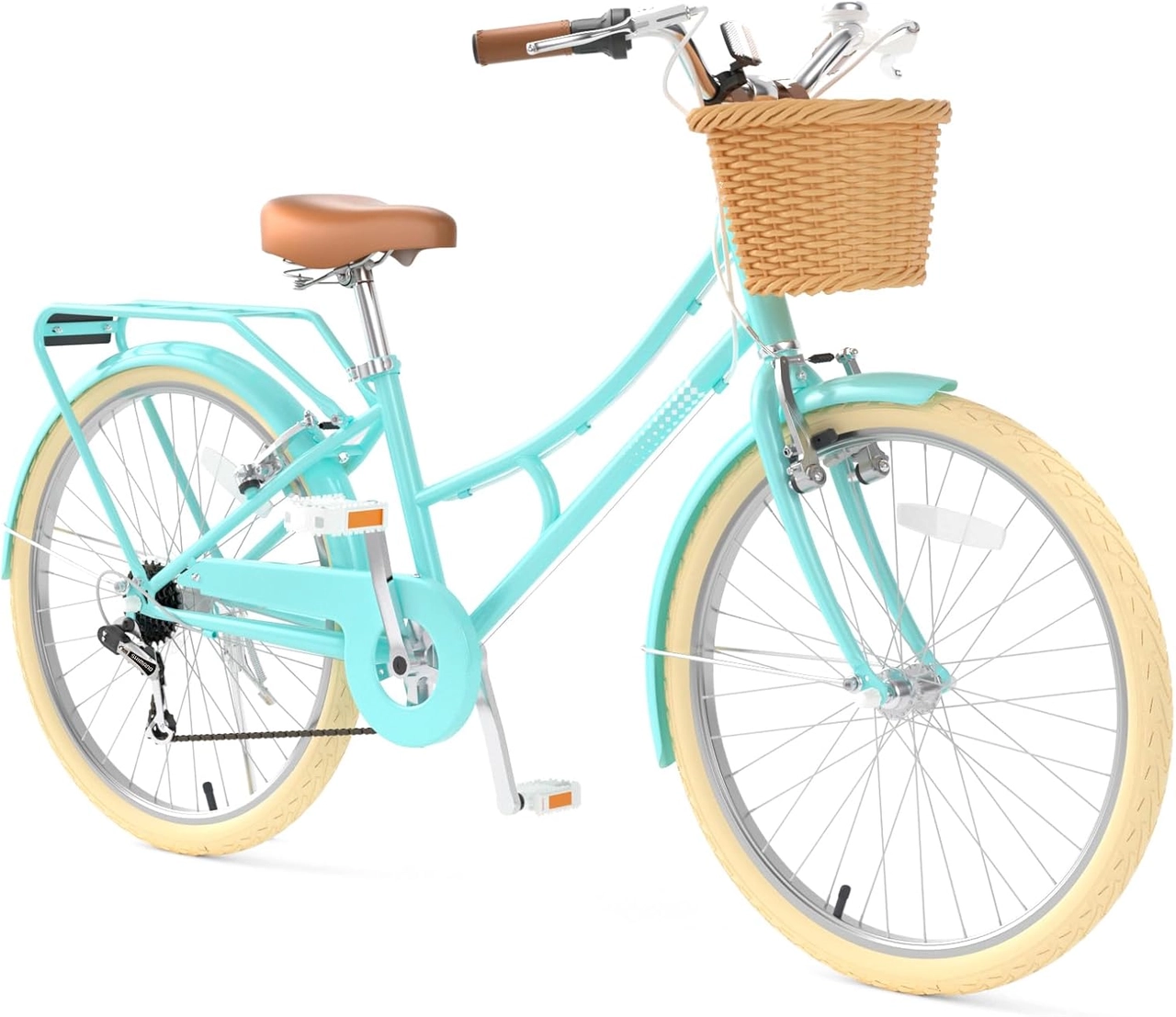 XJD 24-Inch Green Beach Cruiser Bike with U-Brake
This beach cruiser listing provides 24-inch comparison labels plus a 26-inch label; those sizes are not interchangeable and must be assessed against their separate XBikes height starting points.
The Blue XJD Freestyle BMX Bike, 20-Inch – No Pegs is the supplied 20-inch option. Its wheel size matches the XBikes 48–60 in (122–152 cm) starting range. The catalog also identifies it as a kids’ BMX bike and states that it has no pegs. Those facts make it relevant for comparing a 20-inch BMX format, but they do not establish fit without a try-on.
The 24-Inch Purple XJD Beach Cruiser Bike with U-Brake and the XJD 24-Inch Green Beach Cruiser Bike with U-Brake are supplied 24-inch beach cruiser options. A 24-inch starting point applies at 54–64 in (137–163 cm), subject to stand-over, reach, brake control and confidence. Their U-brake wording is a catalog fact, not proof that either model’s controls fit a particular child’s hands.
The green cruiser listing has catalog labels for Green / 24 Inch, Pink / 24 Inch and Pink / 26 Inch. Treat those as selectable labels, not evidence that the sizes are interchangeable. The 26-inch starting point is for youth and adults over 60 in (153 cm), so it should not be chosen for a shorter ten-year-old simply as extra growing room.
Resolve the 20-inch versus 24-inch overlap
If he is under 54 in (137 cm), begin with 20-inch bikes; 24-inch falls outside the supplied height standard. From 54 to 60 in (137–152 cm), both ranges overlap, so compare the actual bicycles and let control decide. Above 60 in (153 cm), a 24-inch remains within its stated range, while a 26-inch becomes a possible comparison—not an automatic choice.
Frame shape can change stand-over and reach even when wheel diameter is identical. If the child cannot stand over, steer or brake comfortably, reject that specific bicycle and try another model or size. For assembly, adjustment, maintenance, load limits, compatibility and torque, follow the exact product manual or ask a qualified bicycle mechanic.
Complete the decision safely
Once a bike fits, add a properly fitting bicycle helmet. It should sit level and its straps should be adjusted according to the helmet manufacturer’s instructions. Recheck the child’s control in a low-risk area before ordinary riding.
For this 10-year-old, measure height and inseam today, shortlist 20-inch or 24-inch using the thresholds above, and buy only after he demonstrates comfortable stand-over, reach, braking and control on the exact bicycle.
Bikes for your next adventure
-

Kids Bike Helmet by XJD for Boys & Girls – Black, Blue, Green, Pink, Purple
The XJD Kids Bike Helmet covers a wide 2-to-8-year age range thanks to two head-…$59.99
-

Kids Bike Helmet by XJD for Girls – Pink
The XJD Kids Bike Helmet in Pink is a lightweight multi-sport helmet for girls r…$59.99
$99 -

XJD Kids Bike for Girls – Pink, 12/14/16/20 Inch with Training Wheels
The XJD Kids Bike for Girls in Pink is a training-wheel bike built to carry your…$139
$159