

What size bike should a 9 year old boy need
Most 9-year-old boys should start with a 20-inch bike, especially at 48–60 inches (122–152 cm) tall. Measure him and confirm the fit before buying.
Start with height, not his ninth birthday
Age gives you a starting point, but it cannot confirm fit. Under the XBikes sizing standard, an 18-inch bike covers ages 5–9 and heights of 43–52 inches (109–132 cm), while a 20-inch bike covers ages 7–12 and heights of 48–60 inches (122–152 cm). A 9-year-old may therefore fall into either range.
If he is 48–52 inches tall, both ranges overlap. Do not decide from that overlap alone: compare his inseam, reach, brake control and confidence on each candidate. If he is below 48 inches, begin the comparison with an 18-inch bike. If he is above 52 inches, a 20-inch bike is the clearer starting point under this standard.
Measure him before comparing bikes
Have him stand straight without shoes, with his back against a wall. Measure from the floor to the top of his head for height. Then measure his inseam from the floor to the crotch while he stands with his feet slightly apart.
Bring both measurements to the fit check. Wheel size identifies a general class of bike; it does not tell you the frame’s stand-over clearance, saddle range or reach. Those details must be checked on the actual bicycle and against its exact product manual.
What a correct fit should let him do
- Stand over the bike: He should be able to straddle it without the frame preventing a stable stance.
- Reach the controls: He should hold the handlebar naturally, without stretching or locking his elbows.
- Operate the brakes: His fingers must reach and use the brake controls confidently while he maintains steering control.
- Start and stop: He should mount, begin riding, slow down and stop without the bike feeling too large or unwieldy.
- Stay composed: Choose a size he can control at his current skill level, not one he may grow into later.
Have him try the bicycle whenever possible. Do not buy an oversized bike merely to extend its useful life; poor stand-over, excessive reach or difficult brake access means the bike does not fit now.
How the supplied bikes help with the comparison
The catalog provides two 20-inch comparison options and larger cruiser sizes. They are relevant if his measurements and hands-on fit check point toward 20 inches, while the larger options show when a model moves beyond the usual starting point for a 9-year-old.
 XJD Kids Beach Cruiser Bicycle, Rear Rack & V-Brakes, Mint Green
Available in 20 Inch, 24 Inch and 26 Inch labels. Its 20 Inch option is relevant when the rider measures within the supplied 48–60-inch height range and passes an individual fit check.
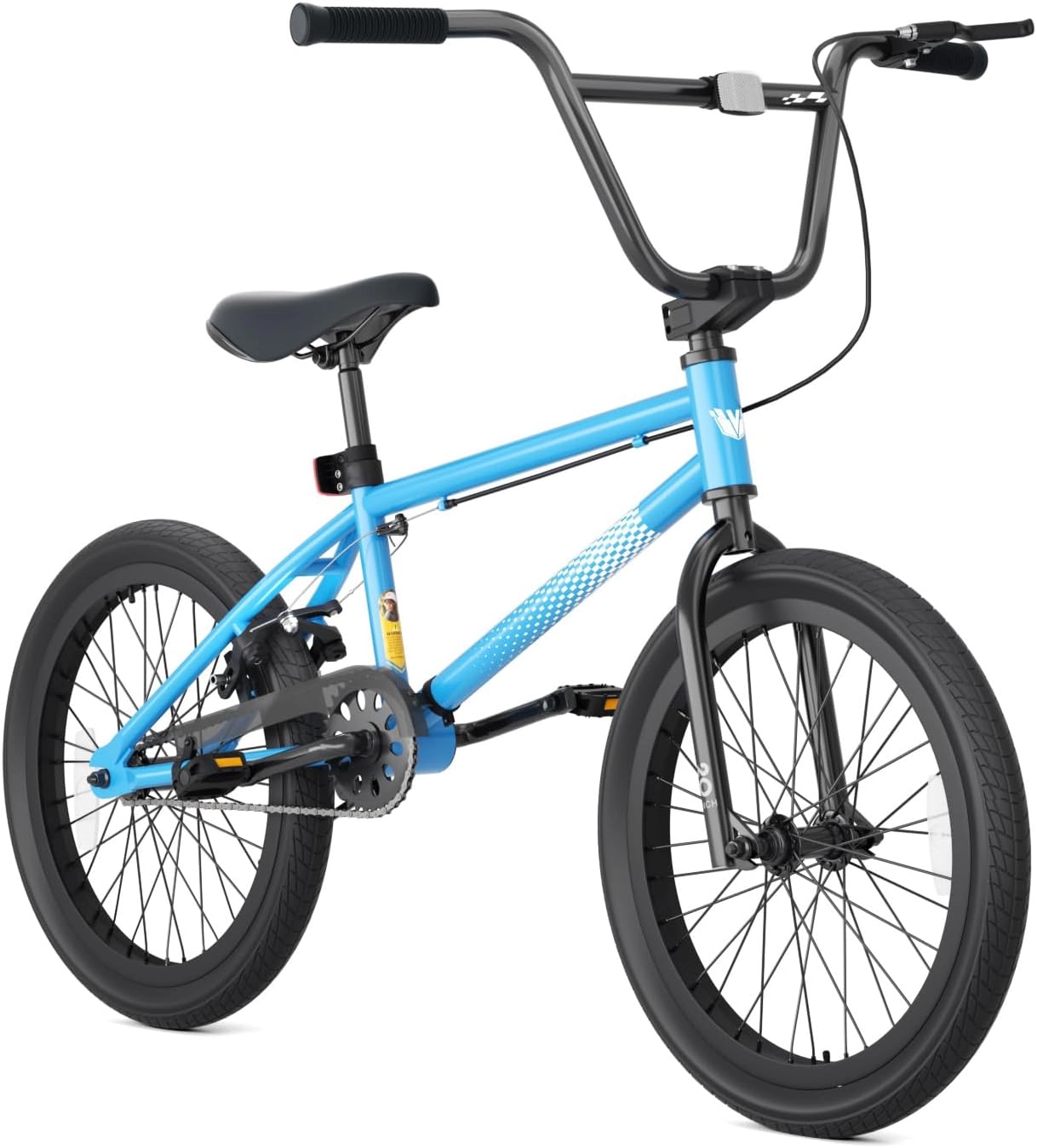 Blue XJD Freestyle BMX Bike, 20-Inch – No Pegs
A 20-inch kids’ BMX comparison for a 9-year-old whose measured height and hands-on control support that size. The supplied catalog identifies a Default SKU and specifies no pegs.
20-inch options
XJD Kids Beach Cruiser Bicycle, Rear Rack & V-Brakes, Mint Green is offered in 20 Inch, 24 Inch and 26 Inch labels. Only its 20 Inch option matches the usual 48–60-inch (122–152 cm) starting range for this age. Its catalog facts also identify a rear rack and V-brakes, but neither feature proves that the bicycle fits your child.
Blue XJD Freestyle BMX Bike, 20-Inch – No Pegs is another 20-inch comparison point. The supplied catalog identifies it as a kids’ BMX bike and says it has no pegs. Its available SKU is labelled Default, so confirm that the exact item and fit details shown at selection match what you intend to order.
When these products are not relevant
If measurement and a real fit check indicate an 18-inch bike, neither supplied product is an 18-inch substitute. They are larger, 20-inch comparison points. Likewise, the cruiser’s 24 Inch label starts at ages 10–14 and heights of 54–64 inches (137–163 cm), while 26 Inch is for youth and adults over 60 inches (153 cm). Even when his height reaches one of those ranges, control and fit still decide.
Make the final decision in this order
- Measure his height and inseam.
- Use 18 inches for 43–52 inches tall or 20 inches for 48–60 inches tall as starting points, resolving the overlap through an individual trial.
- Check stand-over, handlebar reach and access to the brake controls.
- Ask him to demonstrate controlled starting, steering and stopping.
- Reject any bike he cannot manage confidently today, even if it offers room for growth.
Before riding, use a bicycle helmet that fits properly, sits level and has its straps adjusted according to the helmet manufacturer’s instructions. Follow the exact bicycle manual for assembly, maintenance, compatibility, load limits and torque information; if anything is unclear, use a qualified bicycle mechanic.
For a 9-year-old boy, begin with 20 inches if he measures 48–60 inches tall, compare 18 inches if he is within its 43–52-inch range, and buy only the bike he can stand over, reach, brake and control now.
Bikes for your next adventure
-

Kids Bike Helmet by XJD for Boys & Girls – Black, Blue, Green, Pink, Purple
The XJD Kids Bike Helmet covers a wide 2-to-8-year age range thanks to two head-…$59.99
-

Kids Bike Helmet by XJD for Girls – Pink
The XJD Kids Bike Helmet in Pink is a lightweight multi-sport helmet for girls r…$59.99
$99 -

XJD Kids Bike for Girls – Pink, 12/14/16/20 Inch with Training Wheels
The XJD Kids Bike for Girls in Pink is a training-wheel bike built to carry your…$139
$159