

What size boys bike for a 5 foot tall boy
A 5-foot-tall boy should usually start with a 24-inch bike. At 60 inches tall, he is also at the upper limit for a 20-inch bike, so test the fit before choosing.
Why 24 inches is the starting point
The XBikes sizing ranges place a rider who is exactly 60 inches tall in two overlapping groups: 20-inch bikes cover heights from 48 to 60 inches, while 24-inch bikes cover 54 to 64 inches. Because 60 inches is near the middle of the 24-inch range but at the very top of the 20-inch range, a 24-inch model is the more sensible first bike to try.
A 26-inch bike is intended for youth and adults over 60 inches, or 153 cm. A boy who measures exactly 5 feet is not yet over that threshold. Do not move him to a 26-inch bike simply to leave room for growth; an oversized bicycle can make starting, stopping and steering harder.
Measure height and inseam before shopping
Measure his current height without shoes, standing straight against a wall. Five feet equals 60 inches, or about 152 cm, but use the actual measurement rather than an estimate from clothing sizes or an earlier doctor’s visit.
Then measure his inseam. With shoes off, have him stand naturally and measure from the floor to the crotch. Compare that result with the stand-over clearance and fit instructions supplied for the exact bicycle. Wheel size is only a starting point because frame shapes can differ even when their wheel labels match.
Age is secondary. The XBikes starting range for a 24-inch bike is ages 10–14, but a measured fit matters more than whether a child falls inside that age band.
What to check during the test ride
Have him try the assembled bicycle rather than judging from wheel size alone. The American Academy of Pediatrics recommends checking the child’s fit and control instead of buying an oversized bike for future growth.
- Stand-over: He should be able to straddle the bicycle securely. Follow the product manual’s fit guidance for the particular frame.
- Starting and stopping: He should mount, begin riding and stop without the bicycle pulling him off balance.
- Reach: He should hold the handlebar without stretching excessively, locking his elbows or losing a stable riding position.
- Brake control: He should reach and operate the brake controls comfortably with enough confidence to slow and stop.
- Overall confidence: Turning, looking ahead and putting a foot down should feel controlled rather than intimidating.
If the 24-inch bike fails these checks, do not assume he will quickly grow into it. Compare a 20-inch model while recognizing that 60 inches is the top of its stated height range. Frame fit, leg clearance and control should decide between them.
How the supplied bikes help with the comparison
The two catalog options are useful because both offer a 24 Inch size, and one also offers a 20 Inch size for a direct boundary comparison. They should still be tried individually; matching wheel labels do not prove that their frames, reach or riding positions fit the same child.
The Pink XJD Beach Cruiser Bike, 24"/26", U-Brake is available in 24 Inch and 26 Inch labels. For a rider measuring exactly 5 feet, its 24 Inch option is the relevant starting point. Its 26 Inch option is for comparison only if a later measurement places him over 60 inches and an individual fit check confirms control.
The XJD Kids Beach Cruiser Bicycle, Rear Rack & V-Brakes, Mint Green is available in 20 Inch, 24 Inch and 26 Inch labels. That makes its 20 Inch and 24 Inch options particularly relevant when checking which side of the overlap gives him better stand-over, reach and brake control.
These particular catalog options therefore show the sizes closest to the decision a 5-foot rider faces:
 Pink XJD Beach Cruiser Bike, 24"/26", U-Brake
Available in 24 Inch and 26 Inch sizes. For a boy measuring exactly 5 feet, the 24 Inch option is the relevant starting point; the 26 Inch option requires height over 60 inches and an individual fit check.
 XJD Kids Beach Cruiser Bicycle, Rear Rack & V-Brakes, Mint Green
Available in 20 Inch, 24 Inch and 26 Inch sizes, allowing comparison between the two overlapping size ranges that include a 60-inch rider. Final selection still depends on stand-over, reach, brake control and confidence.
Make the final choice in this order
- Confirm his barefoot height and inseam now.
- Try a 24-inch bike first because 60 inches sits within its 54–64-inch starting range.
- Check stand-over, handlebar reach, brake operation, starting, stopping and turning.
- If control is uncertain, compare a 20-inch bike; do not automatically move up to 26 inches.
- Use the exact product manual or a qualified bicycle mechanic for assembly, adjustments, compatibility, maintenance and torque requirements.
Complete the setup with a properly fitted bicycle helmet. U.S. Consumer Product Safety Commission guidance says the helmet should sit level and its straps should be used according to the manufacturer’s instructions.
The decision for a boy who is exactly 5 feet tall
Begin with a 24-inch bicycle and approve it only if he can straddle, reach, brake and ride it confidently. Compare a 20-inch model if the 24-inch frame feels too large; wait on a 26-inch model until he is over 60 inches and can pass the same hands-on fit checks.
Bikes for your next adventure
-

XJD Boys 12/14/16" Training Wheel Bike – Blue
The XJD Boys Bike in Blue is a training wheel bike for riders 71–122 cm tall—rou…$169
$199 -

Black XJD Kids Bike for Boys – 12, 14 & 16 Inch Sizes
For a son between roughly 3 and 8 years old, the XJD Kids Bike in Black covers t…$169
$199 -
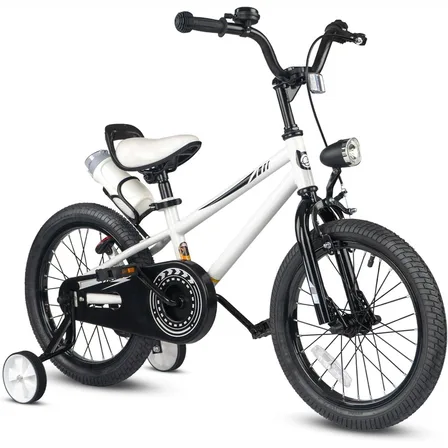
XJD Kids' Training Wheel Bike for Boys & Girls, 12/14/16 Inch – White
The XJD kids' training wheel bike in White is made for riders ages 3–8 (roughly …$169
$199