

Can a 6 year old ride a 16 inch bike
Yes, many 6-year-olds can ride a 16-inch bike, but only if the child’s measured height, inseam, reach, brake control and confidence show that it fits.
Start with height, not age
The XBikes starting point for a 16-inch bike is ages 4–7 and a rider height of 40–48 inches (102–122 cm). A 6-year-old falls within that age range, but age alone cannot confirm the correct size. Measure the child’s height without shoes and compare it with the stated range.
If the child is below 40 inches (102 cm), begin by comparing a 14-inch bike, whose starting range is ages 3–6 and 37–45 inches (94–114 cm). If the child is already 48 inches (122 cm) or taller, compare a 20-inch bike, whose starting range is ages 7–12 and 48–60 inches (122–152 cm). Overlapping ranges are comparison points, not an automatic answer.
Measure inseam and check stand-over clearance
For inseam, have the child stand upright in socks with feet slightly apart. Place a book firmly between the legs, level with the floor, and measure from the floor to the top edge of the book. Record the result rather than trying to choose a wheel size from age or clothing size.
Then have the child try the actual 16-inch bicycle. With both feet flat on the ground while straddling the frame, there should be comfortable clearance rather than pressure from the frame. The child should also be able to get on and off without leaning the bicycle dramatically or depending on an adult to hold it upright.
This individual trial matters because wheel diameter does not reveal the frame’s stand-over height, seat adjustment range or reach. The American Academy of Pediatrics advises trying the bicycle and avoiding an oversized model bought merely for future growth.
Check reach, steering and brake control
Seat the child in a normal riding position and look for relaxed control. The child should reach the handlebar without locking the elbows, stretching the torso or sliding forward on the seat. Ask the child to turn the handlebar both ways while remaining balanced and looking ahead.
Confirm that the child can operate the bicycle’s brakes confidently from the riding position. Brake reach and operation vary, so use the exact product manual for adjustment instructions or ask a qualified bicycle mechanic. Do not improvise a setting or assume that a wheel-size label guarantees usable brake reach.
- Promising fit: comfortable stand-over clearance, easy mounting, relaxed reach, controlled steering and confident braking.
- Too large: difficulty straddling or mounting, stretched arms, poor turning control or inability to operate the brakes reliably.
- Possibly too small: cramped posture or restricted steering; compare the next relevant size on the actual bicycle rather than guessing.
Use confidence as part of the decision
A physically suitable 16-inch bike may still be the wrong next step if the child cannot start, stop and steer with control. Let the child try it in a quiet, level area under close adult supervision. Watch what happens without constantly supporting the bicycle, because continuous adult support can conceal a poor fit.
Training wheels may help some children work on pedaling and steering, but their presence does not correct an oversized or poorly controlled bicycle. Base the choice on fit and current ability first, then decide whether a training-wheel configuration is relevant.
How the supplied 16-inch options are relevant
The XJD Girls' Bike with Training Wheels, 12/14/16/20 Inch – Purple and the XJD Kids Bike for Girls – Pink, 12/14/16/20 Inch with Training Wheels both include catalog options labeled 12 Inch, 14 Inch, 16 Inch and 20 Inch. Their 16-inch variants directly match the wheel size in the question, while the other listed sizes make them useful comparison points when the child measures near a range boundary. Color and title wording do not establish fit.
 XJD Girls' Bike with Training Wheels, 12/14/16/20 Inch – Purple
Available in a 16 Inch option matching the question, with 12, 14 and 20 Inch labels for size comparison. Its catalog category is Training Wheel Bikes; fit still requires measuring and an in-person control check.
 XJD Kids Bike for Girls – Pink, 12/14/16/20 Inch with Training Wheels
This training-wheel bike includes a 16 Inch catalog option, plus 12, 14 and 20 Inch choices. The requested size is relevant only when the child’s height, stand-over clearance, reach, braking and confidence confirm the fit.
These products are relevant when a 16-inch, training-wheel bike is being considered and the child passes an individual fit check. They may not be relevant if the child needs a different wheel size, does not need training wheels, cannot comfortably control the bicycle or prefers a different type of bike. Follow the exact product manual or consult a qualified bicycle mechanic for assembly, maintenance, compatibility, load limits and any torque requirements.
Before the first ride
Use a bicycle helmet that fits properly. Following U.S. Consumer Product Safety Commission guidance, position it level and secure its straps according to the helmet manufacturer’s instructions. Adult supervision, an appropriate riding area and a properly fitted helmet remain necessary even when the bicycle size appears correct.
The practical answer is therefore conditional: choose a 16-inch bike for a 6-year-old only when the child is around 40–48 inches (102–122 cm), can straddle and mount the actual frame comfortably, reaches the controls without stretching, operates the brakes reliably and rides with appropriate confidence. If any check fails, compare the actual 14-inch or 20-inch option indicated by measured height instead of buying the 16-inch bike for convenience or growth.
Bikes for your next adventure
-
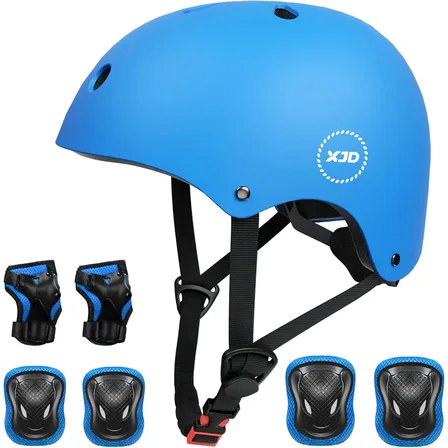
Blue XJD Helmet & Protective Gear Set for Kids, Sizes S/M
The Blue XJD Helmet & Protective Gear Set is made for kids roughly 3 to 8 years …$23.79
-
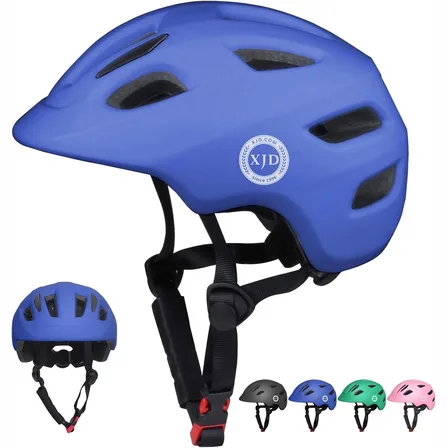
Blue XJD Kids' Bike Helmet, Adjustable Fit – Sizes XS & S
The Blue XJD Kids' Bike Helmet is a lightweight, adjustable helmet for toddlers …$20.39
-

XJD Girls Bike for Kids Ages 3-8, 12/14/16 Inch with Training Wheels – Purple
The XJD Girls Bike in Purple is a training-wheel bicycle for kids ages 3 to 8, f…$149
$169