

Can you attach a child seat to any bike
No, you cannot attach a child seat to every bike. The bicycle, seat and any rack must be compatible, with secure mounting space and approved load limits.
What decides whether a child seat will fit?
Start with the child-seat manual and the bicycle manual. Identify whether the seat mounts to the frame, a rear rack or another location, then confirm that the bicycle permits that mounting method. A clamp fitting around a tube is not proof of compatibility.
Compare the required tube shape and clearances with the actual bicycle. Look for interference from cables, moving parts, the saddle, wheels and the rider’s heels. For a rack-mounted seat, verify that the rack itself is approved for that exact use and that the bicycle can accept the required rack. Do not infer suitability from appearance alone.
- Mounting area: Measure the usable tube or rack space specified by the seat maker, including diameter, width and clearance.
- Combined limits: Compare the child’s current weight, the seat and its mounting system with every applicable limit in the bicycle, rack and seat manuals.
- Bicycle condition: Check the frame, fork, wheels, brakes and mounting points for damage, looseness or wear.
- Rider control: Allow for the changed balance, stopping distance, mounting procedure and low-speed handling caused by carrying a passenger.
Bikes that need extra scrutiny
Unusual frame shapes, suspension movement, small frames, crowded cable routing and bicycles without suitable mounting points may prevent installation. A bicycle can also have enough physical space while its manufacturer still prohibits a child seat or the required rack.
Never drill a frame, improvise brackets or exceed a stated limit to make a seat fit. If either manual is missing or the compatibility language is unclear, ask the child-seat manufacturer or a qualified bicycle mechanic to inspect the exact bicycle, seat, rack and hardware together. Follow the product instructions for assembly, fastener torque, maintenance and load limits; those details cannot be safely guessed.
Are the supplied XBikes options relevant?
The supplied catalog item helps distinguish a child’s own bicycle from an adult bicycle equipped to carry a passenger. The XJD Girls Bike for Kids Ages 3-8, 12/14/16 Inch with Training Wheels – Purple is listed as a training-wheel bike in 12 Inch, 14 Inch and 16 Inch options. Those facts do not establish child-seat compatibility, rack compatibility or passenger capacity. It should therefore be considered only when comparing whether a child is ready for a correctly fitted bicycle of their own, not as evidence that a child seat can be attached.
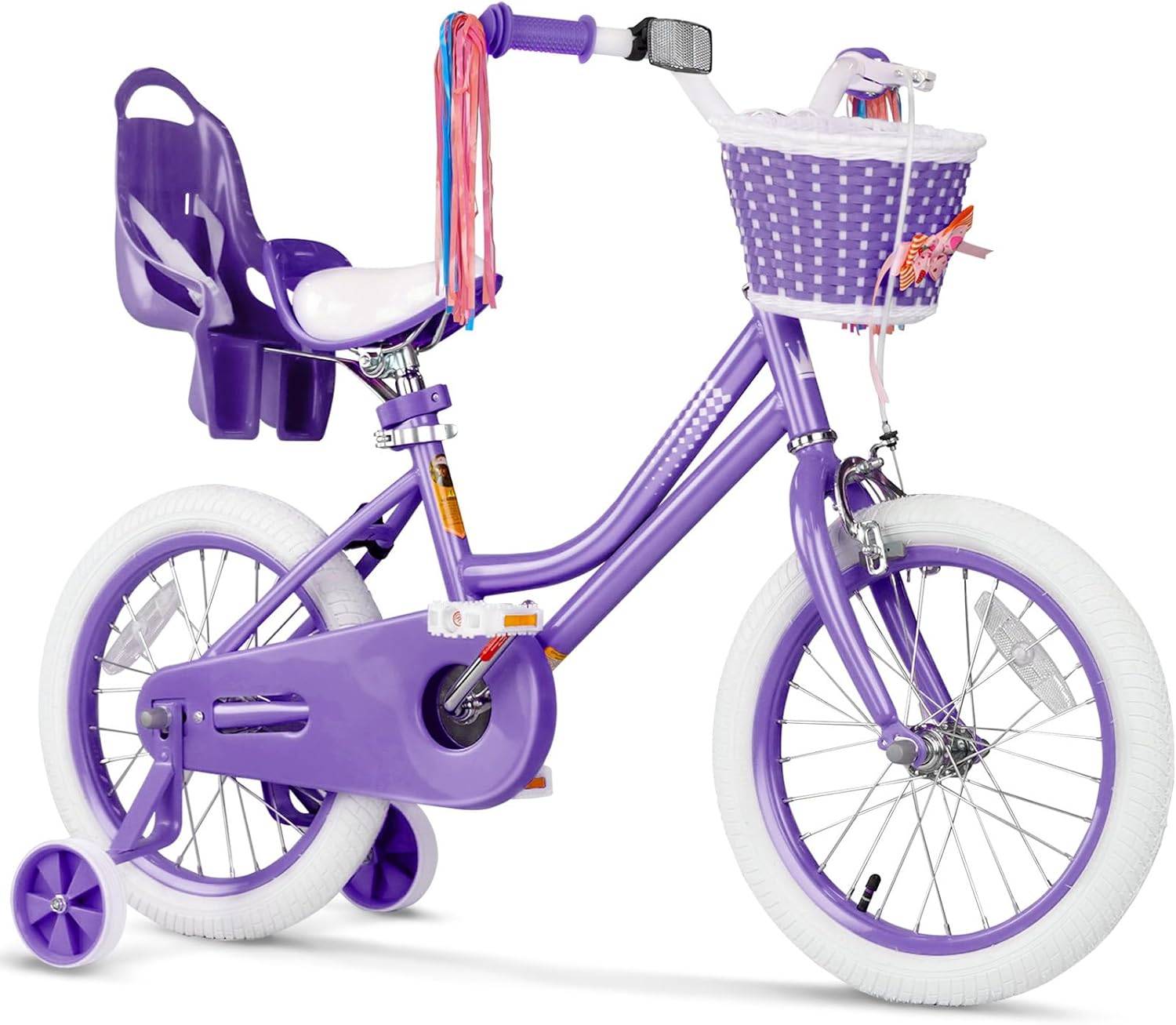
The age wording in that exact product title is a catalog label, not fit evidence. XBikes uses measured rider height as the stronger starting point, followed by inseam, reach, brake control and current confidence. A child should try the bicycle; do not choose an oversized model merely to leave growing room.
| Available size | XBikes starting point | Individual checks |
|---|---|---|
| 12 Inch | Ages 3–4; 34–40 in / 86–102 cm | Stand-over, inseam, reach, brake control and confidence |
| 14 Inch | Ages 3–6; 37–45 in / 94–114 cm | Stand-over, inseam, reach, brake control and confidence |
| 16 Inch | Ages 4–7; 40–48 in / 102–122 cm | Stand-over, inseam, reach, brake control and confidence |
How to check before installation
- Record the bicycle’s exact make and model, then locate its manual and stated restrictions.
- Record the child seat’s exact model and mounting type. Include the rack model when one is required.
- Measure the mounting area exactly where the seat instructions specify, rather than choosing a convenient-looking tube.
- Compare all stated compatibility requirements, clearances and load limits across the bicycle, rack and child-seat manuals.
- Have a qualified bicycle mechanic resolve any ambiguity and install or inspect the system when the instructions call for it.
- Before every ride, perform the checks required by the manuals and confirm that nothing is loose, damaged or interfering with a wheel, cable or moving component.
Fit the child and prepare the rider
Compatibility is only one part of the decision. The child must meet the child-seat maker’s requirements and be secured exactly as instructed. A properly fitting bicycle helmet should sit level, fit securely and use its straps according to the helmet manufacturer’s directions.
The adult rider should be able to start, steer, stop and place a foot down while managing the additional load. Practice the changed handling without the child aboard, following the seat maker’s guidance. Use the specified restraints and foot protection every ride, and never leave a child unattended in a mounted seat.
Make the final decision
Attach the seat only when the bicycle, mounting system and child seat explicitly match, every required measurement and limit is satisfied, and the rider remains in control. If documentation is incomplete or any mounting point must be improvised, do not attach it; take the complete setup to a qualified bicycle mechanic or choose a manufacturer-approved alternative.
Bikes for your next adventure
-

Blue XJD Girls Bike with Training Wheels – 12/14/16 Inch
If you're shopping for a first pedal bike for a daughter roughly 3 to 8 years ol…$149
$169 -
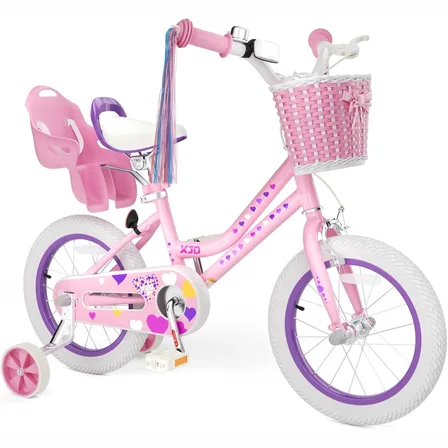
Light Pink XJD Girls' Bicycle with Basket & Training Wheels
The Light Pink XJD Girls' Bicycle with Basket & Training Wheels is a retro-style…$109.99
$129.99 -

Kids Bike Helmet by XJD for Boys & Girls – Black, Blue, Green, Pink, Purple
The XJD Kids Bike Helmet covers a wide 2-to-8-year age range thanks to two head-…$59.99