

How big of a bike for a 12 year old
Most 12-year-olds should start by comparing a 20-inch or 24-inch bike, but height and actual control—not age—decide the correct fit.
Use height to choose the starting size
Measure your child’s height without shoes, standing straight against a wall. Then use the XBikes starting points below to narrow the choice before arranging a hands-on fit check.
| Wheel size | XBikes age starting point | Rider-height starting point |
|---|---|---|
| 20 Inch | Ages 7–12 | 48–60 in / 122–152 cm |
| 24 Inch | Ages 10–14 | 54–64 in / 137–163 cm |
| 26 Inch | Youth and adults | Over 60 in / 153 cm |
A 12-year-old between 48 and 60 inches may begin with a 20-inch comparison. From 54 to 64 inches, compare a 24-inch bike as well. These ranges overlap deliberately: two children of the same height can differ in leg length, reach and confidence. A rider over 60 inches can also begin comparing 26-inch bicycles.
Wheel size is not the same as frame size, and the table is only a starting point. Do not select solely from the child’s birthday or the number printed on a wheel.
Measure inseam before the test ride
Height narrows the search; inseam helps reveal whether the child can stand over and handle a particular bicycle. With the child wearing the shoes normally used for riding, have them stand with their back to a wall and feet slightly apart. Place a rigid book level between the legs, gently raised to simulate the bicycle saddle, and measure from the floor to the book’s top edge.
Compare that measurement with the stand-over space on the exact bike. The child must be able to straddle it comfortably rather than being forced onto tiptoe or against the frame. Because frame shapes vary, an inseam measurement cannot prove that every bike with the same wheel diameter will fit.
Check control on the actual bicycle
Have the child try the bicycle instead of buying an oversized model for future growth. During the fit check, look for all of the following:
- The child can get on and off without struggling.
- There is comfortable stand-over clearance.
- The handlebars can be reached without an extreme stretch or locked elbows.
- The child can steer while remaining balanced and looking ahead.
- Every fitted brake control can be reached and operated confidently.
- Starting, stopping and putting a foot down feel controlled.
If a child appears cramped on one option but stretched or hesitant on the next, compare specific frame designs within the relevant wheel sizes. Do not solve uncertainty by automatically choosing the larger bicycle.
How the supplied XBikes option fits this decision
The Light Pink XJD Girls' Bicycle with Basket & Training Wheels is offered with 12 Inch, 14 Inch, 16 Inch and 20 Inch SKU labels. Its 20 Inch option is relevant as a comparison for a 12-year-old measuring 48–60 inches, provided the individual stand-over, reach, brake control and confidence checks also succeed. The smaller listed sizes fall below the usual XBikes starting points for a 12-year-old and should not be chosen on age alone.
These catalog options help show the available step up to 20 inches and let families compare that size visually before checking the child on the exact bicycle.

This product does not provide a 24 Inch or 26 Inch SKU in the supplied catalog facts. If the rider’s measurements and test fit point toward either of those sizes, the listed product is only a smaller comparison point, not an equivalent substitute. Its training wheels also do not establish whether it suits the rider’s present balance skills; judge that from current confidence and follow the exact product manual.
Reject a bike that is too large
A bike is too large when the child cannot straddle it comfortably, must overreach for the handlebars, cannot reliably reach or operate the brakes, or loses control during starts and stops. Those signs outweigh the desire to leave growing room. An oversized bicycle can make basic handling harder, so move down or try a different frame rather than expecting the child to grow into it.
A bike may be too small if the rider is visibly cramped or cannot use a normal riding position, but wheel diameter alone cannot settle that question. Compare another bicycle in the measured range and repeat the same checks.
Make the final 12-year-old fit decision
- Measure height and inseam accurately.
- Start with 20 Inch at 48–60 inches, compare 24 Inch at 54–64 inches, and consider 26 Inch above 60 inches.
- Have the child straddle and ride the exact bicycle in a controlled setting.
- Confirm comfortable reach, braking, steering, starting and stopping.
- Choose the size the child controls now, not an oversized bike intended for later growth.
Before riding, fit a bicycle helmet so it sits level and secure its straps according to the helmet manufacturer’s instructions. For assembly, adjustments, compatibility, maintenance or torque requirements, follow the exact bicycle manual or use a qualified bicycle mechanic. For this 12-year-old, buy only after the measured range and the hands-on control check point to the same bicycle.
Bikes for your next adventure
-

26-Inch XJD Beach Cruiser Bike for Girls – Purple, V-Brake
This XJD 26-inch purple beach cruiser is sized for big kids and teens — suggeste…$218.49
$229.99 -

Light Pink XJD Girls' Bicycle with Basket & Training Wheels
The Light Pink XJD Girls' Bicycle with Basket & Training Wheels is a retro-style…$109.99
$129.99 -
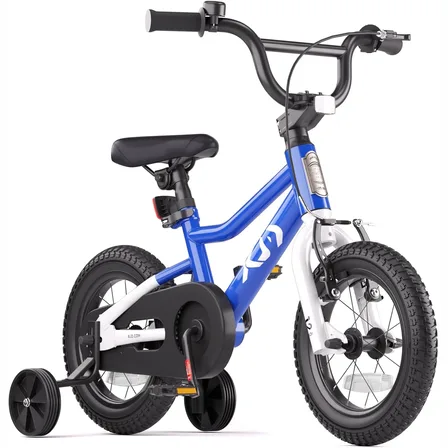
XJD Boys & Girls BMX Bike with Training Wheels, 12/14/16" – Blue
The XJD Boys & Girls BMX Bike in Blue is a first pedal bike for kids roughly age…$99.99
$119.99