

How big of a bike for a 9 year old
For most 9-year-olds, start by comparing a 20-inch bike. If the child is 43–52 inches tall, also check 18-inch models; fit matters more than age.
The likely wheel size at age 9
XBikes uses wheel size as a starting point, not a final fit decision. A 20-inch bike covers ages 7–12 and rider heights of 48–60 inches (122–152 cm), so it is the usual first comparison for a 9-year-old. An 18-inch bike covers ages 5–9 and heights of 43–52 inches (109–132 cm), making it relevant for a shorter or less confident rider.
A 24-inch bike starts at ages 10–14 and heights of 54–64 inches (137–163 cm). A tall 9-year-old may fall within that height band, but age or height alone does not prove that the larger bike fits. Do not buy an oversized bicycle simply to leave room for growth.
| Wheel size | XBikes age starting point | Rider height | Relevance at age 9 |
|---|---|---|---|
| 18 Inch | Ages 5–9 | 43–52 in / 109–132 cm | Check for a shorter rider |
| 20 Inch | Ages 7–12 | 48–60 in / 122–152 cm | Usual first comparison |
| 24 Inch | Ages 10–14 | 54–64 in / 137–163 cm | Consider only after an individual fit check |
Measure before choosing
Measure the child’s current height without shoes, standing straight against a wall. Then measure inseam: have the child stand naturally while you measure from the floor to the crotch. Use height to identify likely wheel sizes, then use inseam during an actual stand-over check. The supplied chart does not set a numerical inseam requirement, so compare the measurement with the exact bicycle and its manual rather than inventing a clearance target.
Record both measurements instead of relying on clothing size, a previous bicycle, or what another 9-year-old rides. Children of the same age can differ substantially in height, limb length, coordination and confidence.
Perform the fit check
Have the child try the bicycle in a controlled area with an adult holding it steady. Check these points before deciding:
- Stand-over: The child should be able to straddle the bicycle without the frame preventing stable footing.
- Starting and stopping: The rider should be able to get into position, begin moving and stop without fighting the bicycle’s size.
- Reach: Hands should reach the controls while the child maintains a comfortable, controlled posture.
- Brake control: The child must be able to reach and operate the brakes confidently. Brake type alone does not establish fit.
- Steering: Ask the child to make gentle turns and demonstrate that the bicycle does not feel cumbersome.
If a 24-inch bicycle fits the height chart but weakens any of these controls, return to a smaller comparison. Likewise, a 20-inch label is not enough if the rider cannot stand over, reach or brake comfortably.
How the supplied XBikes options compare
The catalog options provide useful comparison points around the likely range. One offers smaller training-wheel sizes, while the other has 20-inch and 24-inch choices that can be evaluated against the child’s measured height and control. They do not replace an individual fit check.
 XJD Light Purple Girls Bike with Basket, Training Wheels, 12/14/16/20 Inch
Its supplied available sizes are 12, 14 and 16 inches, all below the usual XBikes starting range for a 9-year-old. It is a smaller-size comparison, not an available 18- or 20-inch option.
 XJD Kids Beach Cruiser Bicycle, Rear Rack & V-Brakes, Mint Green
Available in 20, 24 and 26-inch labels. The 20-inch option is the usual starting comparison for a 9-year-old; consider 24 inches only when measured height and a complete fit check support it.
XJD Light Purple Girls Bike with Basket, Training Wheels, 12/14/16/20 Inch is categorized as a Training Wheel Bike, but its supplied available SKU labels are 12 Inch, 14 Inch and 16 Inch. Those sizes cover XBikes starting ranges below the usual fit range for a 9-year-old. It may serve as a smaller-size comparison, but the supplied catalog data does not show an available 18-inch or 20-inch SKU for this product.
XJD Kids Beach Cruiser Bicycle, Rear Rack & V-Brakes, Mint Green is categorized as a Beach Cruiser Bike and has supplied available labels of 20 Inch, 24 Inch and 26 Inch. Its 20-inch option aligns with the usual starting comparison for a 9-year-old. The 24-inch option should be considered only when the child’s height, stand-over, reach, brake control and confidence support it. The 26-inch starting point is for youth and adults over 60 inches (153 cm), and it still requires a fit check.
Complete the decision safely
Once the child can control the selected size, follow the exact product manual for assembly, adjustment, maintenance, compatibility, load limits and torque information. If anything is unclear or the controls cannot be adjusted appropriately, use a qualified bicycle mechanic rather than guessing.
Choose a properly fitting bicycle helmet too. It should sit level, fit correctly and have its straps used according to the helmet manufacturer’s instructions.
For a 9-year-old, measure first and try a 20-inch bike first in most cases; compare 18 inches for a shorter rider or 24 inches for a taller rider only when the complete hands-on fit check supports that choice.
Bikes for your next adventure
-

26-Inch XJD Beach Cruiser Bike for Girls – Purple, V-Brake
This XJD 26-inch purple beach cruiser is sized for big kids and teens — suggeste…$218.49
$229.99 -

Light Pink XJD Girls' Bicycle with Basket & Training Wheels
The Light Pink XJD Girls' Bicycle with Basket & Training Wheels is a retro-style…$109.99
$129.99 -
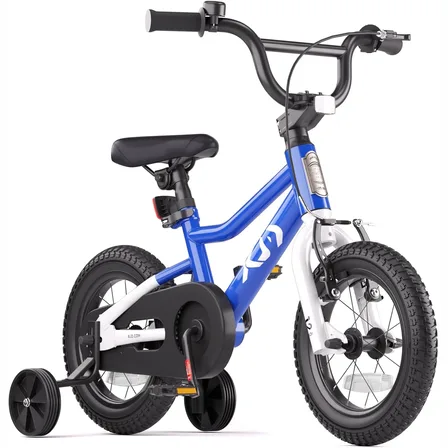
XJD Boys & Girls BMX Bike with Training Wheels, 12/14/16" – Blue
The XJD Boys & Girls BMX Bike in Blue is a first pedal bike for kids roughly age…$99.99
$119.99