

How old can a baby out bike seat
There is no universal maximum age for a baby bike seat. Stop using it when the child exceeds the seat manual’s limits, no longer fits securely, or cannot be carried with stable bicycle control.
Age alone does not decide when a child has outgrown the seat
Check the exact seat manual before every transition. Its stated child-size, load, compatibility and use requirements govern that particular seat; do not substitute a general age estimate. If the label or manual is missing or unreadable, contact the manufacturer or ask a qualified bicycle mechanic to identify the seat and confirm whether it can still be used.
A child must meet every requirement in the manual, not merely remain below one limit. End passenger-seat use if the harness no longer adjusts correctly, the seating area or foot restraints no longer fit as designed, or any permitted riding position becomes cramped. Do not modify the seat, harness, rack or mounting hardware to gain extra room.
What to measure and inspect now
- Measure the child: Record current measurements required by the seat manufacturer and compare them with the manual’s limits.
- Check the secured fit: Confirm that the restraint system, foot supports and other adjustments still fit exactly as the instructions describe.
- Inspect compatibility: Verify that the seat and bicycle remain an approved combination. Follow the manual for mounting, maintenance, load limits and torque.
- Assess bicycle control: With the child carried only as directed, the adult rider must be able to mount, balance, steer and stop predictably.
- Check the helmet: The child’s bicycle helmet should fit properly, sit level and have its straps adjusted according to the helmet manufacturer’s instructions.
If any comparison fails, stop using the passenger seat. A qualified bicycle mechanic can check installation and compatibility, but should not override the manufacturer’s limits.
Is the child ready for a separate bicycle?
Outgrowing a passenger seat does not automatically mean a child is ready to ride independently. Measure standing height and inseam, then have the child try the bicycle. Check stand-over clearance, reach, balance, current confidence and the ability to operate the brakes. Do not buy an oversized bicycle merely to allow room for growth.
These XBikes figures are starting points only; an individual fit check takes priority:
| Wheel size | Starting age | Rider height |
|---|---|---|
| 12 Inch | 3–4 | 34–40 in / 86–102 cm |
| 14 Inch | 3–6 | 37–45 in / 94–114 cm |
| 16 Inch | 4–7 | 40–48 in / 102–122 cm |
| 18 Inch | 5–9 | 43–52 in / 109–132 cm |
| 20 Inch | 7–12 | 48–60 in / 122–152 cm |
| 24 Inch | 10–14 | 54–64 in / 137–163 cm |
| 26 Inch | Youth and adults | Over 60 in / 153 cm |
How the supplied bicycles help with the transition
The supplied products are not baby passenger seats, so they cannot establish how long the current seat may be used. They are relevant only as separate-bicycle comparison options after the child is developmentally ready. Their available wheel sizes let you compare measured height with XBikes starting points before arranging a hands-on fit check.
 XJD Light Purple Girls Bike with Basket, Training Wheels, 12/14/16/20 Inch
A separate training-wheel bicycle offered in 12 Inch, 14 Inch and 16 Inch sizes; relevant only after the child is ready to ride and passes an individual fit check.
 XJD Kids Beach Cruiser Bicycle, Rear Rack & V-Brakes, Mint Green
A Beach Cruiser Bikes comparison option in 20 Inch, 24 Inch and 26 Inch sizes for taller riders; it is not evidence of passenger-seat compatibility or a substitute for the seat manual.
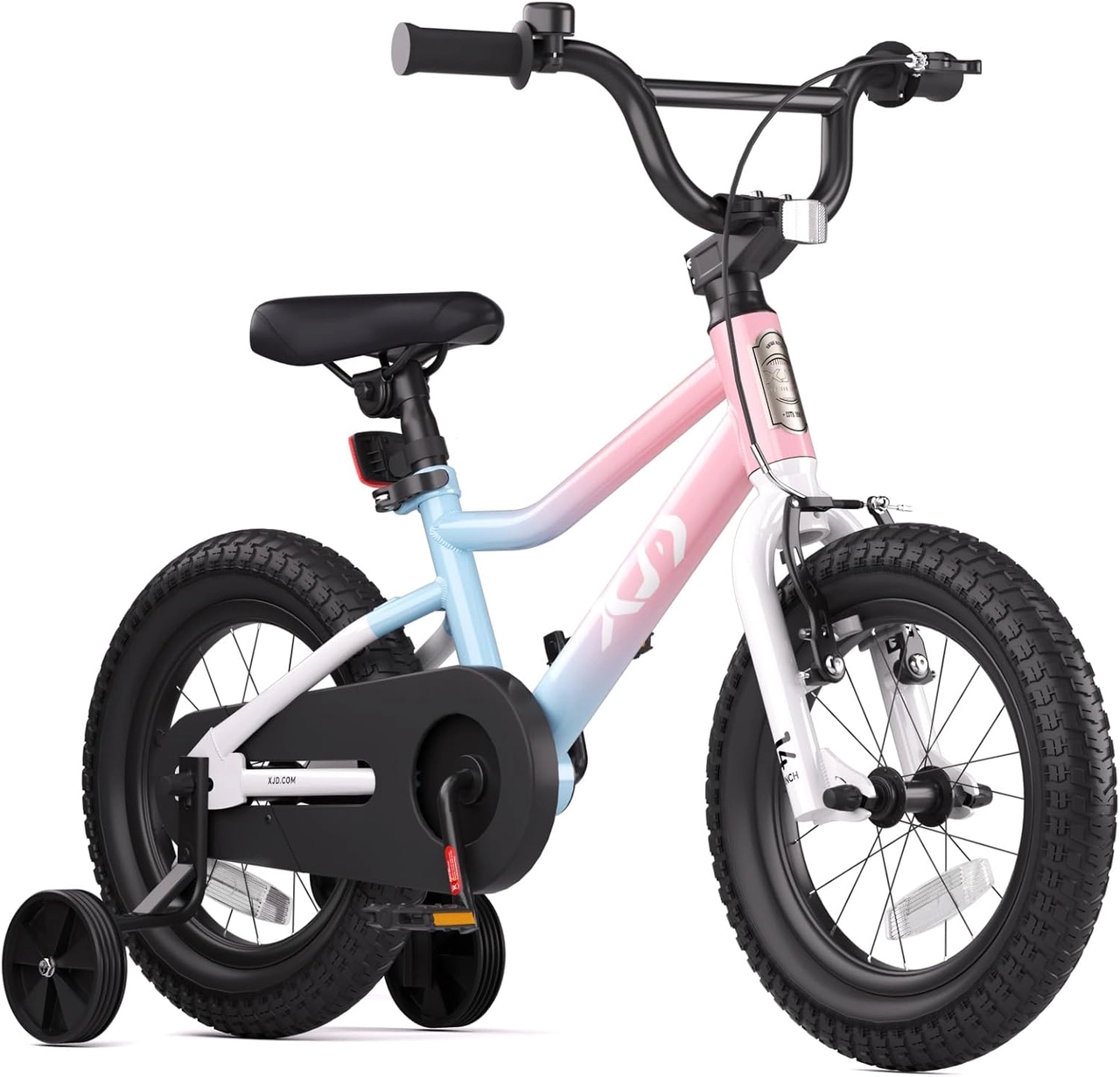 XJD Girls BMX Bike 12/14/16 Inch with Training Wheels – Pink Blue
A Kids' BMX Bikes model offered in 12 Inch, 14 Inch and 16 Inch sizes with training wheels; use measured height and a hands-on fit check rather than the title alone.
The XJD Light Purple Girls Bike with Basket, Training Wheels, 12/14/16/20 Inch is listed in Training Wheel Bikes, with 12 Inch, 14 Inch and 16 Inch options currently represented by the supplied catalog facts. Compare the child’s measured height with the corresponding rows above, then confirm stand-over, reach and control in person.
The XJD Girls BMX Bike 12/14/16 Inch with Training Wheels – Pink Blue is a Kids' BMX Bikes model offered in the same three supplied sizes: 12 Inch, 14 Inch and 16 Inch. Its category and training-wheel wording do not replace a fit or confidence assessment.
The XJD Kids Beach Cruiser Bicycle, Rear Rack & V-Brakes, Mint Green is a Beach Cruiser Bikes model with 20 Inch, 24 Inch and 26 Inch options. Under the XBikes starting points, those sizes correspond to taller riders than the smallest options. Treat the title’s rear-rack and V-brake wording only as catalog facts, not proof that it accepts a passenger seat or suits a particular child.
Make the decision in this order
- Find the exact passenger-seat manual and compare the child with every stated requirement.
- Stop seat use immediately if a limit, secure-fit requirement, compatibility condition or stable-control check is not met.
- If considering a separate bicycle, measure height and inseam before using the table to shortlist a wheel size.
- Have the child try that size and verify stand-over, reach, brake operation and confidence; move to another size if the fit is poor.
The practical answer to “how old can a baby use a bike seat?” is therefore determined by the exact seat instructions and the child’s secure fit—not a birthday. Check those limits now; only compare the supplied bicycles if the child is ready to move from passenger to rider.
Bikes for your next adventure
-

Kids Bike Helmet by XJD for Boys & Girls – Black, Blue, Green, Pink, Purple
The XJD Kids Bike Helmet covers a wide 2-to-8-year age range thanks to two head-…$59.99
-

Kids Bike Helmet by XJD for Girls – Pink
The XJD Kids Bike Helmet in Pink is a lightweight multi-sport helmet for girls r…$59.99
$99 -

XJD Kids Bike for Girls – Pink, 12/14/16/20 Inch with Training Wheels
The XJD Kids Bike for Girls in Pink is a training-wheel bike built to carry your…$139
$159