

How old do kids learn to ride a bike
Most kids can start learning to ride a bike around ages 3–4, but there is no single correct age. Measure height and inseam, then check control and confidence.
Age is a starting point, not the decision
The XBikes chart begins with a 12-inch bike for ages 3–4 and riders 34–40 inches (86–102 cm) tall. That does not mean every three-year-old is ready, or that an older beginner is behind. A child is ready to learn when they can follow simple directions, balance with support, steer intentionally and stay interested without being pressured.
Use age only to identify possible wheel sizes. The final choice should depend on the child’s measured height, inseam, reach, ability to operate the brakes and present confidence. The American Academy of Pediatrics advises having the child try the bicycle rather than buying an oversized model for future growth.
Measure before comparing bikes
- Measure standing height: Have the child stand barefoot against a wall and record the measurement from floor to head.
- Measure inseam: With feet slightly apart, measure from the floor to the top of the inside leg. This helps you assess clearance when the child stands over the bike.
- Check reach: On the actual bicycle, the child should reach the handlebar without an uncomfortable stretch and turn it while remaining balanced.
- Check brake control: Confirm that the child can reach and operate the fitted brakes reliably. Follow the exact product manual for adjustment instructions.
During a fit check, look for usable stand-over clearance, comfortable contact with the controls and the ability to start, stop and dismount without panic. Do not choose a larger wheel merely because the child may grow into it.
XBikes wheel-size starting points
| Wheel size | Starting age | Rider height |
|---|---|---|
| 12 Inch | 3–4 | 34–40 in / 86–102 cm |
| 14 Inch | 3–6 | 37–45 in / 94–114 cm |
| 16 Inch | 4–7 | 40–48 in / 102–122 cm |
| 18 Inch | 5–9 | 43–52 in / 109–132 cm |
| 20 Inch | 7–12 | 48–60 in / 122–152 cm |
| 24 Inch | 10–14 | 54–64 in / 137–163 cm |
| 26 Inch | Youth and adults | Over 60 in / 153 cm |
Overlapping ranges are normal. If a child falls within two rows, compare both sizes in person. Favor the bike on which the child has better stand-over clearance, easier reach, dependable brake control and greater confidence. Wheel size is not interchangeable: a nearby size is only a comparison point, not an equal substitute.
How the supplied bikes fit this decision
The Light Pink XJD Girls' Bicycle with Basket & Training Wheels provides 12-, 14-, 16- and 20-inch comparison options. The Blue XJD Girls Bike with Training Wheels – 12/14/16 Inch covers the three smaller starting points. These models are relevant when a family wants to compare training-wheel bicycles against the child’s measurements.
The Pink XJD Beach Cruiser Bike, 24"/26", U-Brake is a later-size reference. Its 24-inch option starts at ages 10–14 and heights of 54–64 inches (137–163 cm); the 26-inch option is for youth and adults over 60 inches (153 cm). It is not a substitute for a smaller beginner bike.
These particular catalog options help answer the age question by showing available wheel-size comparisons across early-learning and later rider ranges; they still require an individual fit check.
 Pink XJD Beach Cruiser Bike, 24"/26", U-Brake
A later-size comparison with 24- and 26-inch options. Use the XBikes height ranges and an individual fit check; it is not a substitute for a smaller beginner bicycle.
 Light Pink XJD Girls' Bicycle with Basket & Training Wheels
Offers 12-, 14-, 16- and 20-inch options with training wheels, making it relevant for comparing several XBikes starting ranges against measured height, reach, brake control and confidence.
 Blue XJD Girls Bike with Training Wheels – 12/14/16 Inch
Offers 12-, 14- and 16-inch options with training wheels. These sizes cover several early learning starting points, but the child still needs an individual fit and control check.
What to do during the first sessions
Choose a level area away from traffic and obstacles. Keep sessions short enough that fatigue does not replace confidence. Let the child practise mounting, looking ahead, steering and stopping before expecting continuous riding. Training wheels can provide support, but their presence does not prove that the bicycle fits or that the child is ready.
A bicycle helmet must fit properly, sit level and have its straps used according to the helmet manufacturer’s instructions, consistent with U.S. Consumer Product Safety Commission guidance. An adult should supervise learning sessions. For assembly, maintenance, compatibility, load limits or adjustments not stated here, follow the exact bicycle manual or ask a qualified bicycle mechanic.
Make the decision today
Measure the child’s height and inseam, shortlist the matching wheel-size row, and have them try each plausible size. Choose only when they can stand over the bike, reach the controls, operate the brakes and move with confidence. If those checks fail, wait or compare another size—regardless of the child’s birthday.
Bikes for your next adventure
-

Black XJD Kids Bike for Boys – 12, 14 & 16 Inch Sizes
For a son between roughly 3 and 8 years old, the XJD Kids Bike in Black covers t…$169
$199 -

Blue XJD Girls Bike with Training Wheels – 12/14/16 Inch
If you're shopping for a first pedal bike for a daughter roughly 3 to 8 years ol…$149
$169 -
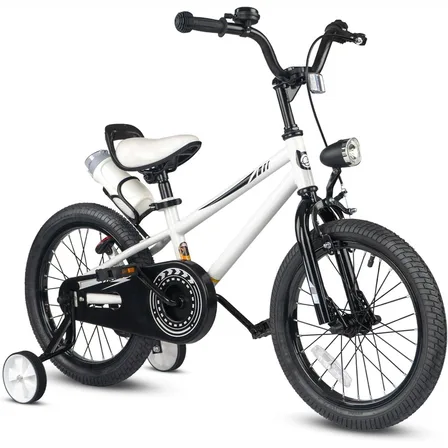
XJD Kids' Training Wheel Bike for Boys & Girls, 12/14/16 Inch – White
The XJD kids' training wheel bike in White is made for riders ages 3–8 (roughly …$169
$199