

How old for 12 inch bike
Most children are ready for a 12-inch bike at ages 3–4 and heights of 34–40 in (86–102 cm), but measured fit and control matter more than age.
Start with height, then check inseam
Measure the child without shoes, standing straight against a wall. Record floor-to-head height and compare it with the 12-inch starting range of 34–40 in (86–102 cm). This range identifies a sensible size to try; it does not confirm that every 12-inch frame will fit the same way.
Next, measure inseam. Have the child stand with feet slightly apart, then measure from the floor to the crotch. Compare that measurement with the bicycle’s stand-over clearance and saddle adjustment information in the exact product manual. No universal inseam number is supplied here, so the physical fit check is essential.
Use age only as a starting point
A 12-inch bike generally corresponds to ages 3–4. A tall three-year-old may need to compare a 14-inch model, while a shorter or less confident four-year-old may still control a 12-inch model more comfortably. Do not move up merely because of a birthday, and do not buy an oversized bicycle for the child to grow into.
| Wheel size | Starting age | Starting height |
|---|---|---|
| 12 Inch | 3–4 | 34–40 in / 86–102 cm |
| 14 Inch | 3–6 | 37–45 in / 94–114 cm |
| 16 Inch | 4–7 | 40–48 in / 102–122 cm |
The overlapping ranges are reasons to try adjacent sizes, not proof that they are interchangeable. If the child is near 40 inches, compare the real riding position on both 12- and 14-inch options before deciding.
Check the bike with the child aboard
Have the child try the bicycle in a clear, level area with close adult supervision. The fit is promising only when the rider can mount and dismount without struggling, stand over the frame with appropriate clearance, sit in a stable position, and reach the handlebar without stretching or becoming cramped.
Ask the child to demonstrate steering and braking rather than merely sitting on the saddle. They should be able to hold a straight line, turn the handlebar without losing balance, and operate the brakes comfortably with enough hand control. If the brake levers are hard to reach or use, the bike is not a sound fit even when height and age match the chart.
Also watch confidence. A child who freezes, tips because the bicycle feels unwieldy, or cannot start and stop predictably needs a different setup or size comparison. Training wheels may assist balance during learning, but their presence does not correct excessive reach, poor stand-over clearance, or inaccessible controls.
How the supplied BMX options help
The catalog choices below are relevant because each provides 12 Inch, 14 Inch and 16 Inch SKU labels, letting a parent identify the requested 12-inch option and compare adjacent sizes where the child’s measurements overlap. Select the exact size label deliberately; the three wheel sizes are not equivalent.
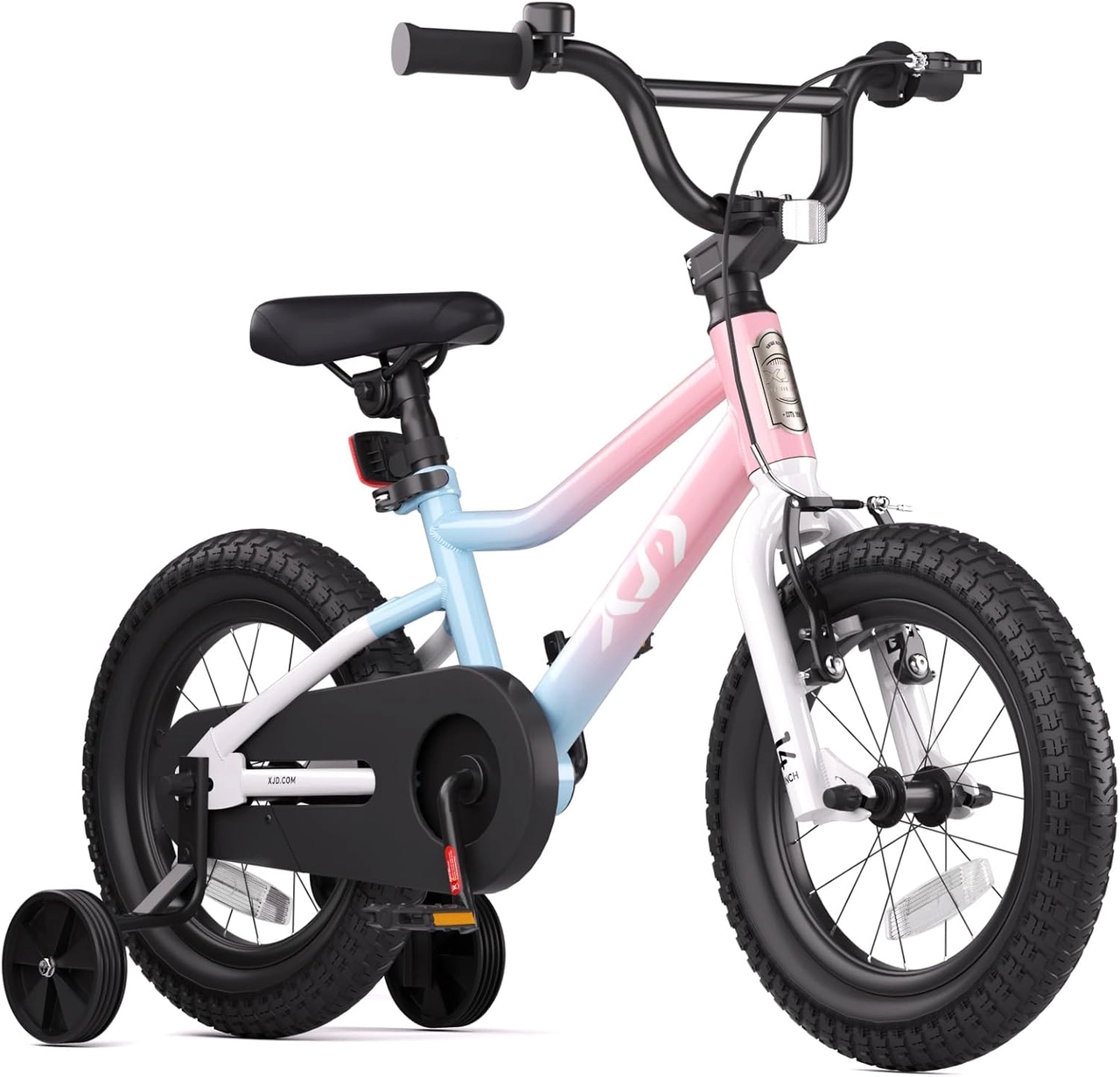 XJD Girls BMX Bike 12/14/16 Inch with Training Wheels – Pink Blue
Available in a 12 Inch SKU relevant to this question, plus 14 Inch and 16 Inch comparison choices. Training wheels are included in the catalog title, but individual height, reach, brake control and confidence still determine fit.
 XJD Boys & Girls BMX Bike with Training Wheels, 12/14/16" – Blue
This Kids' BMX Bike includes 12 Inch, 14 Inch and 16 Inch SKU labels, so its 12 Inch choice is directly relevant. The child should try the selected size and demonstrate comfortable stand-over, reach, braking and control.
XJD Girls BMX Bike 12/14/16 Inch with Training Wheels – Pink Blue is listed as a Kids' BMX Bike with 12 Inch, 14 Inch and 16 Inch choices. Its 12 Inch SKU is relevant to the title, subject to the child completing the individual fit and control checks.
XJD Boys & Girls BMX Bike with Training Wheels, 12/14/16" – Blue is also a Kids' BMX Bike offered with 12 Inch, 14 Inch and 16 Inch labels. Compare its correctly selected 12 Inch version with the rider’s measurements; do not infer fit from the product name alone.
The supplied facts do not specify geometry, saddle range, brake type, weight, load limit or assembly details for either model. Consult the exact product manual for those points. If fit, assembly or adjustment remains uncertain, use a qualified bicycle mechanic rather than improvising a procedure or setting.
Make the 12-inch decision
- Choose 12 Inch as the first size to try when the child is around age 3–4 and measures 34–40 in (86–102 cm).
- Compare 14 Inch when height falls in its 37–45 in (94–114 cm) range, especially near the overlap, but reject it if control or reach becomes worse.
- Confirm stand-over clearance, comfortable reach, reliable steering, brake access and present confidence on the actual bicycle.
- Fit a properly sized bicycle helmet level on the head, with its straps secured according to the helmet manufacturer’s instructions.
If the child falls outside the 12-inch height range or cannot control the bicycle confidently, do not force the age recommendation. Measure again, try the appropriate adjacent size, and buy only after the child can demonstrate a comfortable, controlled fit.
Bikes for your next adventure
-

Kids Bike Helmet by XJD for Boys & Girls – Black, Blue, Green, Pink, Purple
The XJD Kids Bike Helmet covers a wide 2-to-8-year age range thanks to two head-…$59.99
-

Kids Bike Helmet by XJD for Girls – Pink
The XJD Kids Bike Helmet in Pink is a lightweight multi-sport helmet for girls r…$59.99
$99 -

XJD Kids Bike for Girls – Pink, 12/14/16/20 Inch with Training Wheels
The XJD Kids Bike for Girls in Pink is a training-wheel bike built to carry your…$139
$159