

How old for 20 inch bike
A 20-inch bike is an XBikes starting point for ages 7–12 and heights 48–60 inches (122–152 cm), but your child’s measurements and control decide the fit.
Is your child old enough for a 20-inch bike?
Age gives you a quick place to begin, not a final answer. Under the XBikes wheel-size starting points, a 20-inch bike generally suits riders ages 7–12 who are 48–60 inches (122–152 cm) tall. A taller or shorter child may need a different wheel size even when their age falls inside that range.
Do not choose a 20-inch bike merely because your child will eventually grow into it. The American Academy of Pediatrics advises having the child try the bicycle rather than buying an oversized bike for growth. A bike that is too large can make starting, stopping and steering harder.
What to measure before comparing bikes
Measure your child while they are wearing the shoes they will normally use for riding. Record their total height, then measure their inseam from the floor to the crotch. The height can be checked against the XBikes range; the inseam must be compared with the stand-over space and adjustment information for the exact bicycle.
- Height: A measured height of 48–60 inches (122–152 cm) places the rider in the 20-inch starting range.
- Inseam and stand-over: The child should be able to straddle the bicycle with usable clearance rather than being pressed against the frame.
- Reach: Seated in a normal riding position, the child should reach the handlebar without stretching or losing comfortable steering control.
- Brake control: The rider must be able to reach and operate the brakes confidently with their hands in a stable position.
- Confidence: Consider whether the child can start, steer, turn and stop calmly on the bike being considered.
Consult the exact product manual for adjustment limits, assembly, compatibility, torque and maintenance instructions. If the setup or fit is uncertain, use a qualified bicycle mechanic.
How 20 inches compares with nearby sizes
| Wheel size | Starting age | Starting rider height |
|---|---|---|
| 18 Inch | 5–9 | 43–52 in / 109–132 cm |
| 20 Inch | 7–12 | 48–60 in / 122–152 cm |
| 24 Inch | 10–14 | 54–64 in / 137–163 cm |
The overlapping ranges are intentional starting points: they show why age cannot settle the choice. A rider near 48 inches may compare 18- and 20-inch bikes, while one near 54–60 inches may compare 20- and 24-inch bikes. The correct decision comes from trying each relevant bike and checking stand-over, reach, brake operation and control. An 18- or 24-inch bike is not equivalent to a 20-inch bike.
Which supplied products are relevant?
These catalog options help by providing two exact 20-inch choices and one smaller-size comparison. Their supplied size labels let you narrow the shortlist before carrying out the individual fit check.
 XJD Light Purple Girls Bike with Basket, Training Wheels, 12/14/16/20 Inch
Its supplied labels are 12 Inch, 14 Inch and 16 Inch, despite “20 Inch” appearing in the exact catalog title, so it is a smaller-size comparison rather than a supplied 20-inch option.
 XJD Kids Beach Cruiser Bicycle, Rear Rack & V-Brakes, Mint Green
The supplied 20 Inch label makes this beach cruiser directly relevant; its 24 Inch and 26 Inch labels are larger alternatives that require their own measurement and fit checks.
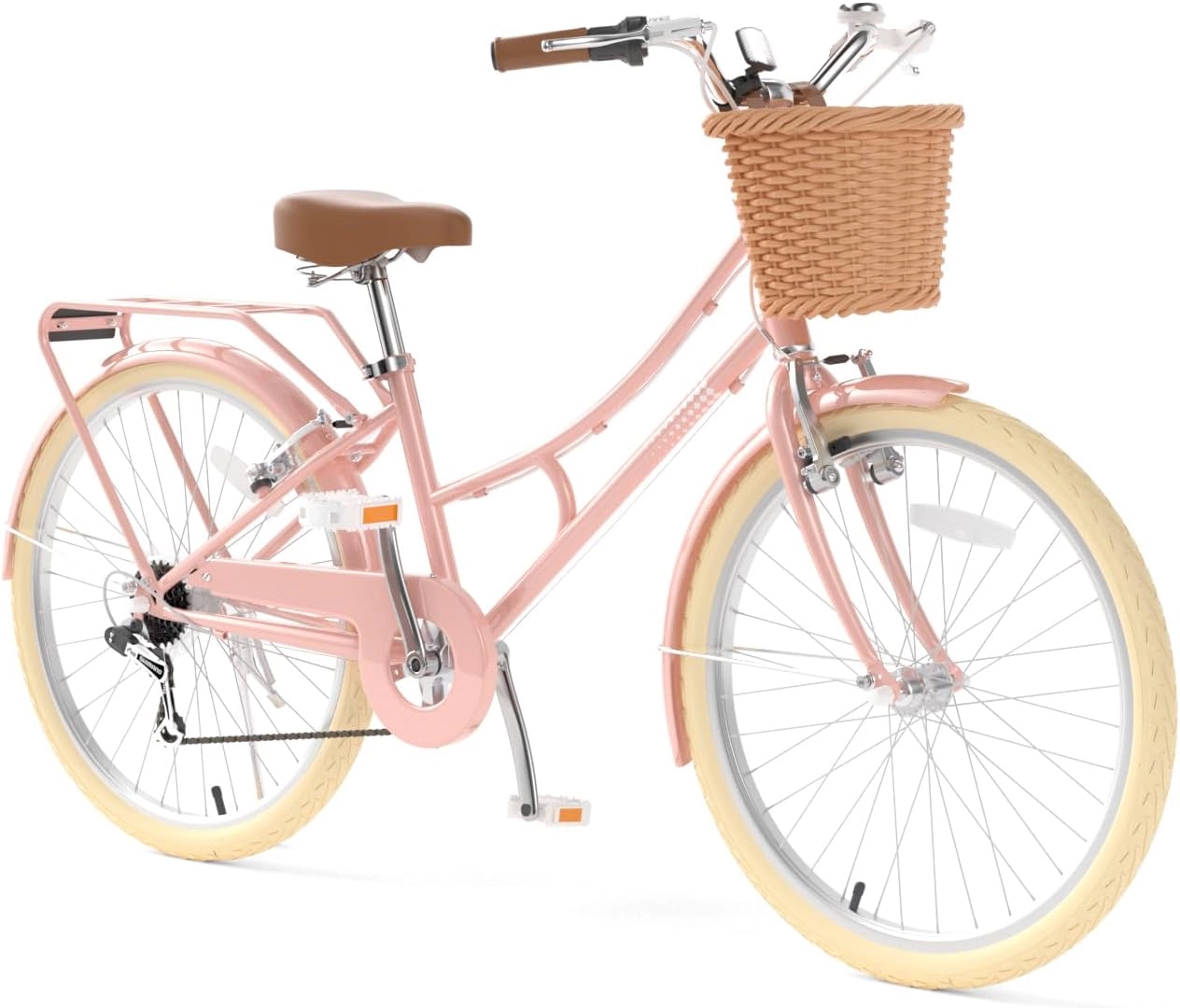 XJD Pink Beach Cruiser for Girls – Rear Rack & V-Brake
This beach cruiser has a supplied 20 Inch option relevant to the question, plus 24 Inch and 26 Inch labels that should not be treated as equivalent sizes.
XJD Kids Beach Cruiser Bicycle, Rear Rack & V-Brakes, Mint Green has supplied 20 Inch, 24 Inch and 26 Inch size labels. Its 20 Inch option is directly relevant when the rider’s measurements and trial fit support that wheel size; the larger labels should be assessed under their own ranges rather than treated as interchangeable.
XJD Pink Beach Cruiser for Girls – Rear Rack & V-Brake is also supplied with 20 Inch, 24 Inch and 26 Inch labels. Compare its 20 Inch option using stand-over, reach, brake control and confidence, not color or age alone.
XJD Light Purple Girls Bike with Basket, Training Wheels, 12/14/16/20 Inch includes “20 Inch” in its exact catalog title, but the supplied available size labels are only 12 Inch, 14 Inch and 16 Inch. It is therefore a smaller-size comparison point here, not a supplied 20-inch option. Its available labels correspond to different XBikes starting ranges and must not be presented as equal substitutes.
Try the bike before deciding
Have the child straddle the bike, sit in a normal riding position and place their hands on the controls. Watch for comfortable clearance, easy handlebar reach and deliberate braking. Then, in a suitable controlled area, check whether they can start, ride a line, turn and stop without the bicycle feeling unwieldy.
If the rider is within the numerical 20-inch range but cannot control the bike confidently, do not select it on age or height alone. Conversely, do not move automatically to 24 inches simply because the child is near the upper end of the range. Compare the actual fit of the relevant bicycles.
Complete the safety check
Use a bicycle helmet that fits properly, sits level and has its straps adjusted according to the helmet manufacturer’s instructions, following U.S. Consumer Product Safety Commission guidance. Confirm the bicycle is assembled and adjusted as directed in its exact manual before riding; ask a qualified bicycle mechanic for help when needed.
Your next step is simple: measure height and inseam, shortlist 20 inches only if the rider is near the 48–60-inch range, and approve the choice only after stand-over, reach, braking and confident control all work for that child.
Bikes for your next adventure
-

Kids Bike Helmet by XJD for Boys & Girls – Black, Blue, Green, Pink, Purple
The XJD Kids Bike Helmet covers a wide 2-to-8-year age range thanks to two head-…$59.99
-

Kids Bike Helmet by XJD for Girls – Pink
The XJD Kids Bike Helmet in Pink is a lightweight multi-sport helmet for girls r…$59.99
$99 -

XJD Kids Bike for Girls – Pink, 12/14/16/20 Inch with Training Wheels
The XJD Kids Bike for Girls in Pink is a training-wheel bike built to carry your…$139
$159