

How old for baby bike trailer
A baby is old enough for a bike trailer only when the child meets the trailer manufacturer’s minimum requirements and can maintain the seated position and head control required by that exact trailer. Do not decide from age alone.
What to check before the first ride
Start with the manual for the exact trailer, seat or approved infant accessory you intend to use. Check its stated minimum age, minimum and maximum passenger size, seating instructions, harness requirements and load limit. These details are product-specific; if the manual is missing or unclear, contact the manufacturer rather than estimating.
Next, observe the child in the installed seat. The child must remain properly positioned without slumping or losing head control. Consider the added size and weight of a helmet. If the child cannot maintain the position required by the manual throughout a ride, wait. For a premature baby or a child with developmental, neck or medical concerns, ask the child’s pediatric clinician for individual guidance.
Measure and compare, rather than guessing
Record the child’s current height and weight, then compare both with the trailer manual. Measure with the clothing and helmet that will actually be used. Confirm that the harness can be adjusted exactly as instructed and that the helmet does not force the head forward against the seat.
- Measure: current height and weight, plus the occupied space with riding clothes and helmet.
- Compare: every measurement with the exact trailer, seat and accessory limits.
- Observe: seated posture, head control and whether the harness remains correctly positioned.
- Stop: if the child slumps, appears uncomfortable or no longer fits within any stated limit.
A birthday is not a substitute for these checks. Two children of the same age can differ substantially in size, posture and readiness, while trailer designs can have different requirements.
Helmet, installation and bicycle checks
The U.S. Consumer Product Safety Commission advises that a bicycle helmet should fit properly, sit level and have its straps used according to the manufacturer’s instructions. A helmet that tips back, shifts or interferes with the trailer seat needs attention before riding.
Install and maintain the trailer only according to its exact manual. Confirm bicycle compatibility, hitch attachment, passenger restraints, tire condition and any required safety devices using the manufacturer’s procedure. Because no universal assembly settings, torque values or load limits apply here, do not improvise them. Have a qualified bicycle mechanic check the setup if compatibility or installation remains uncertain.
How the supplied bicycles relate to this question
The supplied XBikes products are bicycles, not baby bike trailers, so none establishes when a baby is ready to ride as a passenger. They are useful only as later-stage size comparison points, when a child is moving from passenger riding toward riding a bicycle independently. Their wheel sizes are not substitutes for a trailer or proof of trailer readiness.
 Pink XJD Beach Cruiser Bike, 24"/26", U-Brake
A later-stage comparison only: this 24/26 Inch beach cruiser is not a baby trailer. XBikes places these wheel sizes in substantially older and taller rider ranges, with individual fit still required.
 Light Pink XJD Girls' Bicycle with Basket & Training Wheels
This bicycle offers 12, 14, 16 and 20 Inch labels for later independent-riding comparisons. It does not determine baby trailer readiness; use the exact trailer manual and assess the child individually.
 Blue XJD Girls Bike with Training Wheels – 12/14/16 Inch
Its 12, 14 and 16 Inch labels can help compare future bicycle sizing, but this training-wheel bicycle is not a trailer or a substitute for trailer passenger requirements.
The Light Pink XJD Girls' Bicycle with Basket & Training Wheels is offered in 12, 14, 16 and 20 Inch labels. The Blue XJD Girls Bike with Training Wheels – 12/14/16 Inch provides 12, 14 and 16 Inch comparison options. These sizes begin well beyond the baby-trailer decision: XBikes uses 12 Inch as a starting point for ages 3–4 and heights 34–40 in (86–102 cm), subject to an individual fit check.
The Pink XJD Beach Cruiser Bike, 24"/26", U-Brake is available in 24 and 26 Inch labels. XBikes places 24 Inch at ages 10–14 and heights 54–64 in (137–163 cm), while 26 Inch is a starting point for youth and adults over 60 in (153 cm). It is therefore a much later sizing reference, not a baby-transport option.
When a child later moves to a bicycle
For a first independent bicycle, use age only as an initial sorting tool. Measure height and inseam, then have the child try the bicycle. Check stand-over clearance, reach, steering control, brake reach and the child’s present confidence. The American Academy of Pediatrics advises against buying an oversized bicycle merely to allow room for growth.
Within the supplied range, XBikes starts 14 Inch at ages 3–6 and 37–45 in (94–114 cm), 16 Inch at ages 4–7 and 40–48 in (102–122 cm), and 20 Inch at ages 7–12 and 48–60 in (122–152 cm). Overlapping ranges make the physical fit check essential; a wheel-size label alone does not determine fit.
Your next decision
- Find the exact trailer manual and write down every passenger requirement and limit.
- Measure the child and check posture, head control, harness positioning and helmet fit in the installed seat.
- Verify the trailer’s compatibility and installation on the towing bicycle exactly as directed.
- If any requirement is unmet or uncertain, postpone the ride and consult the manufacturer, a qualified bicycle mechanic or the child’s clinician as appropriate.
Use the trailer maker’s requirements—not a general birthday—as the go-or-wait decision. The supplied bicycles become relevant only later, when the child can be individually fitted for independent riding.
Bikes for your next adventure
-

Kids Bike Helmet by XJD for Girls – Pink
The XJD Kids Bike Helmet in Pink is a lightweight multi-sport helmet for girls r…$59.99
$99 -

Blue XJD Kids Bike Helmet for Boys & Girls
The Blue XJD Kids Bike Helmet is a lightweight, adjustable multi-sport helmet fo…$59.99
$99 -
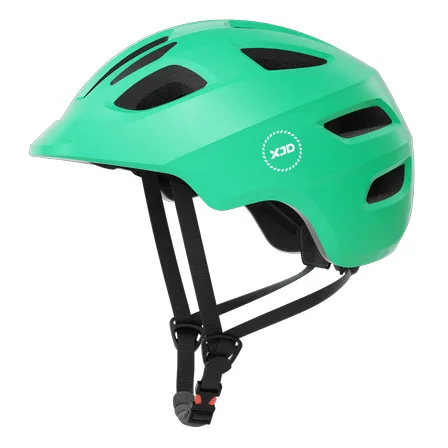
Green XJD Kids Bike Helmet for Boys & Girls
The Green XJD Kids Bike Helmet is a lightweight multi-sport helmet for toddlers …$59.99
$99