

How old for baby in bike trailer
A baby is ready for a bike trailer only when they can sit upright unsupported, keep their head steady while wearing a properly fitted helmet, and meet the trailer manufacturer’s requirements. Age alone is not enough.
Use readiness, not a birthday
There is no single age that makes every baby ready. Neck strength, trunk control, development and the trailer’s design all matter. Do not ride with a baby who slumps, cannot remain upright, or cannot comfortably support their helmeted head through normal movement.
Before the first ride, compare your child’s development with every minimum requirement in the exact trailer manual. If the manual gives an age, height, weight or seating restriction, follow it. Do not improvise with inserts or accessories unless that trailer’s manufacturer explicitly approves them.
If your child was born prematurely, has delayed head or trunk control, or has a medical condition that could affect riding, ask their pediatric clinician before using a trailer. A child who is not yet ready should wait rather than be supported artificially for the ride.
Measure and check before deciding
Record your child’s current height and weight so you can compare them with the trailer manual. Then perform a seated fit check while the trailer is stationary and secured according to its instructions.
- Posture: The child remains upright without slumping sideways or forward.
- Head control: The helmeted head stays steady and is not pushed into an awkward angle by the seat or enclosure.
- Harness fit: The supplied restraint can be adjusted exactly as its manual directs, without routing changes or extra padding.
- Space: The helmet and body fit within the trailer without pressing against areas the manual says must remain clear.
- Limits: The child and anything carried remain within all stated passenger and load limits.
If any point fails, the answer is “not yet,” even if the child has reached an age mentioned in general advice.
Check the trailer, bicycle and helmet together
Confirm that the trailer is compatible with the towing bicycle and that its hitch, restraints and other components are assembled as the exact manuals require. Use a qualified bicycle mechanic when compatibility or assembly is uncertain. Follow the manuals for maintenance, load limits and torque; those details vary, so a guessed number or procedure is not appropriate.
A bicycle helmet must fit the child properly, sit level and use its straps according to the helmet manufacturer’s instructions. Check the complete seated setup because a helmet that fits correctly outside the trailer may interact differently with its seat or enclosure. If correct helmet fit and stable posture cannot coexist, do not ride.
Make the first outing a controlled check
Start only after the stationary fit and equipment checks pass. Choose a short, calm outing away from traffic, steep descents, rough surfaces and tight turns. Ride conservatively and stop promptly to recheck posture, harness position and comfort. End the ride if the child slumps, becomes distressed, or cannot keep their head steady.
Repeat the fit check as the child grows and whenever the helmet, trailer setup or towing bicycle changes. Readiness is not permanent proof that every later configuration fits.
When the supplied bicycle becomes relevant
The Light Pink XJD Girls' Bicycle with Basket & Training Wheels is not a bike trailer and is not suitable evidence that a baby is ready to ride as a passenger. Its supplied 12 Inch, 14 Inch, 16 Inch and 20 Inch options are useful only as later-stage comparison points, when the child is ready to operate a bicycle rather than travel in a trailer.
These catalog options help answer the title by showing the clear separation between baby-trailer readiness and independent bicycle fit: even the smallest listed bicycle starting point is for a later stage and still requires an individual fit check.

| Available size | XBikes starting point | What must decide the fit |
|---|---|---|
| 12 Inch | Ages 3–4; 34–40 in / 86–102 cm | Measured height, inseam, reach, brake control and confidence |
| 14 Inch | Ages 3–6; 37–45 in / 94–114 cm | Individual fit check |
| 16 Inch | Ages 4–7; 40–48 in / 102–122 cm | Individual fit check |
| 20 Inch | Ages 7–12; 48–60 in / 122–152 cm | Individual fit check |
These ranges are starting points, not permission to size by age. Have the child try the bicycle, check stand-over clearance, control and brake reach, and never buy an oversized bicycle merely for growth.
Your decision today
Use the trailer only if your baby can sit unsupported, maintain steady helmeted head control, fit the restraint and space correctly, and satisfy every requirement in the exact trailer manual. If one condition is missing—or the manual is unavailable—wait. The supplied training-wheel bicycle becomes relevant later, after measuring the child and confirming an actual riding fit.
Bikes for your next adventure
-

Kids Bike Helmet by XJD for Girls – Pink
The XJD Kids Bike Helmet in Pink is a lightweight multi-sport helmet for girls r…$59.99
$99 -

Blue XJD Kids Bike Helmet for Boys & Girls
The Blue XJD Kids Bike Helmet is a lightweight, adjustable multi-sport helmet fo…$59.99
$99 -
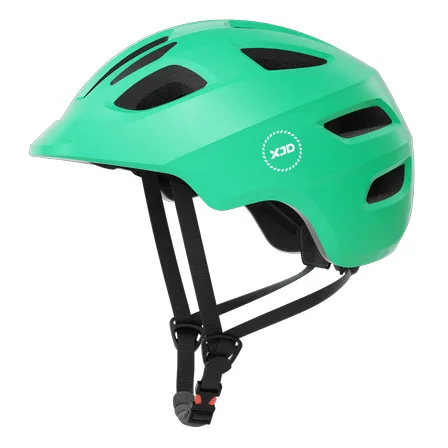
Green XJD Kids Bike Helmet for Boys & Girls
The Green XJD Kids Bike Helmet is a lightweight multi-sport helmet for toddlers …$59.99
$99