

How tall for a 20 inch bike
A 20-inch bike generally fits a child who is 48–60 inches (122–152 cm) tall. Measure the rider and confirm stand-over, reach and brake control before choosing.
Start with height, not age
XBikes lists a 20-inch bike as a starting point for riders ages 7–12 and 48–60 inches (122–152 cm) tall. Height is the more useful first comparison because children of the same age can have different proportions, reach and riding confidence.
Do not move a child onto a 20-inch bike simply because of a birthday or because a larger bicycle will last longer. If the rider is below the height range, cannot stand over the bicycle comfortably or struggles to reach its controls, the bike is too large for that rider now. A child near either end of the range still needs an individual fit check.
Measure the rider correctly
- Height: Have the child stand barefoot against a wall, looking straight ahead, with heels on the floor. Measure from the floor to the top of the head.
- Inseam: With the child standing naturally, measure from the floor to the crotch. This helps you assess clearance over the bicycle rather than relying on total height alone.
- Reach and control: Plan to check these on the actual bicycle. Body proportions differ, so height and inseam cannot confirm handlebar or brake reach by themselves.
Compare the measured height with the XBikes starting points below. These ranges guide which wheel sizes to try; they do not prove that a particular frame will fit.
| Wheel size | Starting age | Rider height |
|---|---|---|
| 16 Inch | 4–7 | 40–48 in / 102–122 cm |
| 18 Inch | 5–9 | 43–52 in / 109–132 cm |
| 20 Inch | 7–12 | 48–60 in / 122–152 cm |
| 24 Inch | 10–14 | 54–64 in / 137–163 cm |
The overlapping ranges are intentional starting points. For example, a 50-inch rider falls within both the 18-inch and 20-inch ranges, while a 56-inch rider falls within both the 20-inch and 24-inch ranges. In either case, try the relevant sizes and choose according to present control and confidence—not hoped-for growth.
Perform the fit check on the bicycle
Have the child try the assembled bicycle while supervised. The American Academy of Pediatrics advises families to check the individual bike and avoid buying an oversized model for a child to grow into.
- Stand-over: The child should be able to straddle the bicycle with appropriate clearance rather than being pressed against the frame.
- Starting and stopping: The rider should be able to get on, start, stop and put a foot down without panic or excessive leaning.
- Reach: Hands should reach the handlebars without the child stretching, locking the elbows or losing a stable riding position.
- Brake control: If the bicycle has hand-operated brakes, the child must be able to reach and operate them confidently while maintaining control.
- Confidence: Watch for smooth steering at low speed. Hesitation, wobbling or difficulty stopping can mean the current setup or size is unsuitable.
How the supplied 20-inch option helps
The catalog includes Girls' Training Wheel Bike by XJD with Basket – Purple in 14 Inch, 16 Inch and 20 Inch SKU labels. Its 20 Inch option matches the wheel size in this question, while the smaller labels provide comparison points when the rider measures below the 20-inch starting range. The labels identify wheel-size options only; they do not replace an individual fit check.

Consider the 20 Inch version only when the measured rider is within the 48–60 inch (122–152 cm) starting range and can pass the on-bike checks. The supplied facts do not establish frame dimensions, brake type, assembly requirements, training-wheel compatibility across sizes or load limits. Consult the exact product manual for those details, or ask a qualified bicycle mechanic to inspect fit and assembly.
Do not overlook the helmet
A correctly sized bicycle still requires a properly fitting helmet. The U.S. Consumer Product Safety Commission advises that the helmet sit level and that its straps be adjusted according to the helmet manufacturer’s instructions. Replace guesswork with a physical helmet fit check each time the child rides.
Make the 20-inch decision
If the child measures 48–60 inches tall, arrange a supervised try-on of a 20-inch bicycle and check stand-over, reach, braking, starting and stopping. If any of those checks fail, do not buy the bike for future growth; compare an overlapping smaller size. If the child is above the range, compare the 24-inch starting point instead and repeat the same fit check.
Bikes for your next adventure
-
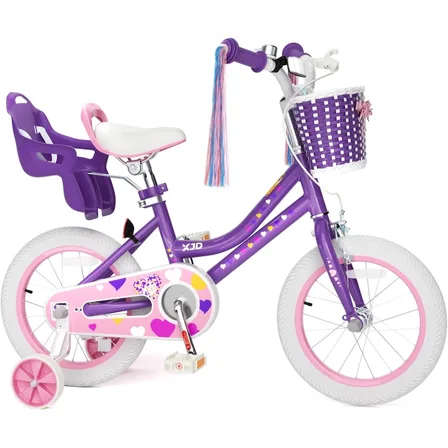
Purple XJD Girls' Bike with Doll Seat & Basket
For girls 71–122 cm tall (about ages 3–7), this XJD girls' bike in Purple pairs …$75.99
$99.99 -

Blue XJD Girls Bike with Training Wheels – 12/14/16 Inch
If you're shopping for a first pedal bike for a daughter roughly 3 to 8 years ol…$149
$169 -

XJD Boys 12/14/16" Training Wheel Bike – Blue
The XJD Boys Bike in Blue is a training wheel bike for riders 71–122 cm tall—rou…$169
$199