

What age for 20 inch bike
A 20-inch bike is usually a starting point for ages 7–12 and riders 48–60 inches (122–152 cm) tall. Measure the child and confirm stand-over clearance, reach, brake control and confidence before choosing.
Age answers the question only partly
For a 20-inch bike, the XBikes starting range is age 7–12. That range helps narrow the search, but two children of the same age may have different heights, inseams, arm reach and riding ability. The rider’s measurements and actual control of the bicycle should decide the fit.
A child outside the stated age range might still need a 20-inch bike if the individual fit is correct. Conversely, being 7 or older does not automatically make a 20-inch model suitable. Do not choose an oversized bicycle simply to leave growing room.
What to measure before shopping
First, measure the child’s height without shoes, standing upright against a wall. Compare that result with the 20-inch starting range of 48–60 inches (122–152 cm). Then measure the inseam from the floor to the crotch while the child stands naturally.
Inseam is useful for checking stand-over clearance, but no single inseam number applies to every 20-inch bicycle because frame shapes vary. Compare the measurement with the exact bicycle and follow its product manual for fit and adjustment guidance.
| Check | What the parent should confirm |
|---|---|
| Height | The rider is near the 48–60 in (122–152 cm) starting range. |
| Stand-over | The child can straddle the frame with practical clearance and without being forced onto tiptoes. |
| Reach | The child can hold the handlebar comfortably without stretching or crowding. |
| Brakes | The child can reach and operate the controls reliably while maintaining steering control. |
| Confidence | Starting, stopping, turning and balancing feel controlled rather than intimidating. |
How to perform the fit check
Have the child try the actual bicycle whenever possible. Begin with the stand-over check, then observe the seated reach to the handlebar and access to the brake controls. Ask the rider to start, stop and turn in a controlled, traffic-free area with close adult supervision.
A poor match may show up as overreaching, difficulty controlling the brakes, wobbling caused by an awkward position, or fear of stopping and putting a foot down. If the fit depends on an extreme adjustment, consult the exact product manual or a qualified bicycle mechanic.
Which XBikes options are relevant?
The supplied catalog includes two exact 20-inch choices that make the requested size concrete: one is categorized as a Kids’ BMX Bike, while the other is a Training Wheel Bike offered in several wheel sizes. They help parents compare the listed bicycle format and select the correct size variant, but neither title replaces an individual fit check.
 Blue XJD Freestyle BMX Bike, 20-Inch – No Pegs
A 20-inch option in the Kids’ BMX Bikes category. The supplied title specifies no pegs, and the only available SKU label is Default; confirm individual stand-over, reach and control.
 Pink 12/14/16/20" XJD Girls Bike with Training Wheels & Basket
A Training Wheel Bike listing with 12-, 14-, 16- and 20-inch SKU labels. Select the 20 Inch variant for this query, then perform an individual fit check.
Blue XJD Freestyle BMX Bike, 20-Inch – No Pegs is listed in the Kids’ BMX Bikes category and has a 20-inch wheel size in its title. Its available SKU label is “Default,” so there is no supplied alternative wheel-size label for that listing.
Pink 12/14/16/20" XJD Girls Bike with Training Wheels & Basket is listed in the Training Wheel Bikes category. Its supplied SKU labels are 12 Inch, 14 Inch, 16 Inch and 20 Inch. For this question, confirm that the selected variant is specifically “20 Inch”; the smaller variants are not equivalent substitutes.
The catalog facts do not provide frame dimensions, brake type, load limits, assembly details or adjustment procedures for either product. Check the exact product manual for those details, or ask a qualified bicycle mechanic to verify assembly and fit.
When a nearby wheel size may be more appropriate
If the rider is below 48 inches (122 cm), do not force a 20-inch choice based on age. The adjacent XBikes starting point is 18 inches for ages 5–9 and heights 43–52 inches (109–132 cm). If the rider is approaching the upper end, a 24-inch bike starts at ages 10–14 and heights 54–64 inches (137–163 cm).
These ranges overlap because height alone is not the final answer. Compare the child’s measured height with the ranges, then use stand-over clearance, reach, brake control and current confidence to distinguish between plausible sizes. A larger size should not be treated as a growth investment when the child cannot control it now.
Make the final 20-inch decision
Choose a 20-inch bike when the child is generally within the 48–60-inch (122–152 cm) range and can comfortably straddle, reach, steer and brake on the specific model. Follow the exact manual for assembly and adjustments. Before every ride, use a bicycle helmet that fits properly, sits level and has straps positioned according to the helmet manufacturer’s instructions. If any fit check fails, compare another size instead of relying on the age label.
Bikes for your next adventure
-

26-Inch XJD Beach Cruiser Bike for Girls – Purple, V-Brake
This XJD 26-inch purple beach cruiser is sized for big kids and teens — suggeste…$218.49
$229.99 -
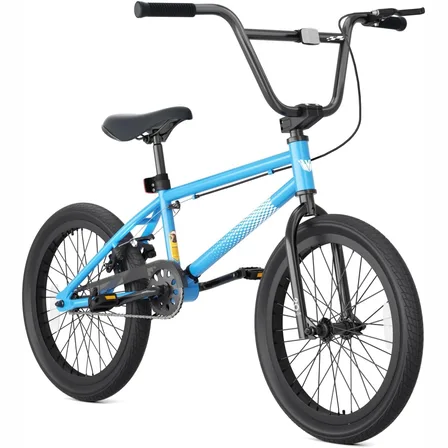
Blue XJD Freestyle BMX Bike, 20-Inch – No Pegs
The XJD 20-Inch Blue Freestyle BMX is an entry-level BMX bike for boys and girls…$189.99
-
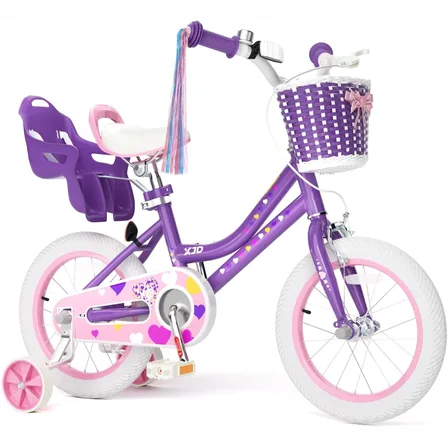
XJD Light Purple Girls Bike with Basket, Training Wheels, 12/14/16/20 Inch
The XJD Girls Bike with Basket in Light Purple is a single-speed training-wheel …$99.99
$119.99