

How tall should a child be for a 20 bike
A child should generally be 48–60 inches (122–152 cm) tall for a 20-inch bike, then pass an individual stand-over, reach and control check.
Start with measured height, not age
XBikes lists a 20-inch bike as a starting point for riders ages 7–12 and 48–60 inches (122–152 cm) tall. Height is the more useful first comparison because children of the same age can have different proportions, reach and riding ability.
Do not move a child to a 20-inch bike simply because they have reached a particular birthday. Likewise, being within the height range does not guarantee that every 20-inch frame will fit. Frame shape, saddle adjustment and handlebar position can differ, so the child must try the exact bicycle.
Measure the child before comparing bikes
Measure standing height without shoes, with the child upright against a wall and looking straight ahead. Record the result in inches or centimetres and compare it with the 20-inch starting range.
Also measure inseam. Have the child stand without shoes, feet naturally spaced, and measure from the floor to the top of the inside leg. This measurement is not matched to a universal number here; instead, use it during the physical stand-over check on the exact bike.
Bring both measurements when shopping, but treat them as screening information. The decisive test is how the child fits and controls the assembled bicycle.
Compare the nearby wheel-size ranges
| Wheel size | XBikes rider-height starting point | Age starting point |
|---|---|---|
| 16 inch | 40–48 in / 102–122 cm | Ages 4–7 |
| 18 inch | 43–52 in / 109–132 cm | Ages 5–9 |
| 20 inch | 48–60 in / 122–152 cm | Ages 7–12 |
| 24 inch | 54–64 in / 137–163 cm | Ages 10–14 |
The overlapping ranges are intentional starting points, not proof that different wheel sizes are interchangeable. A child near a boundary may fit one frame better than another. Compare the exact bicycles rather than choosing the larger wheel automatically.
Perform the fit and control check
Have the child try the bike in a calm, level area with adult support. The American Academy of Pediatrics advises against buying an oversized bicycle for a child to grow into. Check these points before deciding:
- Stand-over: The child should be able to straddle the bicycle without the frame preventing a stable stance.
- Reach: The child should reach the handlebars without stretching, locking the arms or losing a balanced riding position.
- Brake control: The child must be able to reach and operate the exact bike’s brakes confidently.
- Low-speed control: Look for comfortable starting, steering, stopping and getting off rather than merely checking whether the child can sit on the saddle.
- Confidence: Hesitation, wobbling caused by excessive reach, or difficulty stopping are reasons to reassess the size.
If adjustment or assembly is needed, follow the exact product manual. Ask a qualified bicycle mechanic when the manual does not resolve the fit or control issue.
How the supplied catalog option helps
The XJD Light Purple Girls Bike with Basket, Training Wheels, 12/14/16/20 Inch is listed in the Training Wheel Bikes category. However, its supplied available SKU labels are only 12 Inch, 14 Inch and 16 Inch. Those options can help a parent compare smaller starting ranges, but they are nearest-size comparison points rather than substitutes for the requested 20-inch bike. The title’s mention of 20 inches does not establish that a 20-inch SKU is currently available.
These particular catalog options are relevant when the child measures below the 20-inch starting range or when a hands-on fit check shows that a 20-inch bicycle is too difficult to control. Their wheel sizes must still be assessed individually.

For reference, XBikes starts 12-inch bikes at 34–40 inches (86–102 cm), 14-inch bikes at 37–45 inches (94–114 cm), and 16-inch bikes at 40–48 inches (102–122 cm). Do not treat training wheels or a smaller label as automatic proof of fit.
Make the final 20-inch decision
A properly fitted helmet is part of every trial and ride. U.S. Consumer Product Safety Commission guidance says the helmet should fit properly, sit level and have its straps used according to the helmet manufacturer’s instructions.
Choose a 20-inch bike only when the child’s measured height is reasonably aligned with 48–60 inches (122–152 cm) and the exact bicycle passes the stand-over, handlebar reach, brake-operation and confidence checks. If any check fails, do not buy the 20-inch bike for future growth; compare a smaller exact model and repeat the same hands-on assessment.
Bikes for your next adventure
-
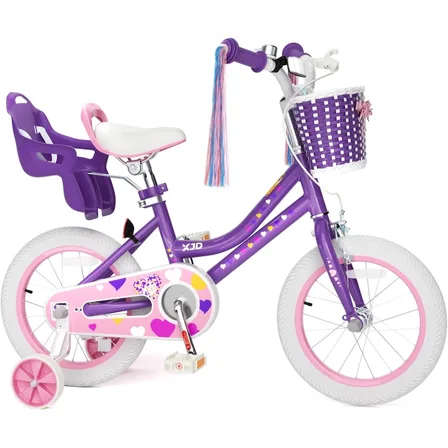
Purple XJD Girls' Bike with Doll Seat & Basket
For girls 71–122 cm tall (about ages 3–7), this XJD girls' bike in Purple pairs …$75.99
$99.99 -

Blue XJD Girls Bike with Training Wheels – 12/14/16 Inch
If you're shopping for a first pedal bike for a daughter roughly 3 to 8 years ol…$149
$169 -

XJD Boys 12/14/16" Training Wheel Bike – Blue
The XJD Boys Bike in Blue is a training wheel bike for riders 71–122 cm tall—rou…$169
$199