

How tall should a kid be for a 20 bike
A child should generally be 48–60 inches (122–152 cm) tall for a 20-inch bike. Treat that range as a starting point: measure the child and check the actual bike before buying.
Start with the child’s standing height
Measure the child without shoes, standing straight against a wall. Mark the top of the head and measure from the floor to the mark. Compare that result with the XBikes starting range for a 20-inch wheel bike: 48–60 inches (122–152 cm).
Age is less reliable than body size and control. The corresponding age range is 7–12, but children of the same age can differ substantially in height, leg length, reach and confidence. A child outside the height range should be compared with the adjacent wheel-size starting points rather than moved automatically to a 20-inch bike.
| Wheel size | Starting rider height | Starting age |
|---|---|---|
| 18 Inch | 43–52 in / 109–132 cm | 5–9 |
| 20 Inch | 48–60 in / 122–152 cm | 7–12 |
| 24 Inch | 54–64 in / 137–163 cm | 10–14 |
The ranges overlap intentionally because wheel size alone cannot confirm fit.
Measure inseam as well as total height
Have the child stand in socks with feet slightly apart. Place a firm, thin book between the legs and raise it gently to simulate the position of a bicycle saddle. Measure from the floor to the top edge of the book. This is the child’s inseam.
Compare that measurement with the bicycle’s stand-over clearance and adjustable saddle range. Those bicycle dimensions are model-specific, so consult the exact product description or manual rather than assuming every 20-inch frame fits identically. With the child straddling the bike, they should be able to stand securely and avoid uncomfortable contact with the frame.
Confirm reach, steering and brake control
A suitable height range does not guarantee that the cockpit fits. Let the child sit on the bike and hold both grips. They should reach the handlebar without stretching, locking their elbows or leaning so far forward that steering becomes difficult.
Ask the child to turn the handlebar in both directions while remaining balanced. Then check whether they can operate the brakes reliably from their normal hand position. Brake reach matters: having to release or significantly shift the grip to reach a lever is a sign that the setup needs adjustment or that the bike may not fit.
Follow the exact product manual for permitted adjustments, assembly and maintenance. If the correct setup is unclear, use a qualified bicycle mechanic rather than improvising a procedure or setting.
Do not choose extra size for future growth
An oversized bicycle can make starting, stopping and steering harder. Do not move a child to a 20-inch bike merely because they may grow into it. If the child cannot stand over the frame comfortably, reach the controls or stop with confidence today, choose a better-fitting option now.
Confidence also changes the decision within the overlapping ranges. A capable rider near a boundary may handle a particular frame differently from a beginner of the same height. The useful test is controlled riding on the actual bicycle in a safe area, not age or wheel diameter by itself.
How the supplied 20-inch options relate
The catalog includes two beach cruiser bicycles with a 20 Inch SKU label, so they are relevant models to inspect for the wheel size in the title. They also offer 24 Inch and 26 Inch labels, which are different sizes and must not be treated as equivalent fits.
 XJD Kids Beach Cruiser Bicycle, Rear Rack & V-Brakes, Mint Green
Available with a 20 Inch SKU label relevant to the question, plus distinct 24 Inch and 26 Inch options. Confirm the child’s stand-over clearance, reach, brake control and confidence on the selected size.
 XJD Pink Beach Cruiser for Girls – Rear Rack & V-Brake
Its available sizes include a directly relevant 20 Inch option alongside separate 24 Inch and 26 Inch options. Use measured height and an individual fit check rather than the wheel-size label alone.
XJD Kids Beach Cruiser Bicycle, Rear Rack & V-Brakes, Mint Green is listed in Beach Cruiser Bikes with 20 Inch, 24 Inch and 26 Inch options. For this question, only its 20 Inch option is the direct wheel-size comparison; verify the individual frame fit and controls.
XJD Pink Beach Cruiser for Girls – Rear Rack & V-Brake is also listed in Beach Cruiser Bikes with 20 Inch, 24 Inch and 26 Inch options. Its 20 Inch option is relevant to the requested size, but the catalog label alone does not establish stand-over clearance, reach or confidence for a particular child.
Both supplied titles identify a rear rack and V-brakes. Do not infer load limits, assembly requirements or adjustment procedures from those titles. Use the manual for the exact selected product or ask a qualified bicycle mechanic.
Make the final fit decision
- Measure standing height and confirm that 48–60 inches (122–152 cm) is the appropriate starting range.
- Measure inseam and compare it with the specific bicycle’s stand-over and saddle adjustment information.
- Have the child try the exact bike and check comfortable handlebar reach, steering and brake operation.
- Reject the fit if the child appears stretched, cannot stand securely or lacks confident control; do not compensate by buying for growth.
- Fit a bicycle helmet so it sits level, fits properly and uses its straps according to the helmet manufacturer’s instructions.
Choose a 20-inch bike only when the child meets the starting height guidance and can comfortably stand over, reach, steer and brake on the exact model today.
Bikes for your next adventure
-

Blue XJD Girls Bike with Training Wheels – 12/14/16 Inch
If you're shopping for a first pedal bike for a daughter roughly 3 to 8 years ol…$149
$169 -
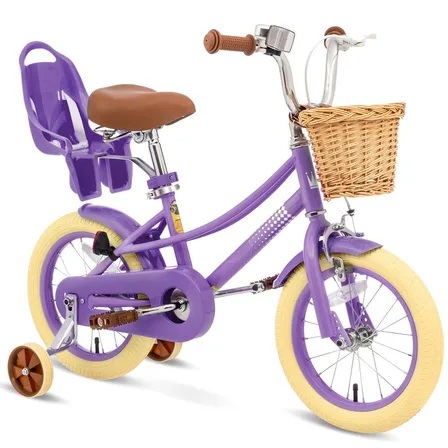
XJD Girls' Bike with Training Wheels, 12/14/16/20 Inch – Purple
The XJD girls' bike with training wheels in Purple is built to grow with your ri…$139
$159 -

XJD Kids Bike for Girls – Pink, 12/14/16/20 Inch with Training Wheels
The XJD Kids Bike for Girls in Pink is a training-wheel bike built to carry your…$139
$159