

How to carry a child on a bike
Carry a child only in a purpose-built child seat, trailer or cargo-bike system that fits your bicycle, your child and the stated load limits. A child’s own bike is not a passenger carrier.
Choose the carrying system first
Start by deciding where and how the child will ride. Common choices include a bicycle-mounted child seat, a cycle trailer, or a cargo bicycle designed for passengers. Compare them using the child and bicycle manuals, not appearance alone.
- Child seat: Confirm that the seat’s mounting system is explicitly compatible with your bicycle and does not interfere with steering, braking, pedalling, cables or moving parts.
- Trailer: Check the approved passenger limits, hitch compatibility and instructions for securing the child. Allow for the trailer’s extra width and different cornering path.
- Cargo bicycle: Use only passenger equipment intended for that model, including the specified seat, restraint and foot protection.
Do not improvise with a basket, handlebar, top tube, rear rack or other place that was not designed and approved to carry a passenger.
Measure the child and inspect the bicycle
Record the child’s current height and weight, then compare both with the carrying product’s manual. Also check any stated requirements concerning sitting ability, helmet use and passenger position. Because those limits are not universal, follow the exact manual rather than relying on a general age estimate.
For the bicycle, identify its exact make, model, frame style, wheel size, rack specifications if applicable, and any restrictions stated by its manufacturer. Inspect the proposed mounting area and verify that the attachment hardware matches it. If compatibility, assembly, load limits or torque values are unclear, stop and ask the manufacturer or a qualified bicycle mechanic.
Check fit and control before riding
Install the system exactly as directed, then secure the child with every supplied restraint and adjustment specified by its manufacturer. Check that clothing, shoelaces, hands and feet cannot reach wheels, spokes, brakes, drivetrain parts or other moving components.
A bicycle helmet must fit properly, sit level and have its straps adjusted according to the helmet manufacturer’s instructions. A helmet does not correct an unsuitable carrier, poor restraint fit or incompatible mounting system.
Before carrying the child, practise mounting, dismounting, starting, stopping and turning with the empty system in a traffic-free area. Added passenger weight can change balance, braking and handling. Repeat the control check with the child aboard in the same protected setting, using another adult to steady the bicycle if needed. Do not proceed if you cannot start, steer and stop confidently.
Use a short pre-ride decision check
- Confirm that the child remains within every current fit and load requirement in the carrier manual.
- Check that the mount, hitch, restraints and required guards are correctly positioned and secure.
- Inspect the bicycle’s tires, wheels, brakes and steering according to its manual.
- Fit the child’s helmet level and adjust its straps as instructed.
- Choose a route suited to your experience with the system, accounting for its width, length and changed handling.
If any requirement is unknown, components are loose, or the child cannot remain correctly positioned, do not ride until the issue has been resolved.
When the supplied XBikes products are relevant
The supplied catalog options are children’s bicycles, not documented child-carrying equipment. They help only when the child is ready to ride independently and you are comparing an appropriately sized bike; they do not answer carrier compatibility or replace a purpose-built passenger system.
 Blue XJD Freestyle BMX Bike, 20-Inch – No Pegs
A 20-inch kids’ BMX bike relevant only for an independently riding child whose individual fit is checked; it is not documented child-carrying equipment.
 Pink 12/14/16/20" XJD Girls Bike with Training Wheels & Basket
A training-wheel bike offered in 12-, 14-, 16- and 20-inch sizes for independent-rider fit comparisons, not as a bicycle passenger carrier.
Blue XJD Freestyle BMX Bike, 20-Inch – No Pegs is a 20-inch kids’ BMX bike with a Default SKU label. Under the XBikes starting points, 20-inch bicycles correspond to rider heights of 48–60 in / 122–152 cm and ages 7–12. Height and age are only starting points, so the child must still try the bicycle.
Pink 12/14/16/20" XJD Girls Bike with Training Wheels & Basket is a training-wheel bike offered in 12-, 14-, 16- and 20-inch SKU labels. The relevant XBikes starting points are:
| Wheel size | Age starting point | Rider-height starting point |
|---|---|---|
| 12 Inch | 3–4 | 34–40 in / 86–102 cm |
| 14 Inch | 3–6 | 37–45 in / 94–114 cm |
| 16 Inch | 4–7 | 40–48 in / 102–122 cm |
| 20 Inch | 7–12 | 48–60 in / 122–152 cm |
For either bicycle, prioritize measured height, inseam, reach, brake control and current confidence over age alone. Have the child try it, check stand-over clearance and control, and make sure the child can reach and operate the brakes. Do not buy an oversized bicycle merely for future growth.
Make the final decision
If the child will be a passenger, select a documented, bicycle-compatible carrying system and verify every fit, restraint and load requirement before riding. If the child will ride independently, measure and test their fit on the appropriate wheel size instead. Do not use either supplied children’s bicycle as equipment for carrying a child.
Bikes for your next adventure
-

XJD Kids Bike for Girls – Pink, 12/14/16/20 Inch with Training Wheels
The XJD Kids Bike for Girls in Pink is a training-wheel bike built to carry your…$139
$159 -

XJD Boys 12/14/16" Training Wheel Bike – Blue
The XJD Boys Bike in Blue is a training wheel bike for riders 71–122 cm tall—rou…$169
$199 -
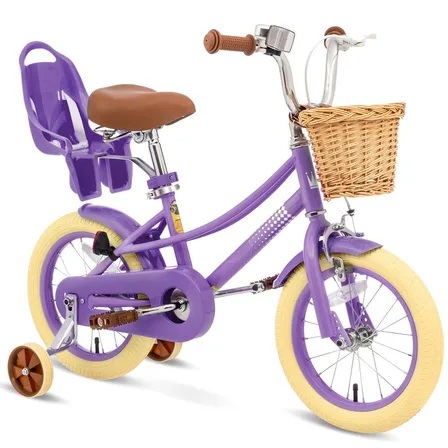
XJD Girls' Bike with Training Wheels, 12/14/16/20 Inch – Purple
The XJD girls' bike with training wheels in Purple is built to grow with your ri…$139
$159