

How to carry baby on a bike
To carry a baby on a bike, first confirm that the child is developmentally ready for the chosen carrier, then match an approved child seat, trailer or cargo system to your bicycle and follow both manufacturers’ instructions exactly.
Choose the carrying system before the bicycle
A baby should ride in purpose-built passenger equipment, not in a basket, on a rack, on the handlebar or in an adult’s arms. The practical choices are a front-mounted child seat, rear-mounted child seat, bicycle trailer or passenger-rated cargo bicycle. Each changes balance, steering, braking and mounting differently.
Check the carrier manual for its minimum passenger requirements, required posture or head control, harness use and permitted helmet arrangement. Also check every stated passenger-weight and size limit. If the baby does not meet all requirements, do not carry the baby by bicycle yet. Ask the child’s healthcare professional when developmental readiness is uncertain.
Measure and compare compatibility
Before buying or installing anything, identify the bicycle’s exact model and measure only where the carrier manufacturer instructs. Compatibility may depend on mounting space, frame or rack interfaces, wheel clearance, cable routing and the position of the rider’s knees or heels.
- For a front seat: verify the specified mounting interface and whether the rider can pedal and steer without contacting the seat.
- For a rear seat: determine whether it mounts to the frame or requires a compatible rack. A normal basket or unspecified rack is not proof that it can carry a passenger.
- For a trailer: verify the hitch type, attachment location and bicycle compatibility stated by both manufacturers.
- For a cargo bike: confirm that the passenger area and accessories are explicitly approved for carrying a child who meets their requirements.
Do not guess about load limits, fastener torque or accessory combinations. Use the exact manuals, and have a qualified bicycle mechanic check the installation when specifications are missing or compatibility is unclear.
Check rider control with the carrier fitted
Install the empty carrier first. In a traffic-free area, practise mounting, starting, turning, braking and stopping. Added passenger equipment can alter the bicycle’s centre of mass even before the baby is aboard.
The adult rider must be able to straddle the bicycle, reach the controls comfortably, operate the brakes decisively and place a foot down without losing control. Do not use an oversized bicycle merely to obtain more carrying space. If steering becomes obstructed, braking feels inadequate or the bicycle cannot be held securely while loading, the setup is unsuitable.
Load and ride deliberately
- Inspect the bicycle and carrier using their manuals, including attachment points, tires, brakes, harness and closures.
- Stabilize the bicycle and keep one hand on it while loading. A kickstand alone should not be treated as supervision.
- Secure the baby exactly as the carrier manufacturer directs. Nothing loose should reach a wheel, chain or moving part.
- Fit each required helmet properly. A bicycle helmet should sit level, fit securely and use its straps according to the manufacturer’s instructions.
- Begin with a short, quiet route. Allow more room for turns and stops, and avoid conditions prohibited by either manual.
Never leave a baby unattended in equipment attached to a bicycle. Stop riding if a mount loosens, the harness shifts, the baby cannot maintain the required position or the adult loses confident control.
How the supplied bicycles relate
The supplied catalog products are conventional size comparison points, not verified baby-carrying systems. They help separate a child’s own bicycle fit from the different question of carrying a baby; none is supplied with passenger-seat, trailer, cargo, load-limit or compatibility facts.
 Pink XJD Beach Cruiser Bike, 24"/26", U-Brake
A 24 or 26 Inch beach cruiser size comparison for the adult or youth rider; the supplied facts do not establish compatibility with a baby seat, trailer or cargo system.
 Light Pink XJD Girls' Bicycle with Basket & Training Wheels
Offered in 12, 14, 16 and 20 Inch sizes for a child rider. Its catalog-listed basket and training wheels do not make it a verified baby-carrying bicycle.
 Blue XJD Girls Bike with Training Wheels – 12/14/16 Inch
A child rider bicycle offered in 12, 14 and 16 Inch sizes. The supplied facts provide no passenger-carrier, trailer, cargo or load-limit compatibility.
Pink XJD Beach Cruiser Bike, 24"/26", U-Brake is offered in 24 Inch and 26 Inch labels. XBikes uses 24 Inch as a starting point for riders 54–64 in (137–163 cm), generally ages 10–14, while 26 Inch starts above 60 in (153 cm) for youth and adults. Those labels do not establish compatibility with a baby carrier.
Light Pink XJD Girls' Bicycle with Basket & Training Wheels has 12, 14, 16 and 20 Inch options. Its basket must not be treated as a baby seat. Blue XJD Girls Bike with Training Wheels – 12/14/16 Inch has 12, 14 and 16 Inch options. Both are children’s rider bicycles, not supplied passenger-carrying solutions.
For reference, XBikes starts 12 Inch at 34–40 in (86–102 cm), 14 Inch at 37–45 in (94–114 cm), 16 Inch at 40–48 in (102–122 cm), and 20 Inch at 48–60 in (122–152 cm). These ranges concern the person riding that bicycle. Measured height, inseam, reach, brake control and confidence take priority over age, and the child should try the bicycle rather than sizing up for growth.
Make the final decision
Proceed only when the baby meets the carrier’s requirements, the carrier and bicycle manuals explicitly permit the combination, the installation is correct, and the adult can control the loaded setup. Otherwise, choose a verified compatible system or postpone the ride.
Bikes for your next adventure
-

XJD Kids Bike for Girls – Pink, 12/14/16/20 Inch with Training Wheels
The XJD Kids Bike for Girls in Pink is a training-wheel bike built to carry your…$139
$159 -

XJD Boys 12/14/16" Training Wheel Bike – Blue
The XJD Boys Bike in Blue is a training wheel bike for riders 71–122 cm tall—rou…$169
$199 -
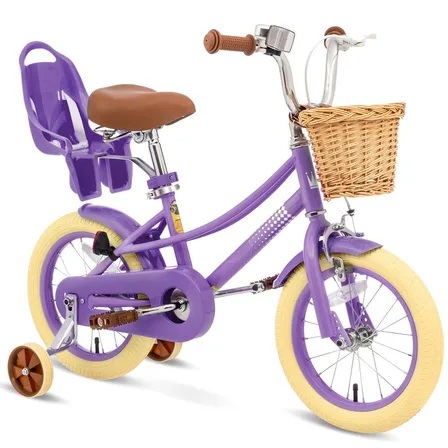
XJD Girls' Bike with Training Wheels, 12/14/16/20 Inch – Purple
The XJD girls' bike with training wheels in Purple is built to grow with your ri…$139
$159