

How to carry kids on bike
To carry kids on a bike, choose a purpose-built child seat, trailer or cargo-bike setup that fits the child, bicycle and adult rider—never improvise a passenger perch.
Choose the carrying method first
A child seat carries one child on the adult bicycle. A trailer places the child behind the bicycle, while a cargo bike carries children in a platform or compartment designed for passengers. These options are not interchangeable: the bicycle and carrier manufacturers must explicitly permit the complete combination.
Start with the child’s ability to use the carrier as required by its manual. Then compare the carrier’s stated child-size and load limits with the child’s current measurements. Also check the permitted number of passengers, required restraints and whether a helmet can be worn without forcing the child’s head forward.
Do not use a rack, basket, handlebar, top tube or improvised cushion as a child seat. If the documentation does not clearly approve carrying a child, ask the manufacturer or a qualified bicycle mechanic before riding.
Measure the child and inspect the adult bike
Record the child’s current height and weight, then check them against the exact carrier manual. Follow that manual for any minimum developmental requirement; do not substitute an assumed age rule. Confirm that the harness or restraint adjusts securely and that the child’s hands, feet, clothing and straps remain protected from wheels and other moving parts.
For the adult bicycle, identify its exact model, frame size and any fitted rack. Compare those details with the carrier maker’s compatibility list and the bicycle maker’s permitted loads. Mounting points, rack approval, load limits, assembly steps and torque values are product-specific. Because none are supplied here, use the exact manuals or have a qualified bicycle mechanic install and inspect the system.
Check handling before carrying the child
- Inspect the complete setup: Check that the carrier is attached as its manual specifies, restraints function correctly and nothing can contact a wheel or drivetrain.
- Fit the helmet: The U.S. Consumer Product Safety Commission advises that a bicycle helmet should fit properly, sit level and have its straps used according to the manufacturer’s instructions.
- Practise without the child: In a traffic-free area, learn how the bicycle starts, stops, turns and balances with the carrier fitted and an appropriate practice load permitted by its instructions.
- Load securely: Stabilize the bicycle exactly as directed in the manual. Fasten every required restraint and recheck feet, hands, clothing and helmet position before moving.
- Ride conservatively: Allow extra room for braking and turning. Avoid any route or surface that exceeds the bicycle or carrier maker’s stated use.
Stop if the bicycle feels unstable, the carrier shifts, a restraint loosens, the child cannot maintain the required position, or the adult cannot confidently start, steer and brake.
When an independent kids bike is more relevant
Once a child is ready to ride rather than travel as a passenger, bicycle fit becomes the central decision. The child should try the bike. Following the HealthyChildren guidance, do not buy an oversized bicycle merely for growth; check stand-over clearance, reach, control and access to the brakes.
| Wheel size | Starting age | Starting rider height |
|---|---|---|
| 12 Inch | 3–4 | 34–40 in / 86–102 cm |
| 14 Inch | 3–6 | 37–45 in / 94–114 cm |
| 16 Inch | 4–7 | 40–48 in / 102–122 cm |
| 18 Inch | 5–9 | 43–52 in / 109–132 cm |
| 20 Inch | 7–12 | 48–60 in / 122–152 cm |
| 24 Inch | 10–14 | 54–64 in / 137–163 cm |
| 26 Inch | Youth and adults | Over 60 in / 153 cm |
These are starting points, not a substitute for fitting. Prioritize measured height, inseam, reach, brake control and current confidence over age alone.
How the supplied XBikes option fits this decision
The Black XJD Kids Bike for Boys – 12, 14 & 16 Inch Sizes is a Training Wheel Bikes catalog option with 12 Inch, 14 Inch and 16 Inch labels. It helps families compare three independent-rider starting sizes after measuring the child and arranging a fit check.
It is not a child carrier and should not be presented as a way for an adult to transport a passenger. Its relevance begins only when the child will ride their own bicycle. The following catalog display is therefore useful for comparing those three labeled sizes, not for choosing a seat, trailer or cargo-bike system.

Make the final decision
If the child will be a passenger, write down the child’s height and weight, identify the adult bicycle exactly, and choose only a purpose-built carrier whose manual approves both. Verify installation, limits and restraints before a child rides. If the child will ride independently, compare the measured height with the XBikes starting points, then confirm inseam, stand-over, reach, brake control and confidence on the actual bike.
Bikes for your next adventure
-

XJD Kids Bike for Girls – Pink, 12/14/16/20 Inch with Training Wheels
The XJD Kids Bike for Girls in Pink is a training-wheel bike built to carry your…$139
$159 -

XJD Boys 12/14/16" Training Wheel Bike – Blue
The XJD Boys Bike in Blue is a training wheel bike for riders 71–122 cm tall—rou…$169
$199 -
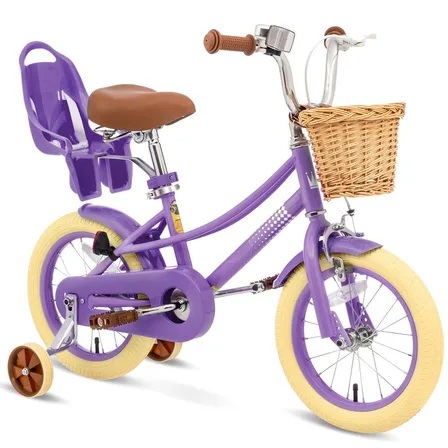
XJD Girls' Bike with Training Wheels, 12/14/16/20 Inch – Purple
The XJD girls' bike with training wheels in Purple is built to grow with your ri…$139
$159