

How to help tow a kids bike behind
To help tow a kids bike behind an adult bicycle, first measure the child and bike, then choose a purpose-built towing system whose manual confirms compatibility with both bicycles. Never improvise with a loose rope, and do not ride until steering, braking, attachment security and helmet fit have been checked.
Measure the child before choosing the bike
A tow setup cannot correct a poor bicycle fit. Measure the child's standing height and inseam, then have the child try the bicycle. Age is only a starting point; measured height, stand-over clearance, reach, brake control and current confidence matter more.
The child should be able to mount and dismount under control, reach the handlebar without stretching, and operate the available brakes comfortably. Do not choose an oversized bicycle simply to leave room for growth.
| Wheel size | XBikes starting point |
|---|---|
| 12 Inch | Ages 3–4; 34–40 in / 86–102 cm |
| 14 Inch | Ages 3–6; 37–45 in / 94–114 cm |
| 16 Inch | Ages 4–7; 40–48 in / 102–122 cm |
| 18 Inch | Ages 5–9; 43–52 in / 109–132 cm |
| 20 Inch | Ages 7–12; 48–60 in / 122–152 cm |
| 24 Inch | Ages 10–14; 54–64 in / 137–163 cm |
| 26 Inch | Youth and adults over 60 in / 153 cm |
Compare the towing system with both bicycles
Identify the exact make, model, wheel size and attachment points of the adult and child bicycles. Then compare them with the towing-system manufacturer's compatibility list and instructions. Check whether the system is intended to carry the child's bike with the child riding, or only to transport an unoccupied bicycle; those are different uses.
Also confirm the permitted bicycle types, wheel sizes, attachment locations and load limits in the exact manuals. The supplied catalog facts do not provide towing compatibility, bicycle weight, attachment specifications or load limits. If any requirement is unclear, ask the towing-system manufacturer or a qualified bicycle mechanic rather than assuming that a connection will work.
How the supplied bikes help with the comparison
The two catalog options are relevant as training-wheel bicycle size comparisons, not as towing equipment. Girls' Training Wheel Bike by XJD with Basket – Purple is offered in 14 Inch, 16 Inch and 20 Inch labels. Flower Pink XJD Girls Bike with Doll Seat & Basket is offered in 12 Inch, 14 Inch and 16 Inch labels. These choices let you compare the child's measured fit with available wheel-size starting points before investigating a separate towing system. Nothing supplied confirms that either bicycle can be towed, or that its training-wheel configuration is compatible with an attachment.
 Girls' Training Wheel Bike by XJD with Basket – Purple
A training-wheel bike offered in 14 Inch, 16 Inch and 20 Inch labels. Use those sizes as fit-comparison starting points; the supplied facts do not establish compatibility with any towing system.
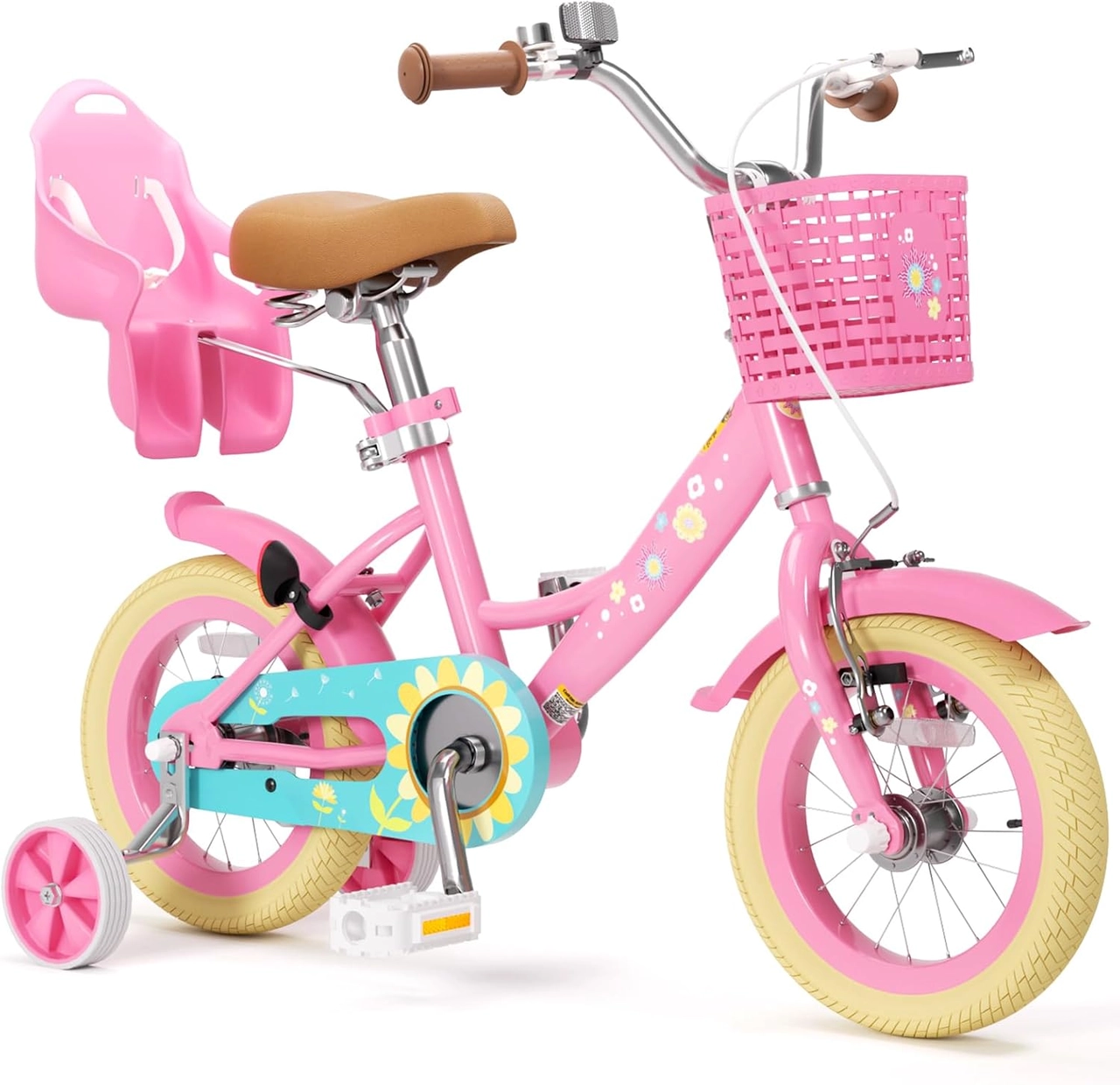 Flower Pink XJD Girls Bike with Doll Seat & Basket
A training-wheel bike offered in 12 Inch, 14 Inch and 16 Inch labels. It can inform wheel-size comparison after measuring the child, but no supplied fact confirms towing-system compatibility.
Set up and inspect the connection
Follow the towing-system manual and both bicycle manuals exactly for assembly, permitted configurations, fastener tightening and inspection. Do not invent a substitute attachment point or guess a torque value. A qualified bicycle mechanic should install or inspect the system if the instructions are incomplete, the parts do not align cleanly, or either bicycle has an unusual frame or accessory arrangement.
Before every ride, check that the connection is secure and cannot contact a wheel, brake, chain or steering control. Make sure accessories such as baskets, a doll seat or training wheels do not obstruct the system. Their presence in a product title does not establish compatibility. Use the configuration only if the relevant manual expressly permits it.
Practise before entering normal riding conditions
- Have the adult practise with the approved setup in a flat, open area away from traffic.
- Start and stop gently, checking that the child can keep hands and feet positioned as the towing-system instructions require.
- Test low-speed turns and braking while allowing substantially more space than when riding one bicycle.
- Stop immediately if the connection moves, steering feels unpredictable, a component rubs, or the child becomes uncomfortable.
The adult rider must remain able to balance, steer and brake the combined setup. Avoid steep slopes, dense traffic, rough surfaces and tight routes until the manual permits the conditions and both riders can manage the system consistently. A child who cannot stay composed or follow instructions is not ready for this arrangement.
Know when not to tow
Do not tow when compatibility is unconfirmed, a required part is missing, either bicycle is damaged, the child's bike does not fit, or the child cannot reach and control it confidently. Do not use an improvised rope or hold the child's bicycle by hand while riding. If the approved system is for an unoccupied bicycle only, the child must not ride on the towed bike.
Each rider needs a properly fitting bicycle helmet. The child's helmet should sit level and its straps should be adjusted according to the helmet manufacturer's instructions.
Your next step is specific: record the child's height and inseam, identify both bicycle models and wheel sizes, and check those details against one towing-system manual. Proceed only when every bicycle, configuration and rider-use requirement is explicitly compatible; otherwise use another transport arrangement.
Bikes for your next adventure
-

Flower Pink XJD Girls Bike with Doll Seat & Basket
The XJD Flower Pink girls' bike is made for riders 71–122 cm tall (roughly ages …$69.99
-

Kids Bike Helmet by XJD for Boys & Girls – Black, Blue, Green, Pink, Purple
The XJD Kids Bike Helmet covers a wide 2-to-8-year age range thanks to two head-…$59.99
-

Kids Bike Helmet by XJD for Girls – Pink
The XJD Kids Bike Helmet in Pink is a lightweight multi-sport helmet for girls r…$59.99
$99