

How to help your child learn to ride a bike
Help your child learn to ride by choosing a correctly fitted bike, practising balance before pedalling, and building skills in short, calm sessions.
Measure your child before choosing a bike
Measure standing height and inseam while your child is wearing the shoes they will ride in. Use height to identify a starting wheel size, then have the child try the actual bicycle. Age is only a rough reference and should never override fit.
| Wheel size | Starting age | Rider height |
|---|---|---|
| 12 Inch | 3–4 | 34–40 in / 86–102 cm |
| 14 Inch | 3–6 | 37–45 in / 94–114 cm |
| 16 Inch | 4–7 | 40–48 in / 102–122 cm |
| 18 Inch | 5–9 | 43–52 in / 109–132 cm |
| 20 Inch | 7–12 | 48–60 in / 122–152 cm |
| 24 Inch | 10–14 | 54–64 in / 137–163 cm |
| 26 Inch | Youth and adults | Over 60 in / 153 cm |
These ranges overlap because children differ in proportions and confidence. Do not buy an oversized bicycle for future growth. On the specific bike, check that your child can stand over it comfortably, reach the handlebar without stretching, steer with control, and operate the brakes confidently. If they cannot, compare another size or design.
Prepare the bike and riding area
Choose a flat, open space away from traffic, slopes, parked vehicles and obstacles. Use a bicycle helmet that fits properly, sits level and has its straps adjusted according to the helmet manufacturer’s instructions. Secure loose clothing and shoelaces, and use closed-toe shoes.
Before every practice, check that the bicycle appears correctly assembled and that the steering, wheels and brakes function normally. Assembly and adjustment procedures differ, so follow the exact product manual. Ask a qualified bicycle mechanic to inspect the bike if anything is loose, damaged, unclear or difficult to operate.
Teach balance before pedalling
- Start with mounting and stopping. Hold the bike steady while your child practises getting on, looking ahead and using the brakes.
- Let the child scoot. With the seat adjusted appropriately under the product manual, let them push along and lift both feet briefly when comfortable. This develops balance without the distraction of pedalling.
- Practise controlled glides. Mark a nearby stopping point and ask the child to glide toward it, brake smoothly and put a foot down.
- Add pedals when balance is repeatable. Help position a pedal for the first push, support the child lightly around the torso rather than steering the handlebar, and release support as soon as balance takes over.
Avoid pushing the bicycle faster than the child chooses. Several short attempts usually preserve attention and confidence better than one exhausting session.
Compare training wheels with balance-first practice
Training wheels can give a hesitant beginner time to practise pedalling, steering and braking while supported. They do not teach two-wheel balance in the same way as scooting and gliding, so plan a later transition. Follow the bicycle manual for installation, adjustment and removal; do not improvise hardware or settings.
If your child already glides confidently, a correctly fitted bike without training wheels may provide the more direct next step. If they are anxious about tipping, supported pedalling may help them become familiar with the controls first. Current confidence and control matter more than rushing to remove support.
How the supplied bikes fit this learning process
The supplied options provide wheel-size and bicycle-style comparison points. Two include training wheels in their catalog titles, while the cruiser spans larger wheel sizes. Compare the available size labels with your child’s measured height, then confirm stand-over clearance, reach, brake control and confidence on the actual bike.
 XJD Light Purple Girls Bike with Basket, Training Wheels, 12/14/16/20 Inch
Available in 12 Inch, 14 Inch and 16 Inch labels, this Training Wheel Bikes option is relevant for smaller riders whose measured height and individual fit support one of those sizes.
 XJD Kids Beach Cruiser Bicycle, Rear Rack & V-Brakes, Mint Green
With 20 Inch, 24 Inch and 26 Inch labels, this Beach Cruiser Bikes option is relevant as a larger-rider comparison when measurements, reach and brake control confirm an appropriate fit.
 XJD Girls BMX Bike 12/14/16 Inch with Training Wheels – Pink Blue
This Kids’ BMX Bikes model has 12 Inch, 14 Inch and 16 Inch labels, and its catalog title includes training wheels for families considering supported pedalling before two-wheel balance.
Smaller supported options
XJD Light Purple Girls Bike with Basket, Training Wheels, 12/14/16/20 Inch is listed in Training Wheel Bikes, with available 12 Inch, 14 Inch and 16 Inch SKU labels. Despite the broader sizes named in its title, only those three supplied SKU labels are confirmed here.
XJD Girls BMX Bike 12/14/16 Inch with Training Wheels – Pink Blue is a Kids’ BMX Bikes option with available 12 Inch, 14 Inch and 16 Inch labels. Its catalog title also identifies training wheels, making it relevant when supported pedalling is part of the learning plan.
Larger-size comparison
XJD Kids Beach Cruiser Bicycle, Rear Rack & V-Brakes, Mint Green is listed under Beach Cruiser Bikes with 20 Inch, 24 Inch and 26 Inch labels. It is relevant only when the rider’s measurements and individual fit check point toward those larger sizes; its V-brakes still require a hands-on brake-reach and control check.
Decide what to do next
Write down height and inseam, identify the starting wheel size from the table, and arrange a real fit check. Choose the bike on which your child can stand over, reach, steer and brake confidently—not the one they may eventually grow into. Then begin with stopping and balance, add pedalling only when gliding feels controlled, and end each session while your child is still comfortable enough to want another try.
Bikes for your next adventure
-

Black XJD Kids Bike for Boys – 12, 14 & 16 Inch Sizes
For a son between roughly 3 and 8 years old, the XJD Kids Bike in Black covers t…$169
$199 -

Blue XJD Girls Bike with Training Wheels – 12/14/16 Inch
If you're shopping for a first pedal bike for a daughter roughly 3 to 8 years ol…$149
$169 -
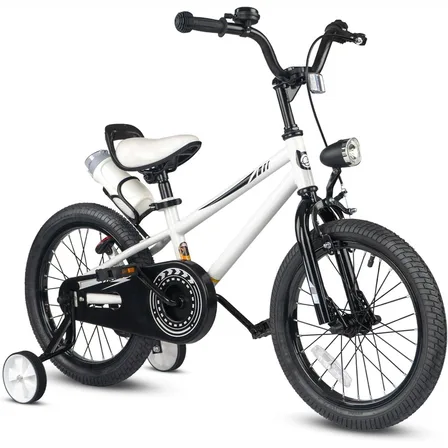
XJD Kids' Training Wheel Bike for Boys & Girls, 12/14/16 Inch – White
The XJD kids' training wheel bike in White is made for riders ages 3–8 (roughly …$169
$199