

How to learn to ride a bike for kids
To teach a child to ride a bike, choose a correctly fitted cycle, practise balance before pedalling, then add starting, braking and turning one skill at a time.
Measure the rider before choosing the bike
Measure the child’s standing height and inseam while they wear the shoes they will use for riding. Height gives you a wheel-size starting point; inseam helps you check whether the child can stand over the bike comfortably. Age is only a rough reference.
| Wheel size | Starting age | Rider height |
|---|---|---|
| 12 Inch | 3–4 | 34–40 in / 86–102 cm |
| 14 Inch | 3–6 | 37–45 in / 94–114 cm |
| 16 Inch | 4–7 | 40–48 in / 102–122 cm |
| 18 Inch | 5–9 | 43–52 in / 109–132 cm |
| 20 Inch | 7–12 | 48–60 in / 122–152 cm |
| 24 Inch | 10–14 | 54–64 in / 137–163 cm |
| 26 Inch | Youth and adults | Over 60 in / 153 cm |
These ranges are not a substitute for trying the bicycle. Do not buy an oversized bike for a child to grow into. On the actual bike, check stand-over clearance, comfortable reach to the handlebar, easy steering and reliable access to the brake controls. The child’s measured fit, control and confidence take priority over age.
Prepare a simple, low-pressure practice area
Choose a flat, open place away from traffic, parked cars, steep slopes and other obstacles. The child should wear closed-toe shoes and clothing that cannot catch in moving parts. A bicycle helmet should fit properly, sit level and have its straps adjusted according to the helmet manufacturer’s instructions.
Before every session, confirm that the bicycle is assembled and operating as described in its exact product manual. If anything feels loose, damaged or difficult to operate, stop and use a qualified bicycle mechanic rather than guessing at adjustments or torque.
Teach balance before pedalling
- Start with walking: Have the child sit on the saddle, hold the handlebar and move the bike forward with their feet. They should look ahead rather than down.
- Practise short glides: Once walking feels controlled, encourage a gentle push followed by a moment with both feet lifted. Let the child put a foot down whenever balance fades.
- Add steering: Place two visible markers far apart and ask the rider to make wide, gradual turns between them. Avoid tight turns until balance is consistent.
- Introduce the pedals: When the child can glide and steer, place one pedal in a useful starting position, push away and begin pedalling. Support the child lightly at the torso if needed; do not pull the handlebar.
Keep sessions short enough that attention and confidence remain intact. Several calm attempts are more useful than continuing after the rider becomes tired or frustrated.
Make stopping a separate skill
Show the child how their particular bicycle stops, following its manual. Before riding farther, have them practise applying the available brake controls while stationary and confirm that they can reach and operate them without changing to an unstable hand position.
Next, ask the child to ride a short, straight line and stop at a marker. Repeat at walking speed until they can stop predictably, put a foot down and remain in control. Increase distance or speed only after the child can start, steer and stop without panic.
How the supplied XBikes options compare
The catalog options help by providing concrete wheel-size comparison points: one model spans early learning sizes and includes training wheels, while two cruiser listings cover larger 20-, 24- or 26-inch choices for taller, more confident riders. Fit still has to be checked on the selected SKU.
 Pink 12/14/16/20" XJD Girls Bike with Training Wheels & Basket
A directly relevant learning comparison with 12-, 14-, 16- and 20-inch labels plus training wheels. Choose the label from measured height, then verify stand-over, reach, brake control and confidence.
 26-Inch XJD Beach Cruiser Bike for Girls – Purple, V-Brake
A cruiser comparison offering 20-, 24- and 26-inch labels in supplied color combinations. It is relevant only for a child whose measured size and individual control suit the selected SKU.
 XJD 24-Inch Green Beach Cruiser Bike with U-Brake
A taller-rider cruiser comparison available in 24-inch and 26-inch labels. Consider it only after matching measured height to the XBikes starting points and checking reach, stand-over and brake control.
Pink 12/14/16/20" XJD Girls Bike with Training Wheels & Basket is the most directly relevant learning comparison because its available labels are 12 Inch, 14 Inch, 16 Inch and 20 Inch, and it is categorized as a training-wheel bike. Select among those labels from measured height, then verify stand-over, reach and brake control on the actual bicycle. Training wheels can support early pedalling confidence, but they do not replace balance practice.
26-Inch XJD Beach Cruiser Bike for Girls – Purple, V-Brake has Mint Green options in 20, 24 and 26 Inch, Pink options in 20, 24 and 26 Inch, and Purple in 26 Inch. Its 20-inch labels begin at the 48–60 in / 122–152 cm starting range; 24-inch labels begin at 54–64 in / 137–163 cm; 26-inch labels are for riders over 60 in / 153 cm. It is relevant only when the child’s measurements, reach, brake access and confidence support the chosen size.
XJD 24-Inch Green Beach Cruiser Bike with U-Brake is available as Green / 24 Inch, Pink / 24 Inch and Pink / 26 Inch. Use it as a comparison for a taller learner: 24 Inch starts at 54–64 in / 137–163 cm, while 26 Inch starts above 60 in / 153 cm. The title’s brake wording identifies the model, but the child must still demonstrate comfortable control.
Know when to remove support
If using training wheels, follow the bicycle’s manual for installation, adjustment and removal. They remain relevant while the child is learning to pedal and steer, but independent riding requires balance. Move toward unsupported gliding when the rider repeatedly looks ahead, steers without abrupt corrections and stops on request.
Your next step is specific: record height and inseam, shortlist the matching wheel-size label, conduct an individual fit check, then begin with walking and gliding before asking the child to pedal independently.
Bikes for your next adventure
-

Black XJD Kids Bike for Boys – 12, 14 & 16 Inch Sizes
For a son between roughly 3 and 8 years old, the XJD Kids Bike in Black covers t…$169
$199 -

Blue XJD Girls Bike with Training Wheels – 12/14/16 Inch
If you're shopping for a first pedal bike for a daughter roughly 3 to 8 years ol…$149
$169 -
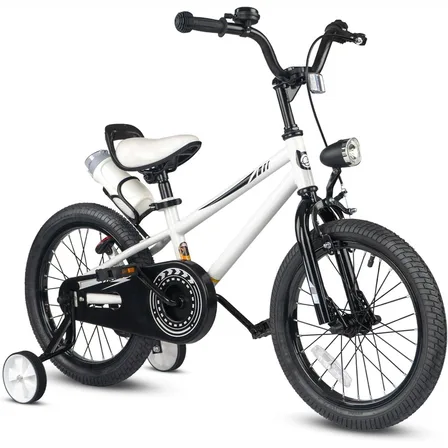
XJD Kids' Training Wheel Bike for Boys & Girls, 12/14/16 Inch – White
The XJD kids' training wheel bike in White is made for riders ages 3–8 (roughly …$169
$199