

How to pick a bike for a kid
Pick a child’s bike by measuring height and inseam, then checking stand-over clearance, reach, brake control and confidence on the actual bike.
Measure the rider before comparing bikes
Start with the child’s current height, measured without shoes against a wall. Then measure inseam from the floor to the crotch while the child stands straight. Age can suggest where to begin, but height and an individual fit check should decide the size.
Bring those measurements when shopping. Have the child try each candidate rather than ordering a larger bike for future growth. An oversized bicycle can make starting, stopping, steering and dismounting harder to control.
Use wheel size only as a starting point
| Wheel size | Starting age | Rider height |
|---|---|---|
| 12 Inch | 3–4 | 34–40 in / 86–102 cm |
| 14 Inch | 3–6 | 37–45 in / 94–114 cm |
| 16 Inch | 4–7 | 40–48 in / 102–122 cm |
| 18 Inch | 5–9 | 43–52 in / 109–132 cm |
| 20 Inch | 7–12 | 48–60 in / 122–152 cm |
| 24 Inch | 10–14 | 54–64 in / 137–163 cm |
| 26 Inch | Youth and adults | Over 60 in / 153 cm |
Overlapping ranges are intentional: two children of the same height may differ in inseam, arm length and confidence. If the measurement falls between sizes, compare both on the ground instead of automatically choosing the larger wheel.
Check the fit on the actual bike
- Stand-over: Ask the child to straddle the bicycle with both feet flat on the floor. The frame should not prevent a comfortable, controlled stand-over position.
- Seated position: Confirm that the seat can be adjusted for the child according to the product manual. The rider should be able to start and stop without feeling trapped or stretched.
- Reach: With hands on the handlebar, the child should not have to lunge forward, lock the elbows or twist away from a natural position.
- Brake control: If the bicycle has hand-operated brakes, the child must be able to reach and operate them confidently. Check every control present on the exact model.
- Low-speed control: Let the child demonstrate starting, steering, stopping and getting off in a clear, supervised area.
A bike is too large if the rider cannot stand over it comfortably, reach its controls or stop predictably. It may be too small if the permitted adjustments still leave the child cramped. Use the exact product manual or a qualified bicycle mechanic for adjustment procedures, compatibility, assembly, maintenance, load limits and torque.
Match the bike to current confidence
Size and readiness are separate decisions. A child within a wheel-size range may still need a more familiar learning setup, while another may already manage starts, turns and stops independently. Choose for the skills the rider can show now, not the skills you expect after growing into the bicycle.
Training-wheel models are relevant when a correctly fitted 12-, 14- or 16-inch option suits the child’s measurements and current learning needs. They are not relevant when the fit check points to another wheel size, or when the intended riding setup does not call for a training-wheel bicycle.
Compare the supplied 12-, 14- and 16-inch options
The three catalog choices below help because each is a training-wheel bicycle offered in 12 Inch, 14 Inch and 16 Inch SKU labels. This makes it possible to compare the same three wheel-size starting points after measuring the rider; the supplied facts distinguish their titles and color descriptions, not their fit geometry, components or performance.
 XJD Boys 12/14/16" Training Wheel Bike – Blue
A training-wheel bike offered in 12 Inch, 14 Inch and 16 Inch labels. Consider it only when the rider’s measurements and an individual control check support one of those sizes.
 Black XJD Kids Bike for Boys – 12, 14 & 16 Inch Sizes
This black Training Wheel Bikes option comes in 12 Inch, 14 Inch and 16 Inch labels. Its title is not fit evidence; measured height, inseam, reach and control should determine relevance.
 XJD Kids' Training Wheel Bike for Boys & Girls, 12/14/16 Inch – White
A white training-wheel model with 12 Inch, 14 Inch and 16 Inch SKU labels. It is relevant when one of those starting ranges matches and the child confirms a comfortable, controlled fit.
- XJD Boys 12/14/16" Training Wheel Bike – Blue is listed in Training Wheel Bikes with 12 Inch, 14 Inch and 16 Inch options.
- Black XJD Kids Bike for Boys – 12, 14 & 16 Inch Sizes is also listed in Training Wheel Bikes and offers those same three size labels.
- XJD Kids' Training Wheel Bike for Boys & Girls, 12/14/16 Inch – White has the same listed category and available size labels.
Words such as “boys,” “girls” or “kids” in these catalog titles do not establish fit. Select among them only after the appropriate size label has been narrowed by measured height and confirmed through stand-over, reach, brake control and a real tryout. Consult each exact product page and manual for details not supplied here.
Make the final decision
Write down the child’s height and inseam, identify the likely wheel sizes in the table, and have the child try those sizes. Buy only when one option lets the rider stand over, reach, steer and brake with control at today’s confidence level. Finish by fitting a bicycle helmet so it sits level and its straps follow the helmet manufacturer’s instructions.
Bikes for your next adventure
-
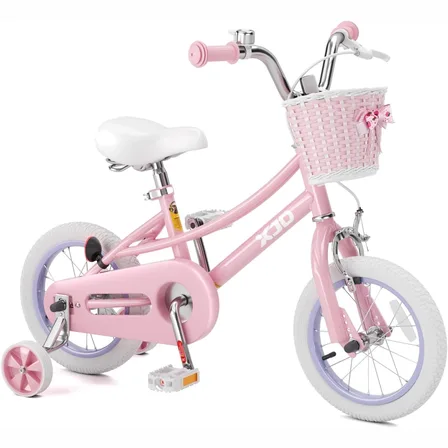
Pink 12/14/16/20" XJD Girls Bike with Training Wheels & Basket
The Pink XJD Girls Bike with Training Wheels & Basket is a first-bike pick f…$65.99
$75.99 -

Light Pink XJD Girls' Bicycle with Basket & Training Wheels
The Light Pink XJD Girls' Bicycle with Basket & Training Wheels is a retro-style…$109.99
$129.99 -

Black XJD Kids Bike for Boys – 12, 14 & 16 Inch Sizes
For a son between roughly 3 and 8 years old, the XJD Kids Bike in Black covers t…$169
$199