

How to pick a bike for kids
Pick a kids’ bike by measuring the child’s height and inseam, then confirm stand-over room, comfortable reach, brake control and confidence on the actual bike.
Measure the rider before comparing bikes
Start with the child’s current height, measured without shoes against a wall. Then measure inseam from the floor to the crotch while the child stands naturally. Height identifies a sensible wheel-size starting point; inseam helps you judge whether the child can stand over the frame comfortably.
Do not choose by age alone. Children of the same age can differ substantially in height, proportions, coordination and confidence. Record the measurements rather than relying on clothing size or a previous bike.
Use wheel size as a starting point
| Wheel size | Age starting point | Rider-height starting point |
|---|---|---|
| 12 Inch | Ages 3–4 | 34–40 in / 86–102 cm |
| 14 Inch | Ages 3–6 | 37–45 in / 94–114 cm |
| 16 Inch | Ages 4–7 | 40–48 in / 102–122 cm |
| 18 Inch | Ages 5–9 | 43–52 in / 109–132 cm |
| 20 Inch | Ages 7–12 | 48–60 in / 122–152 cm |
| 24 Inch | Ages 10–14 | 54–64 in / 137–163 cm |
| 26 Inch | Youth and adults | Over 60 in / 153 cm |
These ranges overlap intentionally. If the rider falls within more than one row, compare both candidate sizes through an individual fit check. The larger option is not automatically more economical or appropriate.
Check the child on the actual bike
Have the child try the bicycle rather than treating the chart as a final answer. The American Academy of Pediatrics advises against buying an oversized bicycle simply for future growth. A bike that is too large can make starting, stopping and steering harder to manage now.
- Stand-over: Ask the child to straddle the frame with both feet planted. The frame should not prevent a comfortable, stable stance.
- Reach: With hands on the controls, look for a natural position rather than locked arms, an extreme forward stretch or difficulty turning the handlebar.
- Brake control: Confirm the child can reach and operate the bicycle’s braking controls reliably without shifting into an unstable hand position.
- Movement: Check whether the rider can get on, start, steer, stop and get off while remaining composed and in control.
- Confidence: Notice hesitation as well as physical fit. A size that technically accommodates the rider may still be inappropriate if it overwhelms their current ability.
If any of these checks fail, compare another size or configuration. Do not assume an adjustment will solve the problem unless the exact product manual permits it.
When the supplied bike is relevant
The Black XJD Kids Bike for Boys – 12, 14 & 16 Inch Sizes is listed as a Training Wheel Bike with 12 Inch, 14 Inch and 16 Inch SKU labels. It is relevant when the rider’s measured height points toward one of those three starting sizes and a training-wheel configuration suits the child’s current confidence. These catalog options make it possible to compare adjacent size labels while applying the same fit checks.

For orientation, the 12 Inch label corresponds to the 34–40 in / 86–102 cm starting range, the 14 Inch label to 37–45 in / 94–114 cm, and the 16 Inch label to 40–48 in / 102–122 cm. The product title and SKU label do not prove fit; the child must still try the selected bike.
This supplied product is not the relevant comparison when measurements point to 18 Inch, 20 Inch, 24 Inch or 26 Inch wheels. It may also be unsuitable when the child does not need or want a training-wheel configuration, or cannot achieve comfortable stand-over, reach, brake operation and control on it.
Compare what the catalog does not establish
The supplied facts do not establish weight, materials, brake type, load limits, compatibility, assembly details or adjustment procedures. Inspect the actual bicycle and consult its exact product manual for those matters. Use a qualified bicycle mechanic when assembly, adjustment, maintenance or compatibility is uncertain, and follow the manual for every specified procedure or torque requirement.
Also check that the chosen bicycle suits where the child will ride and that its controls are understandable to the rider. Those practical checks should happen before purchase or use, not after the child has committed to a size.
Complete the decision safely
Select a properly fitting bicycle helmet at the same time. The U.S. Consumer Product Safety Commission advises that the helmet fit properly, sit level on the head and use its straps according to the helmet manufacturer’s instructions.
Your next step is simple: measure height and inseam, shortlist the matching wheel-size rows, and have the child try those sizes. Choose only the bike on which the child can stand over, reach, brake, steer, start and stop comfortably today—never the oversized one intended merely to last longer.
Bikes for your next adventure
-
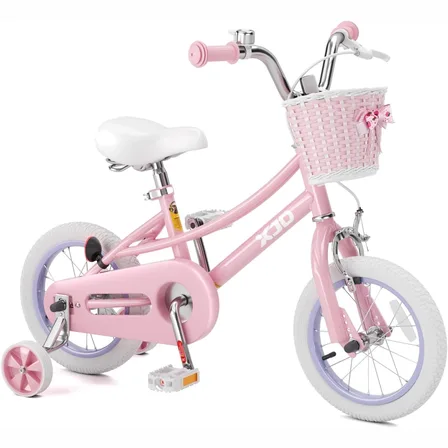
Pink 12/14/16/20" XJD Girls Bike with Training Wheels & Basket
The Pink XJD Girls Bike with Training Wheels & Basket is a first-bike pick f…$65.99
$75.99 -

Light Pink XJD Girls' Bicycle with Basket & Training Wheels
The Light Pink XJD Girls' Bicycle with Basket & Training Wheels is a retro-style…$109.99
$129.99 -

Black XJD Kids Bike for Boys – 12, 14 & 16 Inch Sizes
For a son between roughly 3 and 8 years old, the XJD Kids Bike in Black covers t…$169
$199