

How to pick bike for child
Pick a child’s bike by measuring height and inseam, narrowing the wheel size, then checking stand-over clearance, reach, braking and control in person.
Measure the child before choosing a size
Start with the child’s current measurements, not the size they may grow into. Measure total height without shoes. Then measure inseam from the floor to the crotch while the child stands straight with feet slightly apart. Record both measurements and take them to the fit check.
Height provides a wheel-size starting point. Inseam helps you judge whether the child can stand over the bicycle comfortably. Age is only a rough reference because children of the same age can differ substantially in proportions, reach and confidence.
Use wheel size only as a starting point
| Wheel size | Age guide | Rider-height guide |
|---|---|---|
| 12 Inch | 3–4 | 34–40 in / 86–102 cm |
| 14 Inch | 3–6 | 37–45 in / 94–114 cm |
| 16 Inch | 4–7 | 40–48 in / 102–122 cm |
| 18 Inch | 5–9 | 43–52 in / 109–132 cm |
| 20 Inch | 7–12 | 48–60 in / 122–152 cm |
| 24 Inch | 10–14 | 54–64 in / 137–163 cm |
| 26 Inch | Youth and adults | Over 60 in / 153 cm |
Where ranges overlap, compare both plausible sizes in person. Prioritize measured height, inseam, reach, brake control and present confidence over age alone. A larger wheel label does not prove a better fit.
Perform the fit and control check
Have the child try the bicycle. Do not buy an oversized model merely to allow room for growth: a bike that is difficult to mount, balance, steer or stop can undermine control now.
- Check stand-over: with the child straddling the bicycle, confirm that they can stand comfortably rather than being forced onto tiptoes or against the frame.
- Check the seated position: confirm that the child can settle onto the seat and begin and finish a stop with confidence.
- Check reach: the child should reach the handlebars without stretching, locking the elbows or losing a stable posture.
- Check steering: ask the child to turn the bars both ways while remaining balanced and in control.
- Check braking: verify that the child can reach and operate the bicycle’s actual brake controls reliably. Do not assume that reaching the handlebars is enough.
If the child appears tense, cannot manage a controlled start and stop, or struggles to operate the controls, compare another size or configuration. Use a qualified bicycle mechanic if you are uncertain about fit, adjustment or assembly.
Decide whether training-wheel models are relevant
The supplied XBikes choices are relevant when you want a training-wheel bike and the child’s fit check points toward a 12, 14, 16 or 20 Inch option. They do not cover 18, 24 or 26 Inch sizes, so they are not automatically suitable for every child in the size table.
The three catalog options help answer the choice by offering the same listed wheel-size range in different exact product listings: Girls' Training Wheel Bike by XJD, 12–20 Inch Wheels – Blue; XJD Girls' Bike with Training Wheels, 12/14/16/20 Inch – Purple; and XJD Kids Bike for Girls – Pink, 12/14/16/20 Inch with Training Wheels. Each lists 12, 14, 16 and 20 Inch SKUs, so first select the size through measurement and an individual fit check, then compare the listed color and title.
 Girls' Training Wheel Bike by XJD, 12–20 Inch Wheels – Blue
Relevant when an individual fit check points to a training-wheel bike in one of its listed 12, 14, 16 or 20 Inch sizes; this listing is identified as blue.
 XJD Girls' Bike with Training Wheels, 12/14/16/20 Inch – Purple
This purple training-wheel model lists 12, 14, 16 and 20 Inch SKUs. Use the child’s measurements and control check to determine whether any listed size is appropriate.
 XJD Kids Bike for Girls – Pink, 12/14/16/20 Inch with Training Wheels
This pink kids bike includes training wheels and lists 12, 14, 16 and 20 Inch options. It is relevant only when the required size and individual fit both match.
These products are not relevant if the child needs an 18, 24 or 26 Inch starting point, does not need a training-wheel model, or cannot comfortably control the available size during a fit check. The titles and SKU labels do not establish fit by themselves.
Complete the safety and setup checks
Choose a bicycle helmet that fits the child properly. It should sit level, with its straps adjusted according to the helmet manufacturer’s instructions. Recheck the fit rather than relying only on an age label or nominal helmet size.
Before riding, follow the exact bicycle manual for assembly, adjustments, maintenance, compatibility, load limits and torque requirements. None of those specifications is supplied here, so do not guess. Ask a qualified bicycle mechanic to assemble or inspect the bike when the instructions are unclear or the setup cannot be verified.
Make the final size decision
Measure height and inseam today, shortlist the matching wheel sizes, and have the child try them. Choose only the size on which the child has comfortable stand-over clearance, a relaxed reach, reliable access to the brakes and confident control; if none passes, keep looking rather than sizing up for future growth.
Bikes for your next adventure
-
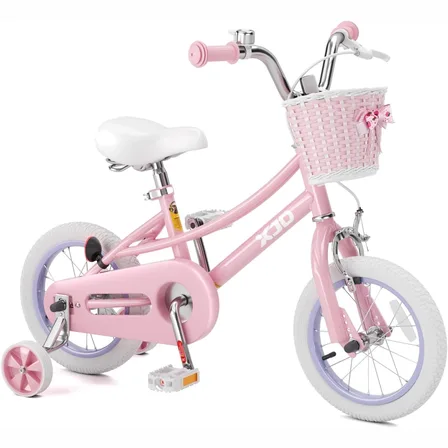
Pink 12/14/16/20" XJD Girls Bike with Training Wheels & Basket
The Pink XJD Girls Bike with Training Wheels & Basket is a first-bike pick f…$65.99
$75.99 -

Light Pink XJD Girls' Bicycle with Basket & Training Wheels
The Light Pink XJD Girls' Bicycle with Basket & Training Wheels is a retro-style…$109.99
$129.99 -

Black XJD Kids Bike for Boys – 12, 14 & 16 Inch Sizes
For a son between roughly 3 and 8 years old, the XJD Kids Bike in Black covers t…$169
$199