

How to ride a bike with toddler
To ride a bike with a toddler, first decide whether you will carry the child or help them ride their own bike. Use only equipment designed for that exact job, check fit and control, and practise away from traffic before taking a shared ride.
Choose the kind of shared ride
If the toddler will be a passenger, use a child-carrying setup whose manufacturer explicitly confirms compatibility with your bicycle and child. That could be a compatible child seat, trailer or purpose-built family bicycle. Check the manual for assembly, load limits, attachment points and operating instructions; if anything is unclear, use a qualified bicycle mechanic.
Do not improvise a passenger position on handlebars, a rack or another part of the bicycle. Before every trip, confirm that the child restraint and all attachment hardware are secure, then make sure clothing, straps, hands and feet cannot contact moving parts.
If the toddler will ride a separate bicycle, the task is different: measure the child, choose a size they can control now, and begin in a quiet, level area. An adult can walk beside the child before attempting a family ride.
Measure before choosing a toddler bike
Record the child’s standing height and inseam. Age is only a starting point, and wording in a product title is not proof of fit. Have the child try the bicycle rather than buying an oversized model for future growth.
| Wheel size | XBikes starting age | Rider height |
|---|---|---|
| 12 Inch | 3–4 | 34–40 in / 86–102 cm |
| 14 Inch | 3–6 | 37–45 in / 94–114 cm |
| 16 Inch | 4–7 | 40–48 in / 102–122 cm |
These ranges are comparison points, not a substitute for trying the bike. Check that the child can stand over it appropriately, reach the controls without stretching, operate the brakes, steer comfortably and remain confident while starting and stopping.
When the supplied bicycle is relevant
The XJD Pink Girls' Bike – Kids 12/14/16 Inch Training Wheel Bicycle is relevant only when the toddler or young child will ride independently with adult supervision. Its available labels—12 Inch, 14 Inch and 16 Inch—let you compare the child’s measured height with the XBikes starting points above. It is not described in the supplied catalog facts as a passenger carrier, child seat, trailer or adult bicycle, so it should not be treated as equipment for carrying a toddler.
These catalog options help answer the title by providing three training-wheel bicycle sizes for a child learning to ride alongside an adult, while making the passenger-versus-rider distinction clear.
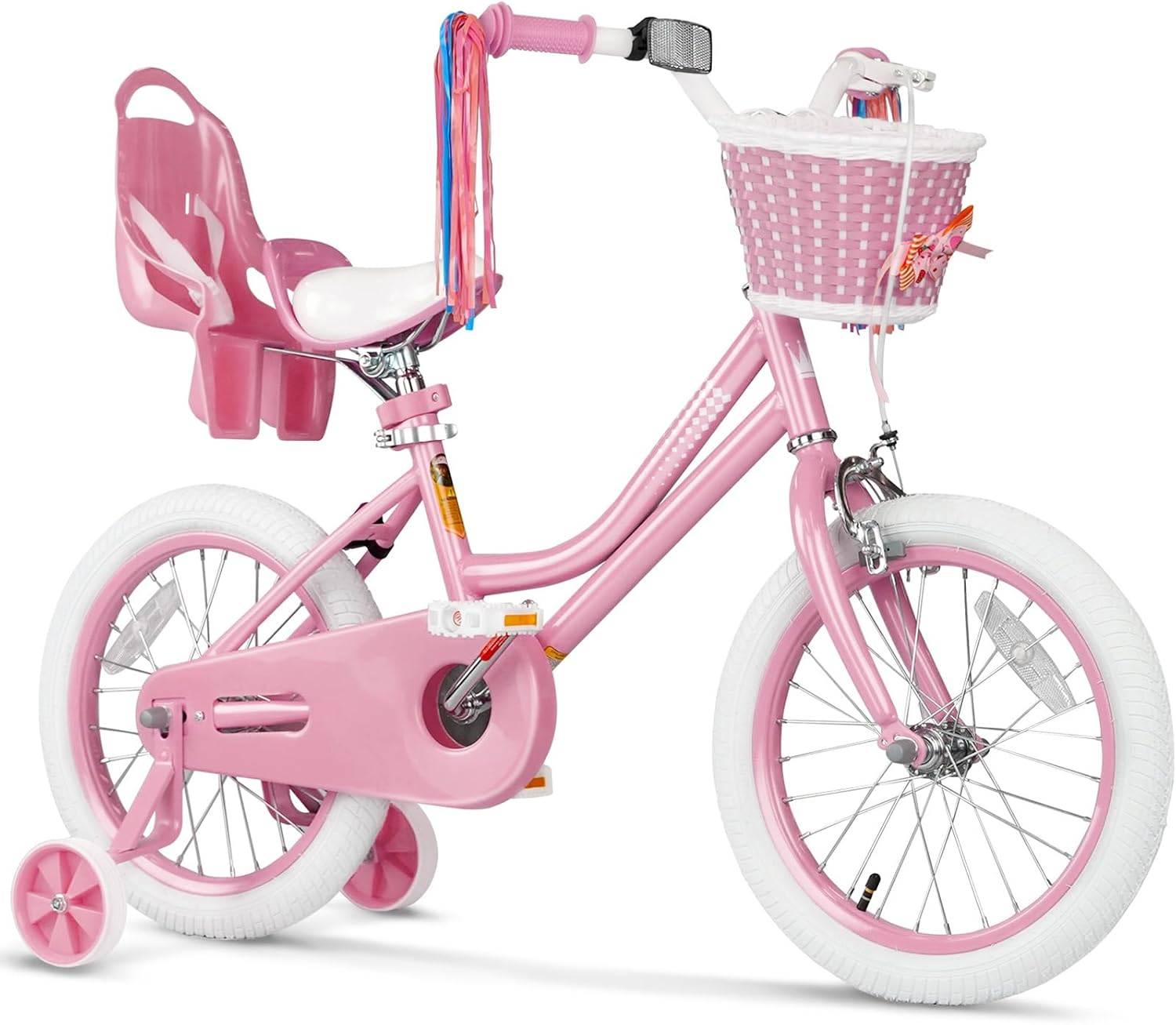
Choose among those labels only after an individual fit check. For assembly, maintenance, adjustment, compatibility and torque instructions, follow the exact product manual or ask a qualified bicycle mechanic.
Fit helmets and check both riders
Each rider should use a bicycle helmet that fits properly, sits level and has straps adjusted according to the helmet manufacturer’s instructions. A helmet that tips backward, slides around or uses loose straps needs correction before riding.
For a child riding their own bicycle, verify that they can:
- mount and dismount without being lifted into an unstable position;
- look ahead while steering a predictable line;
- reach and operate the brakes while keeping control;
- stop when asked and wait for the adult’s signal.
For a toddler travelling as a passenger, follow the carrier manufacturer’s child-fit requirements exactly. A bicycle size chart does not establish whether a child is ready or eligible to use passenger equipment.
Practise the complete routine
- Inspect both bicycles or the approved passenger setup using the applicable manuals.
- Fit helmets and secure any manufacturer-provided restraint.
- Practise mounting, starting, turning, braking and stopping in a traffic-free space.
- Use a simple instruction such as “stop and wait,” and confirm the child responds consistently.
- Begin with a short route where you can stop easily; avoid complex conditions until control is reliable.
Training wheels can assist early balance support, but they do not replace the child’s ability to steer, brake and follow directions. Stay close enough to intervene during practice, and stop if the child becomes tired, distracted or frightened.
Make the go-or-wait decision
Ride together only when the toddler is secured in manufacturer-approved passenger equipment or can control a correctly fitted bicycle, and both helmets fit properly. If reach, braking, restraint compatibility or confidence remains uncertain, postpone the ride, consult the relevant manual or mechanic, and repeat the fit check before trying again.
Bikes for your next adventure
-

Kids Bike Helmet by XJD for Boys & Girls – Black, Blue, Green, Pink, Purple
The XJD Kids Bike Helmet covers a wide 2-to-8-year age range thanks to two head-…$59.99
-

Kids Bike Helmet by XJD for Girls – Pink
The XJD Kids Bike Helmet in Pink is a lightweight multi-sport helmet for girls r…$59.99
$99 -

XJD Kids Bike for Girls – Pink, 12/14/16/20 Inch with Training Wheels
The XJD Kids Bike for Girls in Pink is a training-wheel bike built to carry your…$139
$159