

How to ride bike video older kid learning
For an older kid learning to ride, measure height and inseam first, confirm the bike fits, then practise balance, braking, starts and turns in that order.
Measure before choosing a practice bike
Have the child wear normal riding shoes. Measure total height against a wall and inseam from the floor to the crotch. Then have the child try the actual bicycle; age is only a starting point.
Check that the child can stand over the bike without being forced onto tiptoes, reach the handlebar without stretching, steer comfortably and operate the brakes with control. Do not buy an oversized bicycle merely to allow room for growth. If the child cannot manage the bike while stationary, it is not suitable for learning sessions.
Compare the measurement with wheel-size starting points
| Wheel size | Starting age | Rider height |
|---|---|---|
| 12 Inch | 3–4 | 34–40 in / 86–102 cm |
| 14 Inch | 3–6 | 37–45 in / 94–114 cm |
| 16 Inch | 4–7 | 40–48 in / 102–122 cm |
| 18 Inch | 5–9 | 43–52 in / 109–132 cm |
| 20 Inch | 7–12 | 48–60 in / 122–152 cm |
| 24 Inch | 10–14 | 54–64 in / 137–163 cm |
| 26 Inch | Youth and adults | Over 60 in / 153 cm |
Overlapping ranges are intentional starting points, not proof of fit. Prioritize measured height, inseam, reach, brake control and current confidence. An older beginner may need a 20-, 24- or 26-inch bicycle, but only an individual fit check can settle the choice.
Use this learn-to-ride sequence like a video
- Prepare: Choose a flat, open area away from traffic, obstacles and steep slopes. Fit the helmet level on the head and adjust its straps according to the helmet manufacturer’s instructions.
- Check control: Ask the child to stand over the bike, hold it upright, turn the handlebar and demonstrate the brakes before moving.
- Learn balance: Let the child move at a comfortable pace while looking ahead. Keep each attempt short and reset calmly after a wobble.
- Add braking: Mark an easy stopping point and have the rider slow and stop under control. Repeat until stopping is deliberate rather than a panic reaction.
- Practise starts: Have the child set a pedal in a strong starting position, look forward and push away. Support the rider only as much as necessary; do not pull the handlebar.
- Add wide turns: Use generous loops before attempting tighter steering. Finish with a controlled stop.
Repeat the stage that is inconsistent instead of rushing ahead. A child who is anxious, cannot stop reliably or loses control when turning needs more practice at the previous stage or a fresh fit check.
When the supplied bikes are relevant
The Black XJD Kids' BMX Bicycle with Training Wheels is listed in 12 Inch, 14 Inch and 16 Inch sizes. The Pink Girls' 12/14/16" Bike by XJD – Basket & Doll Seat is also listed in 12 Inch, 14 Inch and 16 Inch sizes, under Training Wheel Bikes. These options help parents compare the upper end of smaller learning-bike sizes and whether a training-wheel format is relevant.
 Black XJD Kids' BMX Bicycle with Training Wheels
Available in 12, 14 and 16 Inch labels, this kids' BMX bike with training wheels is relevant only if the rider’s measurements and individual fit support one of those sizes.
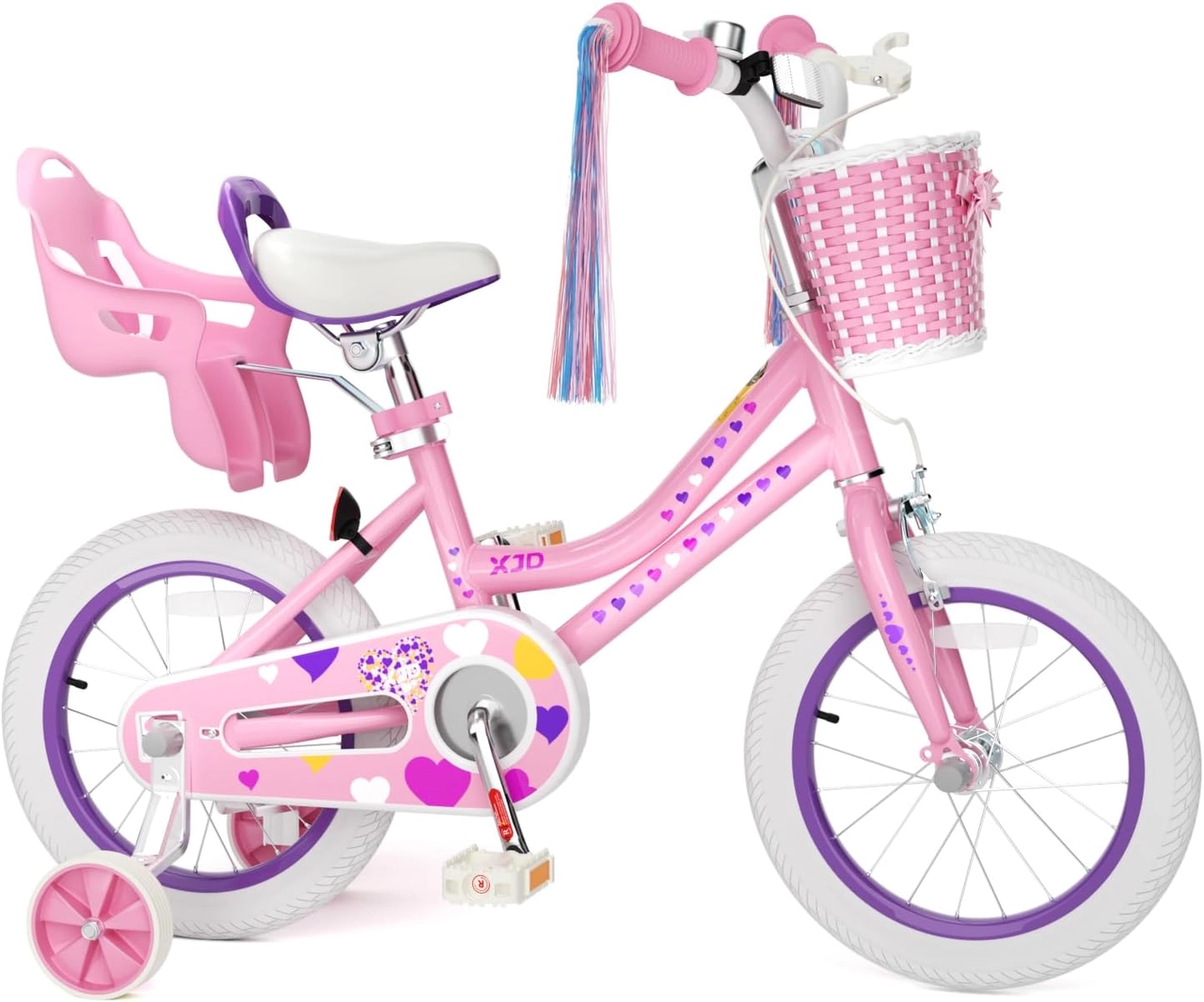 Pink Girls' 12/14/16" Bike by XJD – Basket & Doll Seat
This training-wheel bike is available in 12, 14 and 16 Inch labels. Compare it only when the older beginner fits those starting ranges and can demonstrate suitable stand-over, reach and brake control.
For an older child whose measurements indicate 18, 20, 24 or 26 inches, neither supplied product has that exact wheel size. They are nearest-size comparison points only, not substitutes; a 16-inch bicycle is not equivalent to a larger required size. Even when the child falls within a 12-, 14- or 16-inch starting range, confirm stand-over clearance, reach and brake operation on the actual bicycle.
Know when to pause or get help
Stop the session if the helmet shifts out of position, the child cannot reach or control the brakes, the bicycle seems too tall or cramped, or steering and stopping remain unpredictable. Recheck measurements and actual fit before continuing.
For assembly, adjustment procedures, maintenance, load limits, compatibility and torque settings, follow the exact bicycle manual. If instructions are missing or the bike does not operate correctly, use a qualified bicycle mechanic rather than guessing.
Make the next decision
Measure the older rider today, identify the matching wheel-size starting range, and try that size in person. Proceed with the learning sequence only when the child can stand over, reach, steer and brake confidently; otherwise choose a better-fitting size before the next practice.
Bikes for your next adventure
-

Blue XJD Freestyle BMX Bike, 20-Inch – No Pegs
The XJD 20-Inch Blue Freestyle BMX is an entry-level BMX bike for boys and girls…$189.99
-

Kids Bike Helmet by XJD for Boys & Girls – Black, Blue, Green, Pink, Purple
The XJD Kids Bike Helmet covers a wide 2-to-8-year age range thanks to two head-…$59.99
-

Kids Bike Helmet by XJD for Girls – Pink
The XJD Kids Bike Helmet in Pink is a lightweight multi-sport helmet for girls r…$59.99
$99