

How to take bikes for toddler
To take a bike for a toddler, measure the child’s height and inseam, then choose the smallest wheel size they can stand over, reach and control comfortably.
Measure the child before choosing
Begin with the rider, not the age printed on a box or product name. Measure height without shoes. For the inseam, have the child stand upright with feet slightly apart and measure from the floor to the crotch. Record both measurements rather than relying on memory.
These numbers narrow the search, but they do not prove that a bicycle fits. Body proportions differ: two children of equal height can have different leg lengths, arm reach and hand strength. The child must therefore try the actual bicycle whenever possible.
Use wheel size only as a starting point
For the toddler and early-childhood sizes relevant here, XBikes uses these starting points:
| Wheel size | Age starting point | Rider-height starting point |
|---|---|---|
| 12 Inch | 3–4 | 34–40 in / 86–102 cm |
| 14 Inch | 3–6 | 37–45 in / 94–114 cm |
| 16 Inch | 4–7 | 40–48 in / 102–122 cm |
Prioritize measured height over age. A child below 34 inches / 86 cm falls outside the supplied starting range for these bicycles, so none of the listed sizes can be recommended from this table alone. Likewise, do not move up a size merely because the child is close to a birthday or you want room for growth.
Check the fit on the actual bicycle
Have the child wear the shoes they will ride in and check these points:
- Stand-over: the child should be able to straddle the bicycle without the frame preventing stable contact with the ground.
- Reach: the child should hold the handlebar without stretching, locking the elbows or leaning excessively forward.
- Brake control: if the bicycle has hand controls, confirm the child can reach and operate them as directed in that model’s manual.
- Starting and stopping: the rider should be able to mount, start, steer, slow and stop without losing control.
- Confidence: hesitation, rigid posture or difficulty following simple stopping directions means the fit or bicycle type needs reconsideration.
Do not buy an oversized bicycle for future growth. A larger wheel may match an age band while still making stand-over, reach or stopping difficult today.
Compare the two supplied catalog options
The Black XJD Kids' BMX Bicycle with Training Wheels is categorized as a Kids’ BMX Bike and is offered with 12 Inch, 14 Inch and 16 Inch SKU labels. The Pink Girls' 12/14/16" Bike by XJD – Basket & Doll Seat is categorized as a Training Wheel Bike and has the same three wheel-size labels. These particular options help because their size choices cover the supplied 12-, 14- and 16-inch starting ranges, allowing a comparison after the child has been measured.
 Black XJD Kids' BMX Bicycle with Training Wheels
Relevant when an individual fit check supports one of its supplied 12 Inch, 14 Inch or 16 Inch options. It is categorized as a Kids’ BMX Bike and includes training wheels in its catalog title.
 Pink Girls' 12/14/16" Bike by XJD – Basket & Doll Seat
Relevant when the rider fits its supplied 12 Inch, 14 Inch or 16 Inch option after measuring and trying the bicycle. It is categorized as a Training Wheel Bike; the title also identifies a basket and doll seat.
Choose between them only after identifying the likely wheel size and completing an individual fit check. The supplied facts do not establish differences in weight, frame dimensions, brakes, adjustability or component quality, so do not infer those details from the titles or categories. Confirm them in the exact product listing and manual if they affect your decision.
Know when these products are not relevant
Neither product is automatically suitable simply because the rider is called a toddler. They are not supported by the supplied fit standard when the child is shorter than the 12-inch starting range, cannot stand securely over the bicycle, cannot comfortably reach its controls, or lacks the confidence to start and stop under close supervision.
A product may also be unsuitable if the child’s proportions do not match its actual geometry, even when height falls within a listed range. In that case, try another size or design rather than forcing the fit. For assembly, maintenance, load limits, compatibility and torque settings, follow the exact product manual or use a qualified bicycle mechanic.
Prepare for the first ride
Before riding, inspect the assembled bicycle according to its manual and select a level area away from traffic and obstacles. Provide close adult supervision. A bicycle helmet must fit properly, sit level on the head and use its straps according to the helmet manufacturer’s instructions.
The next step is simple: measure height and inseam today, use the table to shortlist a wheel size, and let the child try that exact bicycle. Take it only if stand-over, reach, braking and confident control all work now—not after the child grows.
Bikes for your next adventure
-
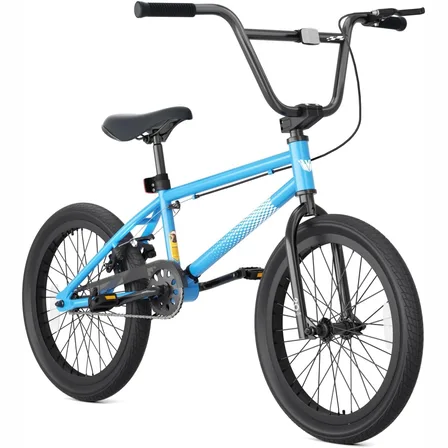
Blue XJD Freestyle BMX Bike, 20-Inch – No Pegs
The XJD 20-Inch Blue Freestyle BMX is an entry-level BMX bike for boys and girls…$189.99
-

Light Pink XJD Girls' Bicycle with Basket & Training Wheels
The Light Pink XJD Girls' Bicycle with Basket & Training Wheels is a retro-style…$109.99
$129.99 -

Flower Pink XJD Girls Bike with Doll Seat & Basket
The XJD Flower Pink girls' bike is made for riders 71–122 cm tall (roughly ages …$69.99