

How to teach a kid to ride a dirt bike
Teach a kid to ride a dirt bike by fitting the bike first, rehearsing every control with the power off, then practicing starts, stops and wide turns in a flat, closed riding area under direct adult supervision.
Measure the rider before teaching
Measure the child’s standing height and inseam, then check the actual dirt bike together. The rider needs a stable mounting and stopping position, a comfortable reach to the handlebar, and enough hand strength and reach to operate the brakes and other controls without stretching or changing grip.
Do not choose an oversized machine simply to allow room for growth. Age labels are only starting points; measured fit, control reach and the child’s current confidence matter more. Because no numerical dirt-bike fit standard is supplied here, use the manufacturer’s fit guidance for the exact model and have a qualified dealer or instructor assess any uncertain fit.
Prepare the bike, equipment and practice area
Use a properly fitting bicycle or powersports helmet appropriate to the activity. A helmet should sit level and its straps should be adjusted according to the helmet manufacturer’s instructions. Add the protective clothing and equipment required by the dirt-bike manufacturer, riding facility and applicable local rules.
Before every session, follow the exact bike manual’s inspection and operating procedures. If assembly, maintenance, control adjustment, fastener torque or load limits are unclear, stop and use a qualified mechanic. Practice only in a legal, closed area away from traffic, pedestrians, fixed obstacles and uncontrolled riders.
Teach the controls with the power off
Have the child identify and operate each control while the bike cannot move under power. Depending on the exact model, this may include the brakes, power or engine stop control, throttle or power control, and any transmission controls. Use the manual’s names and operating sequence rather than assuming every dirt bike works alike.
Ask the rider to demonstrate three things before proceeding: a relaxed riding position, immediate release of the power control, and a deliberate stop. If the child cannot reach or operate a control consistently, adjust the bike only as its manual permits or change to a better-fitting model.
Build the first ride one skill at a time
- Walk the route: Show the start point, stopping point and boundaries before powering the bike.
- Practice controlled starts: Use the lowest beginner setting provided by the exact model, if it has one, and follow its manual.
- Stop on command: Keep each attempt short and finish with a planned, controlled stop.
- Add straight runs: Continue only when starts and stops are repeatable without panic or abrupt inputs.
- Introduce wide turns: Use generous space and one direction at a time before combining turns into a simple course.
Stay close enough to supervise without standing in the bike’s path. End the session when attention, grip or control begins to deteriorate. Hills, jumps, loose technical terrain and other riders add difficulty; leave them for instruction appropriate to the child’s demonstrated ability.
Know when bicycle practice is relevant
A pedal bicycle can help a child rehearse looking ahead, steering, braking and following boundaries without dirt-bike power. However, a training-wheel bicycle does not reproduce dirt-bike balance, power delivery, weight or controls, so it is preparation rather than a dirt-bike substitute.
The XJD Girls' Bike with Training Wheels, 12/14/16/20 Inch – Purple is relevant only as a pedal-bicycle practice or fit-comparison option. Its supplied choices are 12 Inch, 14 Inch, 16 Inch and 20 Inch, all within the Training Wheel Bikes category; none is an equivalent wheel-size recommendation for a dirt bike.

Compare the listed bicycle sizes correctly
| Bicycle wheel label | XBikes starting point |
|---|---|
| 12 Inch | Ages 3–4; height 34–40 in / 86–102 cm |
| 14 Inch | Ages 3–6; height 37–45 in / 94–114 cm |
| 16 Inch | Ages 4–7; height 40–48 in / 102–122 cm |
| 20 Inch | Ages 7–12; height 48–60 in / 122–152 cm |
These are bicycle starting points, not proof of fit and not dirt-bike sizing. Have the child try the bicycle and check stand-over clearance, reach, brake operation and confidence. If two ranges overlap, choose by actual control and fit rather than age alone.
Decide whether to continue
Continue only when the child can name the controls, release power promptly, start smoothly, stop on command and make wide turns while remaining calm. If fit is marginal, controls are difficult to reach, instructions are unclear or the rider freezes, postpone powered practice and get help from a qualified youth dirt-bike instructor or mechanic. The next step is a repeatable controlled stop—not more speed.
Bikes for your next adventure
-

Blue XJD Freestyle BMX Bike, 20-Inch – No Pegs
The XJD 20-Inch Blue Freestyle BMX is an entry-level BMX bike for boys and girls…$189.99
-
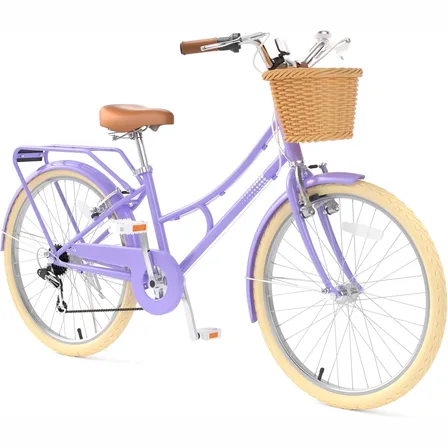
24-Inch Purple XJD Beach Cruiser Bike with U-Brake
The XJD 24-Inch Purple Beach Cruiser is built for girls and young women roughly …$159.99
-

XJD 24-Inch Green Beach Cruiser Bike with U-Brake
This XJD 24-inch beach cruiser in green is made for riders about 4'8" to 5'4" ta…$159.99
$199.99