

How to teach kid to ride dirt bike
Teach a kid to ride a dirt bike by checking fit first, then practising controls, balance, braking and smooth starts in a flat, closed area.
Measure the rider before choosing the bike
Measure the child’s standing height and inseam without shoes. Then have the child try the actual bike. They need a stable stand-over position, a comfortable reach to the controls and enough hand strength and reach to operate the brakes. Do not choose an oversized bike merely to leave room for growth.
Age is only a starting point for bicycle sizing. Measured height, inseam, reach, brake control and current confidence decide whether a bike is manageable. For a pedal bicycle, use these XBikes starting points:
| Wheel size | Starting age | Rider height |
|---|---|---|
| 12 Inch | 3–4 | 34–40 in / 86–102 cm |
| 14 Inch | 3–6 | 37–45 in / 94–114 cm |
| 16 Inch | 4–7 | 40–48 in / 102–122 cm |
| 18 Inch | 5–9 | 43–52 in / 109–132 cm |
| 20 Inch | 7–12 | 48–60 in / 122–152 cm |
| 24 Inch | 10–14 | 54–64 in / 137–163 cm |
| 26 Inch | Youth and adults | Over 60 in / 153 cm |
These figures apply to bicycle wheel sizing, not to the sizing or power selection of a motorized dirt bike. For a powered model, follow its manual and obtain model-specific instruction.
Set up a controlled first lesson
Use a level, open area closed to vehicles, pedestrians and other riders. Keep the first session away from hills, jumps, loose trails, water and obstacles. The goal is predictable control, not speed or distance.
A bicycle helmet should fit properly, sit level and have its straps adjusted according to the helmet manufacturer’s instructions. For a motorized dirt bike, use the protective equipment specified by the bike and equipment manufacturers. An adult should supervise closely and remain able to stop the exercise immediately.
Before riding, inspect and assemble the bike exactly as its manual directs. Any missing maintenance, compatibility, load-limit or torque information should come from the exact product manual or a qualified bicycle mechanic.
Teach one control at a time
- Walk the bike: Have the child hold the controls, steer between two visible points and stop on command while walking.
- Practise braking: At walking pace, ask for a smooth stop at a marker. Repeat until the child stops without panic or abrupt steering.
- Build balance: Let the rider coast briefly with feet ready for support. Work on looking ahead rather than down at the front wheel.
- Add propulsion: On a pedal bike, introduce steady pedalling only after steering and stopping are consistent. On a powered dirt bike, use only the manufacturer’s starting procedure and control settings; model-specific operation cannot be assumed.
- Link the skills: Ride a short straight line, slow down, stop and place feet securely. Increase distance only after several controlled repetitions.
Use one short instruction at a time: “look ahead,” “steady,” or “stop at the marker.” End the session when concentration or control begins to fade.
Know when the child is ready for more
Move beyond the flat practice area only when the child can start without rushing, steer a planned line, slow smoothly, stop on command and explain what each control does. Confidence should appear calm and repeatable, not dependent on speed.
If the child cannot reach the brakes comfortably, repeatedly tips while stationary, stretches for the controls or cannot stop predictably, pause. Recheck fit and setup instead of encouraging the child to push through. A smaller or otherwise better-fitting model may be needed.
Where the supplied training-wheel bike fits
The XJD Girls' Bike with Training Wheels, 12/14/16/20 Inch – Purple is a training-wheel bicycle offered in 12, 14, 16 and 20 Inch labels. Those choices can help a family compare bicycle starting sizes while a child develops pedalling, steering and stopping routines. It is not identified in the supplied catalog facts as a dirt bike, so it should not be presented as a substitute for a purpose-selected dirt bike or as suitable for dirt riding.
These particular catalog options are relevant when the child still needs a training-wheel bicycle for foundational control practice. Compare the listed wheel label with measured height, then confirm stand-over clearance, reach and brake operation on the actual bike.

The 12 Inch label corresponds to the 34–40 in / 86–102 cm starting range; 14 Inch to 37–45 in / 94–114 cm; 16 Inch to 40–48 in / 102–122 cm; and 20 Inch to 48–60 in / 122–152 cm. Overlapping ranges make an individual fit check essential. The catalog title itself is not proof of fit.
Make the next decision
Measure height and inseam, verify reach and braking on the actual bike, and choose a closed, level practice area. If the intended dirt bike is powered, stop before teaching propulsion until its manual, controls, protective-equipment requirements and model-specific instruction are available. Begin the lesson only when the child can comfortably control and stop that exact bike.
Bikes for your next adventure
-

Blue XJD Freestyle BMX Bike, 20-Inch – No Pegs
The XJD 20-Inch Blue Freestyle BMX is an entry-level BMX bike for boys and girls…$189.99
-
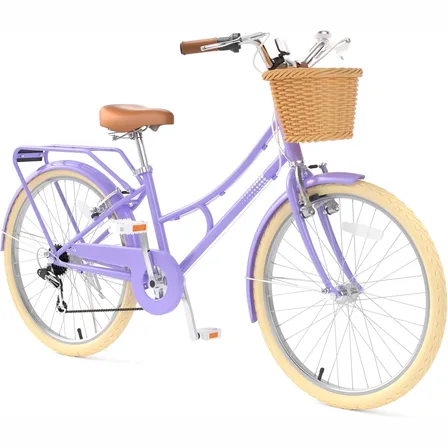
24-Inch Purple XJD Beach Cruiser Bike with U-Brake
The XJD 24-Inch Purple Beach Cruiser is built for girls and young women roughly …$159.99
-

XJD 24-Inch Green Beach Cruiser Bike with U-Brake
This XJD 24-inch beach cruiser in green is made for riders about 4'8" to 5'4" ta…$159.99
$199.99