

What age can a child ride a two wheel bike
Most children can ride a two-wheel bike when they can balance, steer, brake and follow directions—often around ages 3–7, but readiness and fit matter more than age.
Age is only the starting point
There is no single correct birthday for removing training wheels or beginning on two wheels. One child may be ready at three or four, while another may need more time. The useful question is whether the child can control a correctly fitted bike without relying on an adult to hold it upright.
Confidence also matters. A hesitant child should not be pressured because peers of the same age are riding. Short, positive practice sessions are more useful than forcing a transition before the child can balance and stop predictably.
Measure before choosing a wheel size
Measure the child’s height without shoes. Also measure inseam from the floor to the crotch while the child stands straight with feet slightly apart. Compare height with the XBikes starting points below, then have the child try the bicycle. These ranges narrow the search; they do not prove that a particular frame fits.
| Wheel size | Starting age | Rider height |
|---|---|---|
| 12 Inch | 3–4 | 34–40 in / 86–102 cm |
| 14 Inch | 3–6 | 37–45 in / 94–114 cm |
| 16 Inch | 4–7 | 40–48 in / 102–122 cm |
| 18 Inch | 5–9 | 43–52 in / 109–132 cm |
| 20 Inch | 7–12 | 48–60 in / 122–152 cm |
| 24 Inch | 10–14 | 54–64 in / 137–163 cm |
| 26 Inch | Youth and adults | Over 60 in / 153 cm |
If the child overlaps two ranges, do not automatically choose the larger wheel. Compare both bikes in person and favor the one the child can mount, stand over, steer and brake confidently. Do not buy an oversized bicycle merely to allow room for growth.
Use a five-part readiness check
A child is ready to practise on two wheels when all five points are reasonably consistent:
- Balance: The child can coast while keeping the bike upright rather than immediately putting a foot down.
- Steering: The child looks ahead and makes controlled turns without sharp, panicked corrections.
- Stopping: The child understands how to slow and stop on command.
- Brake reach: The child can comfortably reach and operate the bicycle’s controls. Check the actual model rather than assuming this from wheel size.
- Judgment: The child can listen, follow simple directions and remain aware of nearby people and obstacles.
Stand-over clearance and reach must also be checked on the actual bicycle. The child should not appear stretched toward the controls or unable to manage the bike’s position while stopped. If control is uncertain, continue practising balance and braking before removing training support.
Where the supplied bikes fit
The supplied catalog choices are relevant because both are training-wheel bikes offered in 12, 14 and 16 Inch SKU labels, covering XBikes starting ranges from ages 3–7 and heights 34–48 in / 86–122 cm across those sizes. They can help a family compare supported-riding options before a child transitions to independent two-wheel riding, but the individual fit checks still decide suitability.
 Girls 12/14/16 Inch Kids Bike by XJD with Training Wheels – Peach
A training-wheel bike offered in 12, 14 and 16 Inch labels, relevant for comparing supported-riding sizes after measuring the child and checking reach, control and confidence.
 XJD Light Purple Girls Bike with Basket, Training Wheels, 12/14/16/20 Inch
A Training Wheel Bike with supplied available labels of 12, 14 and 16 Inch. Its title mentions 20 Inch, but suitability and availability should not be inferred beyond the supplied SKU labels.
Girls 12/14/16 Inch Kids Bike by XJD with Training Wheels – Peach is listed in the Training Wheel Bikes category with 12, 14 and 16 Inch options. Compare the child’s measured height with the corresponding range, then verify stand-over, reach, brake control and confidence on the chosen size.
XJD Light Purple Girls Bike with Basket, Training Wheels, 12/14/16/20 Inch is also categorized as a Training Wheel Bike. Although “20 Inch” appears in its catalog title, the supplied available SKU labels are 12, 14 and 16 Inch. Do not treat title wording as proof that another size is available or suitable.
Neither product should be selected from age wording or appearance alone. If the child needs an 18, 20, 24 or 26 Inch bike after measurement and an individual fit check, these supplied 12–16 Inch options are nearest-size comparison points only, not substitutes for the required wheel size.
Practise the transition safely
Choose a flat, open area away from traffic and fixed obstacles. Begin with mounting, controlled coasting, looking ahead and stopping at a clear marker. Keep sessions short enough that fatigue does not replace good control. An adult can stay close without continually steering or pulling the bicycle, because the goal is to see whether the child can maintain balance independently.
A bicycle helmet must fit properly, sit level and have its straps adjusted according to the helmet manufacturer’s instructions. Before riding, follow the exact bicycle manual for assembly, adjustments, maintenance, compatibility and any limits or torque requirements. If the manual is unclear or the bike cannot be adjusted for reliable control, use a qualified bicycle mechanic.
Make the decision
Measure height and inseam today, shortlist the matching wheel sizes, and arrange an actual fit check. Move to two-wheel riding only when the child can stand over the bike, reach and operate the controls, balance, steer and stop with confidence; otherwise, keep practising with appropriate support and reassess later.
Bikes for your next adventure
-
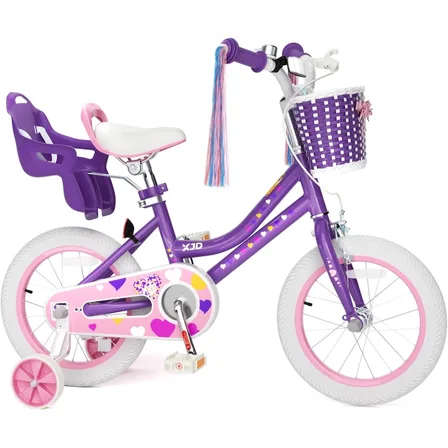
Purple XJD Girls' Bike with Doll Seat & Basket
For girls 71–122 cm tall (about ages 3–7), this XJD girls' bike in Purple pairs …$75.99
$99.99 -
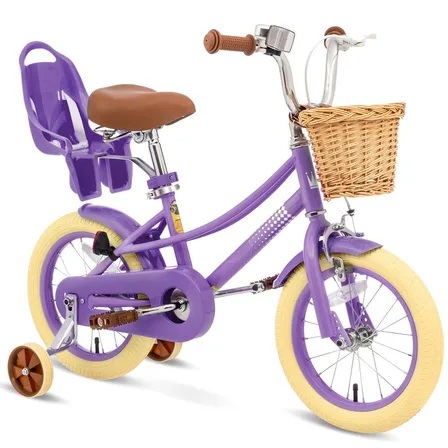
XJD Girls' Bike with Training Wheels, 12/14/16/20 Inch – Purple
The XJD girls' bike with training wheels in Purple is built to grow with your ri…$139
$159 -
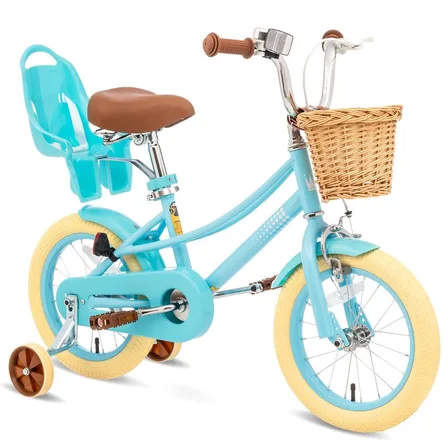
Girls' Training Wheel Bike by XJD, 12–20 Inch Wheels – Blue
This XJD girls' training wheel bike in Blue covers one of the widest fit ranges …$139
$159