

What age can child go in bike trailer
A child can go in a bike trailer only when they can sit upright independently, maintain steady head and neck control while helmeted, and meet the trailer manufacturer’s stated requirements. Age alone is not enough. Check the exact trailer manual, your local helmet and passenger laws, and ask the child’s clinician if development, prematurity or a medical condition makes readiness uncertain.
Use ability and the trailer manual, not a birthday
There is no single age that applies to every child and every trailer. Children develop head, neck and trunk control at different rates, while trailer designs have their own passenger requirements and limits. The manual for the exact model should therefore decide the minimum age, permitted seating arrangement and any restrictions.
A child is not ready if they slump sideways, cannot remain seated without support, or cannot keep their head stable with the required helmet on. Do not add an unapproved infant insert, cushion or head support to make a child appear ready. Use only accessories and seating configurations expressly permitted by the trailer manufacturer.
What to measure before the first ride
Make these checks with the trailer stationary, on level ground, and configured exactly as its manual directs:
- Child and load weight: compare the child’s current weight—and any other passenger or cargo included in the manufacturer’s calculation—with the trailer’s stated limits.
- Seated height and headroom: confirm that the child, including any required helmet, fits below the trailer’s stated height limit and does not press against the roof or frame.
- Harness fit: verify that the supplied restraint adjusts securely in the approved belt path without crossing the neck, hanging loose or requiring improvised padding.
- Posture: watch whether the child stays upright and keeps their head controlled while seated and restrained.
Never guess a load limit or alter a harness. If a label is missing, the manual is unclear, or the trailer is second-hand with unknown parts, contact the manufacturer or have a qualified bicycle mechanic inspect it.
Compare the trailer with the towing bicycle
Read both manuals before connecting anything. Confirm that the hitch, axle or mounting point is approved for that particular bicycle and trailer combination. Follow the manufacturer’s instructions for assembly, attachment, safety straps, tires and maintenance; use a qualified bicycle mechanic when compatibility or installation is uncertain.
Before carrying the child, inspect the restraint, enclosure, hitch and wheels as directed by the manual. Make an unloaded practice ride to learn the trailer’s extra width and its effect on starting, stopping and turning. For the first occupied ride, choose a short, low-traffic route and stop immediately if the child slumps, becomes distressed or cannot maintain a stable position.
Helmet fit is a separate decision
Follow the trailer manual and local law to determine whether the passenger must wear a helmet. When a helmet is used, the U.S. Consumer Product Safety Commission advises that it fit properly, sit level on the head and have its straps adjusted according to the helmet manufacturer’s instructions.
Check helmet fit on the child rather than buying for future growth. Then repeat the seated-height and posture checks inside the trailer: a properly fitted helmet must not force the head forward because it contacts the seat or enclosure. If the required helmet cannot be accommodated without changing posture, the setup is not suitable.
Why the listed kids’ bikes are comparison points
The supplied catalog contains children’s bicycles, not bike trailers, so none establishes when a child may ride as a trailer passenger. These particular options are useful only as later-stage comparison points if the child is moving from passenger riding toward an individually fitted bicycle. Their wheel sizes are not trailer-age standards or substitutes for a trailer manual.
 XJD Boys & Girls BMX Bike with Training Wheels, 12/14/16" – Blue
A 12, 14 and 16 Inch kids’ BMX bicycle comparison for a later transition to independent riding; it does not establish passenger readiness, limits or compatibility for a bike trailer.
 XJD Pink Beach Cruiser for Girls – Rear Rack & V-Brake
Offered in 20, 24 and 26 Inch labels, this beach cruiser is relevant only to later bicycle fit comparisons, not to deciding when a child can ride in a trailer.
 Girls' Training Wheel Bike by XJD with Basket – Purple
Its 14, 16 and 20 Inch options can inform a later individually checked bicycle fit. Training wheels and wheel labels do not provide evidence of trailer readiness or trailer compatibility.
The XJD Boys & Girls BMX Bike with Training Wheels, 12/14/16" – Blue is offered in 12, 14 and 16 Inch labels. The Girls' Training Wheel Bike by XJD with Basket – Purple is offered in 14, 16 and 20 Inch labels. The XJD Pink Beach Cruiser for Girls – Rear Rack & V-Brake is offered in 20, 24 and 26 Inch labels. Those facts support bicycle-size comparisons only; they provide no evidence about trailer readiness, trailer compatibility or passenger limits.
If selecting a bicycle later, begin with measured rider height: 12 Inch corresponds to 34–40 in / 86–102 cm; 14 Inch to 37–45 in / 94–114 cm; 16 Inch to 40–48 in / 102–122 cm; 20 Inch to 48–60 in / 122–152 cm; 24 Inch to 54–64 in / 137–163 cm; and 26 Inch to youth and adults over 60 in / 153 cm. These are starting points, not proof of fit.
Have the child try the bicycle. Prioritize height, inseam, stand-over clearance, reach, brake control and current confidence, and do not buy an oversized bicycle merely for growth. Any age wording in a catalog title would remain a label rather than individual fit evidence.
Your go-or-wait decision
- Find the exact trailer manual and confirm every passenger requirement and limit.
- Measure the child’s weight and seated height, then test upright posture, head control and approved harness fit while stationary.
- Confirm towing-bike compatibility and correct attachment from both manuals.
- Check applicable helmet rules and, when used, verify level helmet fit, correct straps and adequate trailer headroom.
If any requirement is unknown, exceeded or failed, wait: do not carry the child until the manufacturer, the child’s clinician where appropriate, or a qualified bicycle mechanic resolves it.
Bikes for your next adventure
-

Kids Bike Helmet by XJD for Girls – Pink
The XJD Kids Bike Helmet in Pink is a lightweight multi-sport helmet for girls r…$59.99
$99 -

Blue XJD Kids Bike Helmet for Boys & Girls
The Blue XJD Kids Bike Helmet is a lightweight, adjustable multi-sport helmet fo…$59.99
$99 -
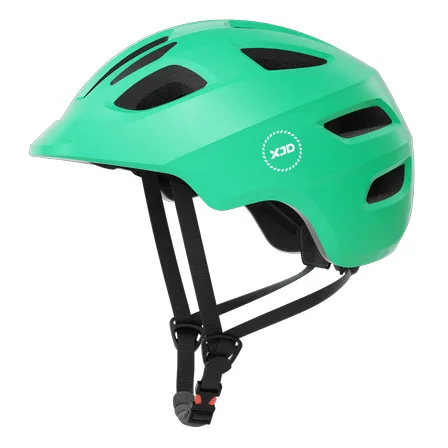
Green XJD Kids Bike Helmet for Boys & Girls
The Green XJD Kids Bike Helmet is a lightweight multi-sport helmet for toddlers …$59.99
$99