

What age can kids ride a bicycle
Kids can usually start riding a bicycle at ages 3–4, when they fit a 12-inch bike and can control it confidently. Age is only a starting point: measure height, check inseam clearance, reach and brake control, and never size up just for growth.
Start with height, not the birthday
The XBikes starting point for a 12-inch bicycle is ages 3–4 and a rider height of 34–40 inches (86–102 cm). A child within that range may be ready, but only an individual fit check can answer whether the bicycle is suitable now.
Measure the child’s height without shoes, standing straight against a wall. Also measure inseam from the floor to the crotch. Compare height with the wheel-size ranges below, then have the child try the actual bicycle. Body proportions differ, so two children of the same age and height may need different fits.
XBikes age and height starting points
| Wheel size | Age starting point | Rider height |
|---|---|---|
| 12 Inch | 3–4 | 34–40 in / 86–102 cm |
| 14 Inch | 3–6 | 37–45 in / 94–114 cm |
| 16 Inch | 4–7 | 40–48 in / 102–122 cm |
| 18 Inch | 5–9 | 43–52 in / 109–132 cm |
| 20 Inch | 7–12 | 48–60 in / 122–152 cm |
| 24 Inch | 10–14 | 54–64 in / 137–163 cm |
| 26 Inch | Youth and adults | Over 60 in / 153 cm |
Overlapping ranges are intentional. If a child falls into two rows, do not choose from age alone. Compare both candidate sizes in person and favor the bicycle on which the child has better clearance, reach, braking control and confidence.
Check whether the child can control the bicycle
A correctly sized wheel is not enough. With the child wearing the shoes used for riding, check these points on the fully assembled bicycle:
- Stand-over: The child should be able to straddle the bicycle with appropriate clearance rather than being pressed against the frame.
- Reach: The child should reach the handlebar without stretching, locking the elbows or losing a stable position.
- Brake control: The child must be able to reach and operate the bicycle’s braking controls reliably.
- Confidence: The child should be able to start, steer, stop and put a foot down without appearing overwhelmed by the bicycle’s size.
If any of these checks fail, the child is not ready for that particular bicycle even when the age or height chart appears to match. Do not buy an oversized bicycle for future growth; difficult reach and control matter now.
When the supplied training-wheel bikes are relevant
The two supplied options help families comparing 12-, 14- and 16-inch training-wheel bicycles. Those sizes span XBikes starting points from ages 3–4 through 4–7 and heights from 34–48 inches (86–122 cm), but each child still needs the fit and control checks above.
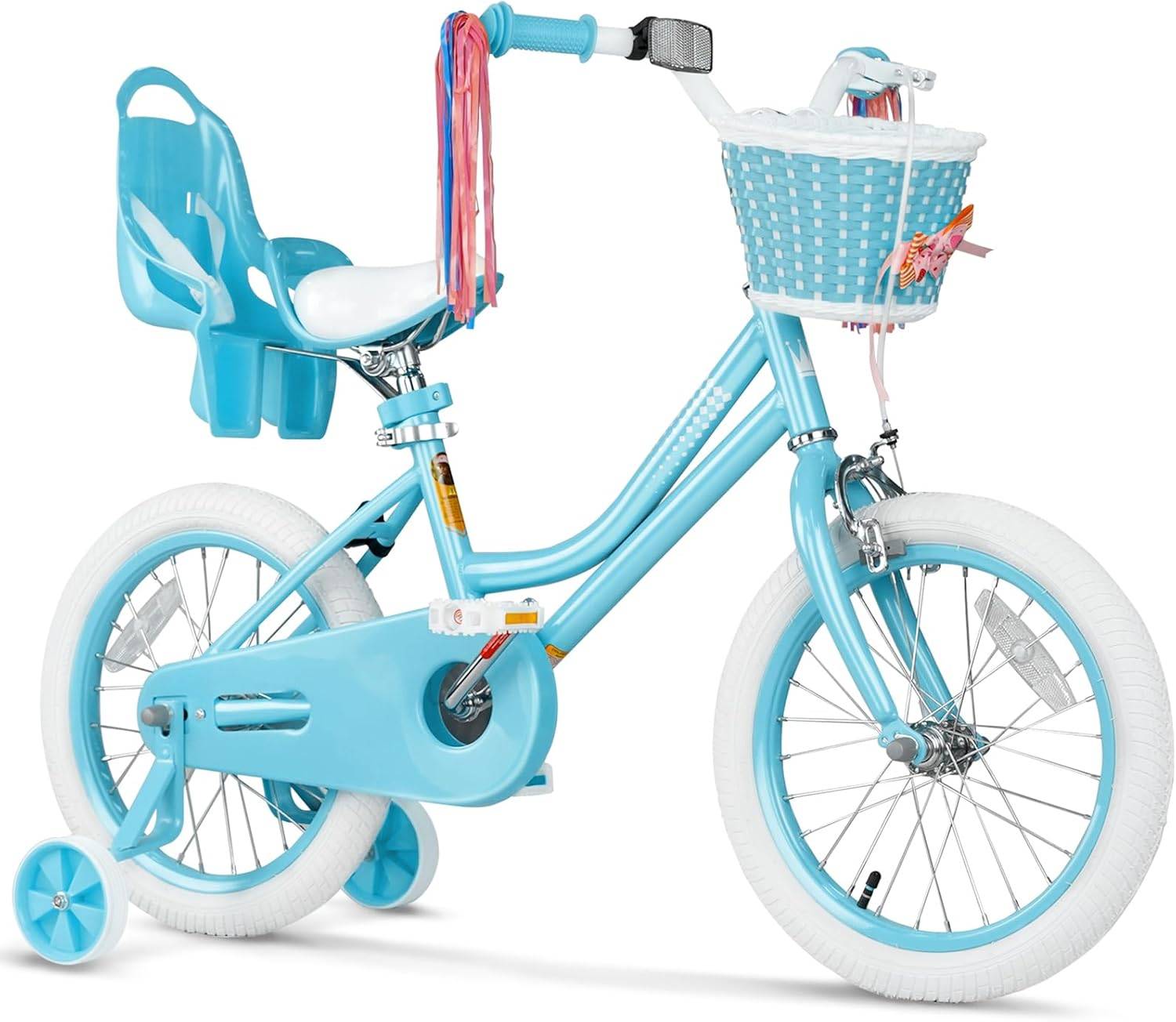 Blue XJD Girls Bike with Training Wheels – 12/14/16 Inch
A Training Wheel Bike offered in 12 Inch, 14 Inch and 16 Inch labels, making it relevant to children whose measured height and individual fit support one of those sizes.
 XJD Boys 12/14/16" Training Wheel Bike – Blue
This blue Training Wheel Bike has 12 Inch, 14 Inch and 16 Inch labels. Use the XBikes height ranges to shortlist a size, then confirm stand-over, reach, braking and confidence.
Blue XJD Girls Bike with Training Wheels – 12/14/16 Inch is cataloged as a Training Wheel Bike and is offered in 12 Inch, 14 Inch and 16 Inch labels. XJD Boys 12/14/16" Training Wheel Bike – Blue is also cataloged as a Training Wheel Bike with the same three size labels.
On the supplied facts, their relevance to this question is the same: both provide size choices that correspond to the 12-, 14- and 16-inch rows in the XBikes chart. Their titles do not prove that either bicycle fits a particular child. They are not relevant when the measured rider needs an 18-, 20-, 24- or 26-inch starting point, or when training wheels are not the type being considered.
Helmet and setup come before the first ride
Use a bicycle helmet that fits the child properly, sits level and has straps adjusted according to the helmet manufacturer’s instructions. An age label alone does not establish helmet fit.
Before riding, follow the exact bicycle manual for assembly, adjustments, maintenance, load limits, compatibility and any torque requirements. If the instructions are missing, unclear or beyond your experience, use a qualified bicycle mechanic. Do not guess at a procedure or setting.
Make the decision today
- Measure the child’s height and inseam.
- Use the table to identify one or two candidate wheel sizes.
- Have the child try each candidate and compare stand-over clearance, reach, brake operation and confidence.
- Reject any bicycle that is oversized or difficult to control, regardless of the age range.
A child can ride when a bicycle fits now and they can control it—not simply when they reach a particular birthday. Begin with the chart, confirm the fit in person, and wait or choose another size if the child cannot comfortably straddle, reach, brake and stop.
Bikes for your next adventure
-
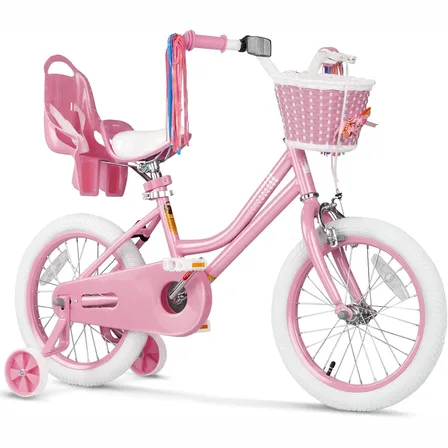
XJD Pink Girls' Bike – Kids 12/14/16 Inch Training Wheel Bicycle
The XJD Pink Girls' Bike is a training-wheel bicycle for girls ages 3 to 8 (ride…$149
$169 -
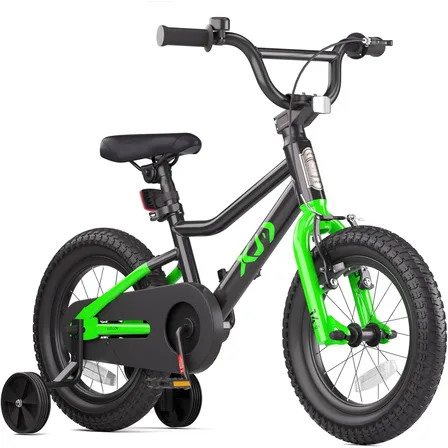
Black XJD Kids' BMX Bicycle with Training Wheels
The XJD Kids' BMX Bicycle with Training Wheels is built for children roughly 3 t…$99.99
$119.99 -
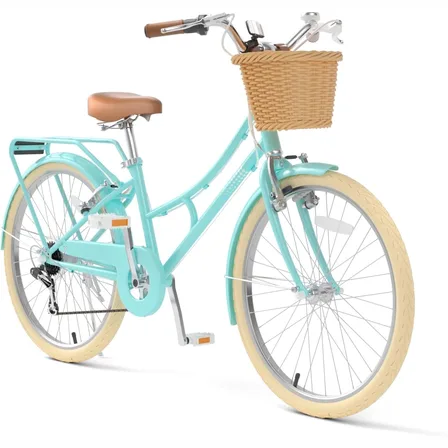
XJD Kids Beach Cruiser Bicycle, Rear Rack & V-Brakes, Mint Green
The XJD Beach Cruiser in Mint Green is a geared, multi-speed cruiser bike for ol…$179.99
$209.99