

What age can ride a 20 inch bike
A 20-inch bike generally suits children ages 7–12 who are 48–60 inches (122–152 cm) tall, but the rider must pass an individual fit check.
Age is only the starting point
The age range answers the title broadly, but height, inseam, reach, brake control and current confidence decide whether a particular 20-inch bike fits. Two children of the same age can have different proportions and riding abilities.
Do not choose an oversized bicycle solely to leave room for growth. A bike that is difficult to stand over, steer or stop can undermine control now. Have the child try the exact bicycle whenever possible.
Measure the rider before comparing bikes
First, measure the child's height without shoes, standing straight against a wall. A measured height of 48–60 inches (122–152 cm) places the rider within the XBikes starting range for a 20-inch wheel bike.
Next, measure inseam. With shoes off, have the child stand upright with feet slightly apart. Place a firm, level book between the legs to represent the saddle area, then measure from the floor to the top edge of the book. Compare that measurement with the stand-over space on the exact bike rather than relying on wheel diameter alone.
Wheel size is not frame size. Geometry can differ between bicycles carrying the same wheel label, so the child's inseam and reach still need to be checked on the actual model.
Compare the nearest wheel-size ranges
| Wheel size | Starting age range | Starting rider height |
|---|---|---|
| 16 Inch | 4–7 | 40–48 in / 102–122 cm |
| 20 Inch | 7–12 | 48–60 in / 122–152 cm |
| 24 Inch | 10–14 | 54–64 in / 137–163 cm |
These ranges overlap because age alone does not establish fit. A 10-year-old, for example, may fall within the starting height ranges for both 20-inch and 24-inch wheels. That is a signal to try the exact bicycles and compare control, not automatically select the larger one.
If the rider is below 48 inches (122 cm), compare the smaller starting points instead of assuming a 20-inch bike will work. If the rider is above 60 inches (152 cm), compare the 24-inch starting point. Boundary measurements require an especially careful trial.
Run a practical fit check
Ask the child to stand over the bicycle. There should be usable space between the rider and the frame, and the child should not have to strain or tilt the bike sharply just to stand securely.
Then check the riding position and controls:
- The child can reach the handlebar without an extreme stretch or cramped posture.
- The child can steer steadily and make controlled turns.
- The child can reach and operate the fitted brakes confidently. Brake type and adjustment must be checked on the exact bicycle.
- The child can start, stop and remain in control at their present skill level.
If any of these checks fail, another frame or wheel size may be more appropriate even when the age and height chart points to 20 inches. Follow the exact product manual for assembly, adjustment, maintenance and limits, or use a qualified bicycle mechanic.
How the supplied 20-inch options are relevant
The XJD Girls' Bike with Training Wheels, 12/14/16/20 Inch – Purple and the XJD Kids Bike for Girls – Pink, 12/14/16/20 Inch with Training Wheels both include a 20 Inch SKU label. They are relevant catalog options for comparing a requested 20-inch configuration, while their 12, 14 and 16 Inch labels also provide smaller-size alternatives. Both are categorized as Training Wheel Bikes; the catalog facts do not establish frame dimensions, brake type or individual fit.
 XJD Girls' Bike with Training Wheels, 12/14/16/20 Inch – Purple
Offers a catalog-listed 20 Inch option, plus 12, 14 and 16 Inch SKU labels for smaller comparisons. Its training-wheel configuration may suit that preference, but the exact bicycle still requires an individual fit check.
 XJD Kids Bike for Girls – Pink, 12/14/16/20 Inch with Training Wheels
Includes catalog-listed 12, 14, 16 and 20 Inch options and is categorized as a Training Wheel Bike. The 20 Inch selection is relevant only after confirming the rider's height, stand-over, reach, brake control and confidence.
Because the titles state that these bicycles have training wheels, they may be relevant when that feature matches the rider's current confidence. Training wheels do not make an incorrectly sized bike fit, and the presence of a 20 Inch option does not replace the stand-over, reach and control checks. Confirm the selected SKU label before ordering and consult its exact manual for setup and compatibility details.
Helmet and final decision
For every ride, use a bicycle helmet that fits properly, sits level and has its straps positioned according to the helmet manufacturer's instructions. A helmet cannot correct poor bicycle fit, so complete both checks separately.
Choose a 20-inch bike only when the child is near the 7–12 and 48–60 inch starting point and can comfortably stand over, reach, steer and brake on the exact bicycle. If those checks are uncertain, try the neighboring size rather than buying the 20-inch bike for future growth.
Bikes for your next adventure
-
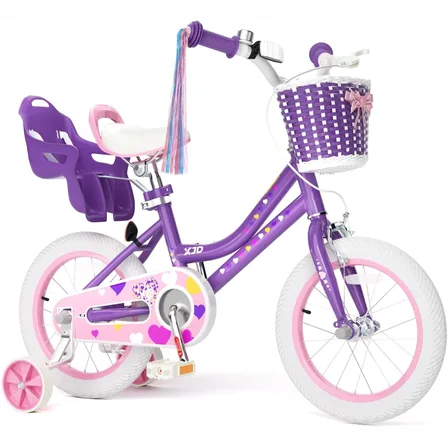
XJD Light Purple Girls Bike with Basket, Training Wheels, 12/14/16/20 Inch
The XJD Girls Bike with Basket in Light Purple is a single-speed training-wheel …$99.99
$119.99 -
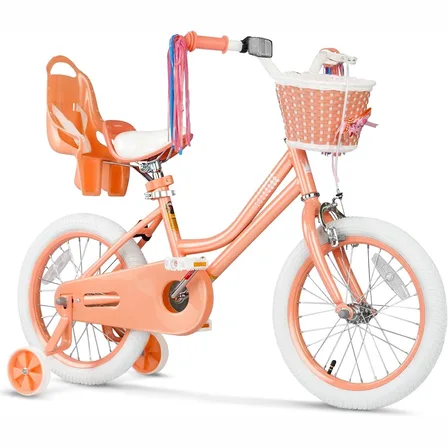
Girls 12/14/16 Inch Kids Bike by XJD with Training Wheels – Peach
The XJD Girls Bike in Peach is a training-wheel bike built for girls roughly 3 t…$149
$169 -
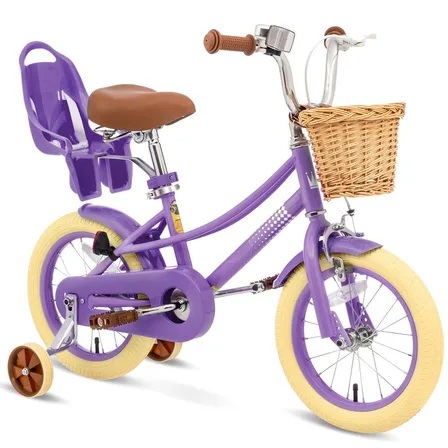
XJD Girls' Bike with Training Wheels, 12/14/16/20 Inch – Purple
The XJD girls' bike with training wheels in Purple is built to grow with your ri…$139
$159