

What age can toddler seat in the back of bike
There is no single age when a toddler can ride in a rear bike seat. Use the seat manual, the child’s development and the bicycle’s compatibility—not age alone.
What decides whether your toddler can ride
First, identify the exact rear child seat and bicycle you intend to use. Read the seat manufacturer’s minimum requirements and load limit, then confirm that the bicycle and any rack or mounting system are explicitly compatible. If this information is missing or unclear, do not guess; ask the manufacturer or a qualified bicycle mechanic.
Your child must meet every requirement in the seat manual. Consider whether the child can maintain the posture and control the manual requires for the full ride, including while wearing a properly fitted helmet. A birthday by itself does not establish readiness.
Measure and compare before riding
- Record the child’s current measurements. Measure what the rear-seat manual requests, such as body weight or height. Compare actual measurements with every stated minimum and maximum.
- Check the complete carrying system. Confirm the bicycle, child seat, rack if used, mounting hardware and other required parts are compatible. Follow the exact manuals for installation, maintenance and load limits.
- Check the child restraint and helmet fit. Adjust the seat’s restraint exactly as its manufacturer directs. The bicycle helmet should fit properly, sit level and have its straps positioned according to the helmet manufacturer’s instructions.
- Assess control before adding the child. The adult rider should be able to mount, stop, balance and handle the bicycle with the installed seat. A child and rear seat change the bicycle’s balance and handling.
If any measurement falls outside the manual, a required part is incompatible, or the bicycle feels difficult to control, the child should not ride in that setup. Have a qualified bicycle mechanic inspect uncertain assembly or compatibility.
Rear seat or the child’s own bicycle?
A rear child seat and a training-wheel bicycle answer different needs. The rear seat carries a passenger and must be selected from its own manual requirements. A training-wheel bike is for a child who is ready to ride and control a correctly fitted bicycle. One does not prove readiness for the other.
For a child’s own bike, use measured height only as a starting point, then check stand-over clearance, reach, brake control and confidence. Have the child try the bicycle, and do not choose an oversized model merely to allow room for growth.
| Wheel size | XBikes starting age | Rider height |
|---|---|---|
| 12 Inch | 3–4 | 34–40 in / 86–102 cm |
| 14 Inch | 3–6 | 37–45 in / 94–114 cm |
| 16 Inch | 4–7 | 40–48 in / 102–122 cm |
| 20 Inch | 7–12 | 48–60 in / 122–152 cm |
These ranges are starting points, not a substitute for trying the bike. If height falls in overlapping ranges, compare the child’s stand-over position, reach, ability to operate the brakes and present confidence rather than selecting by age alone.
How the supplied XBikes options relate
The supplied products are training-wheel bikes, not rear child seats, so they cannot answer whether a toddler fits a passenger seat. They are useful only as comparison options when the child is moving toward riding a separate bike: XJD Kids' Training Wheel Bike for Boys & Girls, 12/14/16 Inch – White offers 12 Inch, 14 Inch and 16 Inch labels; Girls' Training Wheel Bike by XJD, 12–20 Inch Wheels – Blue offers 12 Inch, 14 Inch, 16 Inch and 20 Inch labels; and XJD Girls' Bike with Training Wheels, 12/14/16/20 Inch – Purple offers the same four labels.
 XJD Kids' Training Wheel Bike for Boys & Girls, 12/14/16 Inch – White
A training-wheel bike with 12 Inch, 14 Inch and 16 Inch labels. It is relevant only for comparing a child’s independent-bike fit, not for deciding rear child-seat readiness or compatibility.
 Girls' Training Wheel Bike by XJD, 12–20 Inch Wheels – Blue
This training-wheel model has 12 Inch, 14 Inch, 16 Inch and 20 Inch labels, offering several size comparison points for an independent rider. It is not a rear passenger seat.
 XJD Girls' Bike with Training Wheels, 12/14/16/20 Inch – Purple
Available with 12 Inch, 14 Inch, 16 Inch and 20 Inch labels, this training-wheel bike may be compared with measured rider height. Its catalog facts do not establish rear-seat suitability.
Those wheel labels let you compare the measured child with the XBikes starting points above. They provide no evidence about rear-seat compatibility, passenger load limits or the age at which a child may ride behind an adult. For assembly, braking details, maintenance and exact fit adjustments, consult the relevant product manual or a qualified bicycle mechanic.
Make the decision
Put the child’s measurements beside the rear-seat manual’s requirements and verify the bicycle and mount as one complete system. Proceed only when every limit and compatibility instruction is satisfied, the restraint and helmet fit correctly, and the adult can control the loaded setup. Otherwise, postpone the rear-seat ride. If considering a separate training-wheel bike instead, begin with measured height, arrange a real fit check and reject any size the child cannot comfortably stand over, reach, brake and control.
Bikes for your next adventure
-
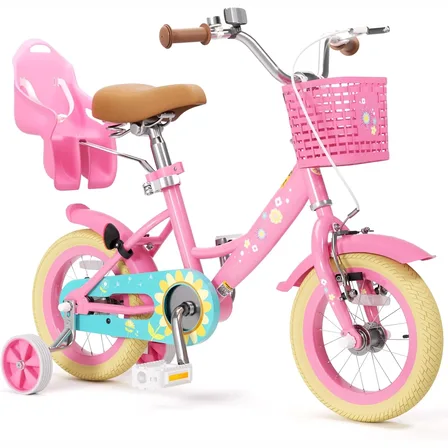
Flower Pink XJD Girls Bike with Doll Seat & Basket
The XJD Flower Pink girls' bike is made for riders 71–122 cm tall (roughly ages …$69.99
-

Light Purple XJD Toddler Bike Helmet, Adjustable, Size XS (46–51 cm)
This Light Purple XJD toddler bike helmet is made for the smallest riders — the …$20.39
-
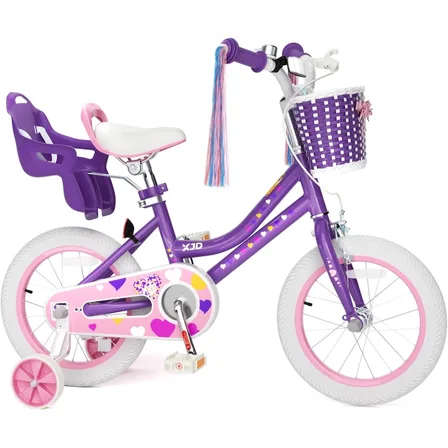
Purple XJD Girls' Bike with Doll Seat & Basket
For girls 71–122 cm tall (about ages 3–7), this XJD girls' bike in Purple pairs …$75.99
$99.99