

What age can you take a baby on a bike
There is no single age when every baby can go on a bike. Wait until your child meets the carrier or trailer manual’s limits, has the required head and neck control, and can wear a properly fitted helmet. If any point is uncertain, ask your pediatrician before riding.
Why age alone cannot answer the question
Babies develop at different rates, and bike seats and trailers can have different requirements. A birthday does not establish that a baby can remain stable, tolerate the riding position, or fit the restraint and helmet correctly.
Start with the exact manual for the child seat, trailer or cargo-bike passenger system you intend to use. Check its minimum and maximum passenger requirements, permitted riding position, restraint instructions, bicycle compatibility and load limits. If the manual is missing or unclear, contact the manufacturer or have a qualified bicycle mechanic inspect the setup. Do not estimate missing limits.
What to measure and compare before riding
Use your baby’s current measurements, not clothing size or an expected growth date. Compare them directly with the passenger system’s instructions.
- Body size: Measure current height and weight if the manual uses them. Stay within every stated limit.
- Seated fit: Confirm that the child sits in the position required by the manual and that the restraint adjusts correctly without improvised padding or extensions.
- Head and neck control: Check whether the child can maintain the posture the product requires while seated and helmeted. Ask a pediatrician if development or medical history makes this uncertain.
- Helmet fit: Use a bicycle helmet that fits properly, sits level and has straps adjusted according to its manufacturer’s instructions. A helmet that cannot be fitted correctly is a reason to wait.
- Bike compatibility: Verify the mount, bicycle type and all required hardware against the exact manuals. Assembly, compatibility and torque questions should go to the manufacturer or a qualified bicycle mechanic.
Do a stationary check before the first trip
Install the passenger equipment exactly as directed, then check the complete setup while the bicycle is stationary. Confirm that restraints remain secure, the child’s hands and feet cannot reach moving parts, and the adult rider can hold, start, steer, brake and stop the loaded bicycle confidently.
Next, practise without the baby in a quiet, traffic-free area using an appropriate substitute load only if the product manual permits it. A passenger changes balance, stopping and handling. Begin an actual ride only when the equipment fits, the child meets every requirement and the adult can control the bicycle without hesitation.
When to postpone the ride
Wait if the child falls outside any manual limit, cannot maintain the required posture, cannot obtain a correct helmet fit, or does not fit securely in the restraint. Also postpone if mounting instructions, hardware, load limits or bicycle compatibility are unresolved.
Stop during a ride if the restraint shifts, the child’s position changes, equipment loosens, or bicycle control feels uncertain. Recheck the manual and use a qualified mechanic where needed rather than creating a workaround.
How the supplied kids’ bike relates to this question
The Purple XJD Girls' Bike with Doll Seat & Basket is a training-wheel bicycle offered in 12 Inch, 14 Inch and 16 Inch labels. It is not supplied here as a baby seat, trailer or passenger carrier, so it does not establish when a baby can ride as a passenger. Its relevance comes later: it provides comparison points for a child preparing to ride an appropriately fitted bicycle independently.

XBikes’ starting points place 12 Inch at ages 3–4 and 34–40 in / 86–102 cm, 14 Inch at ages 3–6 and 37–45 in / 94–114 cm, and 16 Inch at ages 4–7 and 40–48 in / 102–122 cm. These overlapping ranges are starting points, not proof of fit.
When your child is ready for their own bike
Measure standing height and inseam, then have the child try the bicycle. Compare wheel-size guidance with actual stand-over clearance, reach, brake control and present confidence. Do not buy an oversized bicycle merely for growth. The child should be able to get into position, reach the controls and manage the bike rather than stretching to make it work.
For a baby passenger ride, make the decision from the passenger system’s exact limits, your child’s development and helmet fit—not from a general age. If all three do not clearly align, wait and recheck later.
Bikes for your next adventure
-

Light Pink XJD Girls' Bicycle with Basket & Training Wheels
The Light Pink XJD Girls' Bicycle with Basket & Training Wheels is a retro-style…$109.99
$129.99 -

Flower Pink XJD Girls Bike with Doll Seat & Basket
The XJD Flower Pink girls' bike is made for riders 71–122 cm tall (roughly ages …$69.99
-
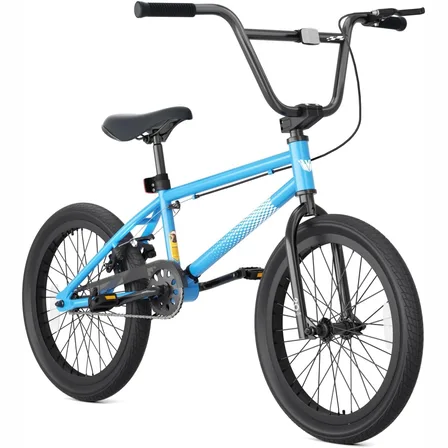
Blue XJD Freestyle BMX Bike, 20-Inch – No Pegs
The XJD 20-Inch Blue Freestyle BMX is an entry-level BMX bike for boys and girls…$189.99