

What age can you use baby bike seat
There is no single safe age for every baby bike seat. Use one only when your child can sit upright unsupported, has reliable head and neck control, and meets every requirement in the seat manual.
Age alone cannot decide readiness
A birthday does not confirm that a baby can tolerate the movement and posture involved in riding as a passenger. Check the child’s physical readiness first, then compare their measurements with the exact limits and instructions supplied by the seat manufacturer.
If your child cannot remain steadily upright or control their head while wearing a properly fitted helmet, do not use the seat yet. If readiness is uncertain, ask the child’s healthcare professional before riding. Local rules may also set requirements for child passengers, so check the rules where you ride.
What to measure and compare
Before installing or using a baby bike seat, record the child’s current weight and any other measurement requested by its manual. Compare those figures with the minimum and maximum limits for that exact seat; do not rely on a general age label.
- Development: Confirm independent sitting plus stable head and neck control.
- Seat limits: Follow the manual’s stated age, weight, height, and passenger-position requirements.
- Bicycle compatibility: Confirm that the seat, bicycle, rack or frame, and mounting hardware are explicitly compatible.
- Helmet fit: Use a properly fitting bicycle helmet that sits level, with its straps adjusted according to the helmet manufacturer’s instructions.
- Final setup: Follow the manuals for assembly, fasteners, load limits, maintenance, and inspections. If anything is unclear, use a qualified bicycle mechanic.
Do not estimate compatibility or invent a mounting method. A seat that is appropriate for one bicycle or child may be unsuitable for another.
Check the complete riding setup
After confirming the child meets the seat requirements, inspect how the combination works in practice. The seat must not interfere with steering, braking, wheels, pedals, or the rider’s ability to mount, dismount, and balance the bicycle. Follow the seat and bicycle manuals for the actual checks required.
Recheck the child’s measurements and the installation regularly because children grow and fittings can change. Stop using the seat when the child exceeds any stated limit, no longer fits as directed, or the bicycle becomes difficult for the adult rider to control.
How the supplied kids’ bikes relate
The products shown below are child-ridden bicycles, not baby passenger seats. They help distinguish the later stage—when a child rides a correctly fitted bicycle independently or with training wheels—from the earlier passenger-seat question. Their wheel sizes are comparison starting points only and do not establish readiness for a baby bike seat.
 XJD Light Purple Girls Bike with Basket, Training Wheels, 12/14/16/20 Inch
A Training Wheel Bike offered in supplied 12, 14, and 16 Inch labels. It is relevant only as a later child-rider comparison, not as a baby passenger seat.
 XJD Kids Beach Cruiser Bicycle, Rear Rack & V-Brakes, Mint Green
A Beach Cruiser Bike with supplied 20, 24, and 26 Inch labels. Its rear-rack wording does not prove baby-seat compatibility; consult the exact bicycle, rack, and seat manuals.
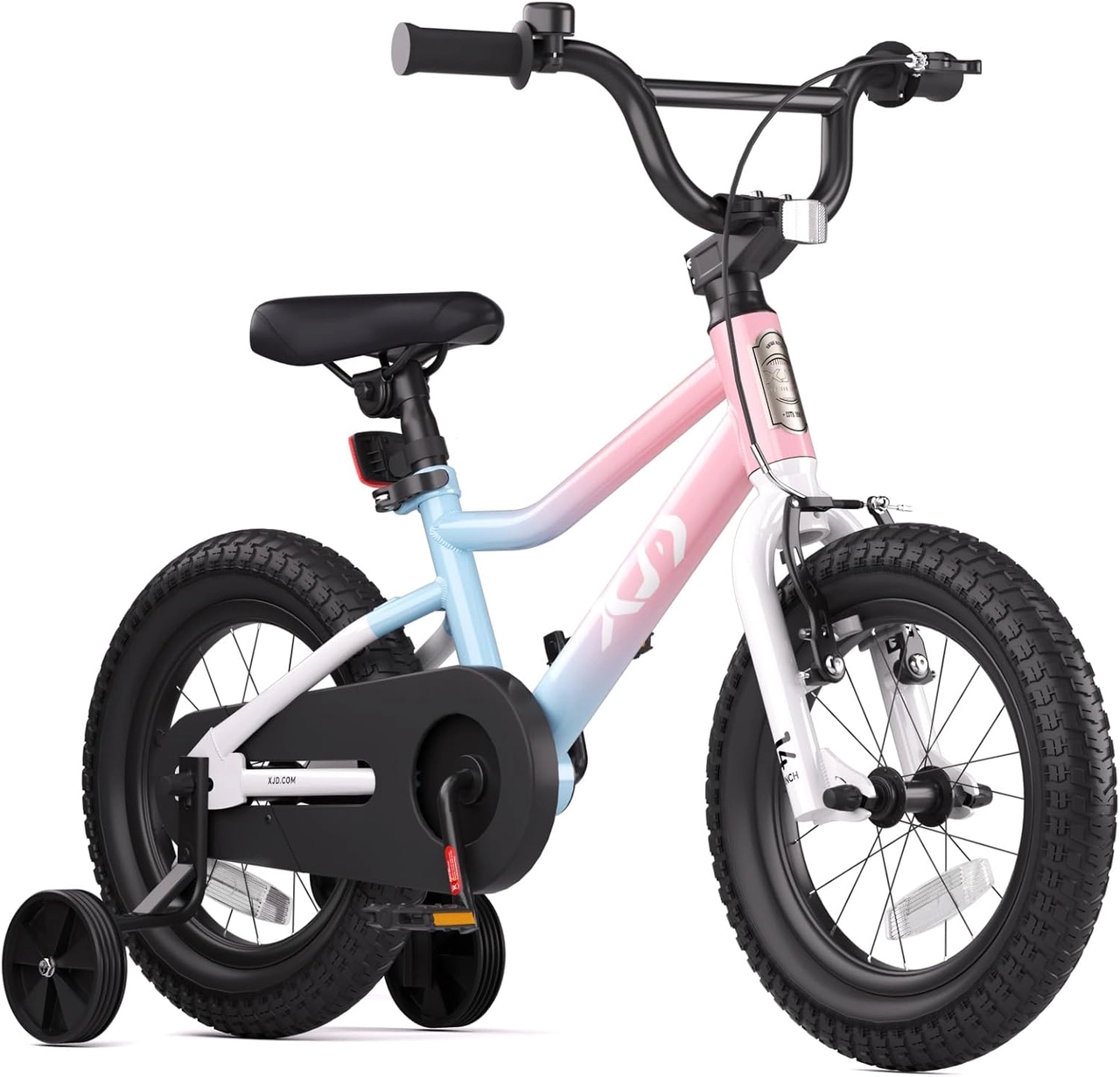 XJD Girls BMX Bike 12/14/16 Inch with Training Wheels – Pink Blue
A Kids’ BMX Bike offered in supplied 12, 14, and 16 Inch labels with training wheels. It illustrates the child-ridden bicycle stage and is not a baby passenger seat.
The XJD Light Purple Girls Bike with Basket, Training Wheels, 12/14/16/20 Inch is supplied here in 12, 14, and 16 Inch SKU labels. The XJD Girls BMX Bike 12/14/16 Inch with Training Wheels – Pink Blue also offers supplied 12, 14, and 16 Inch labels. These are Training Wheel Bikes and Kids’ BMX Bikes respectively, rather than passenger seats.
The XJD Kids Beach Cruiser Bicycle, Rear Rack & V-Brakes, Mint Green has supplied 20, 24, and 26 Inch SKU labels. Although its title mentions a rear rack, the catalog facts do not establish that the rack accepts a baby seat. Do not attach one unless the exact bicycle, rack, and seat manuals confirm compatibility.
When a child is ready for their own bicycle
For the later transition to a child-ridden bike, use measured height as the starting point and complete an individual fit check. These XBikes ranges are not baby-seat guidance:
| Wheel size | Starting age | Rider height |
|---|---|---|
| 12 Inch | 3–4 | 34–40 in / 86–102 cm |
| 14 Inch | 3–6 | 37–45 in / 94–114 cm |
| 16 Inch | 4–7 | 40–48 in / 102–122 cm |
| 18 Inch | 5–9 | 43–52 in / 109–132 cm |
| 20 Inch | 7–12 | 48–60 in / 122–152 cm |
| 24 Inch | 10–14 | 54–64 in / 137–163 cm |
| 26 Inch | Youth and adults | Over 60 in / 153 cm |
Have the child try the bicycle. Check stand-over clearance, reach, brake control, and present confidence; never buy an oversized bicycle merely for growth. The listed ages are only starting points, while measured height and actual control take priority.
What to do next
- Confirm unsupported sitting and dependable head and neck control.
- Measure the child and check every limit in the exact baby-seat manual.
- Verify bicycle and mounting compatibility in both manufacturers’ instructions.
- Fit the helmet level and adjust its straps as directed.
- Have a qualified bicycle mechanic resolve any installation or compatibility doubt.
If any one of those checks fails, wait before using the baby bike seat. Consider the supplied kids’ bicycles only when the child reaches the child-rider stage and can pass an individual bicycle fit and control check.
Bikes for your next adventure
-

XJD Boys 12/14/16" Training Wheel Bike – Blue
The XJD Boys Bike in Blue is a training wheel bike for riders 71–122 cm tall—rou…$169
$199 -

Light Pink XJD Girls' Bicycle with Basket & Training Wheels
The Light Pink XJD Girls' Bicycle with Basket & Training Wheels is a retro-style…$109.99
$129.99 -

Blue XJD Girls Bike with Training Wheels – 12/14/16 Inch
If you're shopping for a first pedal bike for a daughter roughly 3 to 8 years ol…$149
$169