

What age child bicycle seat
A child bicycle seat is suitable only when the child meets that seat’s manual requirements and can ride in it as directed; age alone cannot establish readiness.
First decide which “bicycle seat” you mean
If you mean a passenger seat attached to an adult bicycle, check the seat and bicycle manuals before riding. The supplied information does not include a universal minimum age, weight limit, mounting method or compatibility rule, so no single age can be stated responsibly.
If you mean choosing a bicycle with a seat at the right height for a child rider, use the child’s measured height to select a starting wheel size. Then confirm stand-over clearance, reach, brake control and confidence on the actual bicycle. Do not choose an oversized bicycle merely to allow room for growth.
For a passenger seat, check readiness and compatibility
Find the exact passenger-seat manual and compare all of its requirements with the child, the adult bicycle and the proposed mounting position. Check every stated age or developmental condition, child-size or load limit, bicycle compatibility requirement, restraint instruction and helmet guidance. If the manual is missing or the combination is unclear, ask the manufacturer or a qualified bicycle mechanic rather than guessing.
Before each ride, make sure the child can remain positioned as the manual requires and that all restraints and foot-retention features are used correctly. Confirm that the mounted seat does not interfere with steering, braking, wheels or the rider’s ability to control the bicycle. Follow the manual for assembly, inspection, maintenance and tightening instructions; no universal torque value or installation procedure applies to every model.
A bicycle helmet must fit the child properly, sit level and have its straps adjusted according to the helmet manufacturer’s instructions. A helmet does not make an incompatible seat, an unsuitable child or an incorrectly installed system acceptable.
For a child’s own bicycle, measure before comparing ages
Measure the child’s standing height without shoes. Inseam is also useful for checking how the bicycle fits, but the supplied XBikes standard provides numerical starting points only for standing height. Use age as a rough orientation, never as the deciding measurement.
| Wheel size | Age starting point | Rider-height starting point |
|---|---|---|
| 12 Inch | 3–4 | 34–40 in / 86–102 cm |
| 14 Inch | 3–6 | 37–45 in / 94–114 cm |
| 16 Inch | 4–7 | 40–48 in / 102–122 cm |
| 18 Inch | 5–9 | 43–52 in / 109–132 cm |
| 20 Inch | 7–12 | 48–60 in / 122–152 cm |
| 24 Inch | 10–14 | 54–64 in / 137–163 cm |
| 26 Inch | Youth and adults | Over 60 in / 153 cm |
Overlapping ranges are intentional starting points, not proof that either size fits. A child near a boundary should try the relevant bicycles rather than automatically moving up.
Perform the individual fit check
Have the child try the bicycle in a controlled setting. Check that the child can stand over it appropriately, reach the handlebar without stretching, steer with control and operate the brakes comfortably. Seat adjustment may refine a suitable fit, but it cannot correct a frame or wheel size that prevents safe stand-over, reach or control.
- Reject a bicycle the child cannot control confidently now.
- Check that the child can reach and use the brake controls reliably.
- Compare adjacent wheel sizes when height ranges overlap.
- Use the exact bicycle manual for seat adjustment, assembly, maintenance and tightening requirements.
How the supplied catalog bicycle helps
The XJD Kids Beach Cruiser Bicycle, Rear Rack & V-Brakes, Mint Green is offered with 20 Inch, 24 Inch and 26 Inch SKU labels. Those sizes let families compare three later-stage wheel-size starting points after measuring the rider. This is a child-ridden bicycle, not evidence about the appropriate age for riding in an adult bicycle’s passenger seat.

Under the XBikes starting points, consider its 20 Inch option for a rider measuring 48–60 inches, its 24 Inch option for 54–64 inches, and its 26 Inch option for a youth or adult over 60 inches. The overlapping 20- and 24-inch height ranges make an actual fit comparison especially important. The rear rack and V-brakes are catalog features only; they do not establish passenger-seat compatibility or replace a brake-reach check.
Make the age decision
For an attached child passenger seat, proceed only when the child and bicycle satisfy every condition in that exact seat’s manual; otherwise wait or obtain qualified help. For the child’s own bicycle, measure standing height, select the matching wheel-size starting point, and buy only after the child demonstrates suitable stand-over, reach, braking and present-day control.
Bikes for your next adventure
-

XJD Girls Bike for Kids Ages 3-8, 12/14/16 Inch with Training Wheels – Purple
The XJD Girls Bike in Purple is a training-wheel bicycle for kids ages 3 to 8, f…$149
$169 -
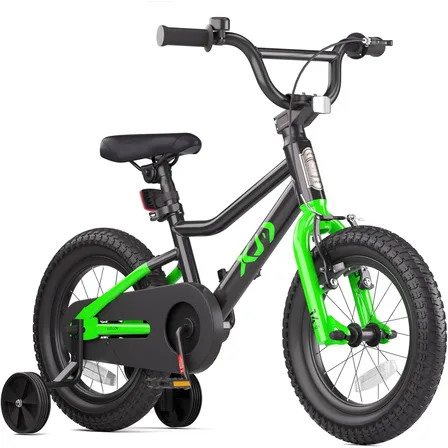
Black XJD Kids' BMX Bicycle with Training Wheels
The XJD Kids' BMX Bicycle with Training Wheels is built for children roughly 3 t…$99.99
$119.99 -

Light Pink XJD Girls' Bicycle with Basket & Training Wheels
The Light Pink XJD Girls' Bicycle with Basket & Training Wheels is a retro-style…$109.99
$129.99