

What age child is a 24-inch bicycle for
A 24-inch bicycle is usually for a child aged 10–14 who is 54–64 inches (137–163 cm) tall. Height is the better starting point, but the child must also pass an individual fit and control check.
Measure your child before choosing
Measure the child without shoes, standing straight against a wall. Record total height. Then measure inseam from the floor to the crotch using a firm book held level between the legs.
Compare the measured height with the XBikes 24-inch starting range of 54–64 inches (137–163 cm). Inseam matters too, but there is no universal inseam number for every 24-inch frame: frame shapes and component positions vary. Use the inseam measurement to check the actual bicycle rather than converting it into a wheel size by itself.
Age is a starting point, not the decision
The 10–14 age range answers the general question, but children of the same age can differ substantially in height, proportions, coordination and confidence. A tall nine-year-old might warrant a 24-inch fit check, while a shorter or less confident 12-year-old may still control a 20-inch bicycle more comfortably.
| Wheel size | Starting age | Rider height |
|---|---|---|
| 20 Inch | 7–12 | 48–60 in / 122–152 cm |
| 24 Inch | 10–14 | 54–64 in / 137–163 cm |
| 26 Inch | Youth and adults | Over 60 in / 153 cm |
The overlapping ranges are intentional starting points, not proof that two wheel sizes fit equally well. When a child falls in an overlap, compare the actual bicycles and favor the one the rider can mount, stop, steer and balance confidently.
Perform a five-part fit check
- Stand-over: Have the child straddle the bicycle with both feet flat on the ground. The frame should not press into the child, and mounting or stepping off should feel controlled.
- Seated position: Adjust the seat only within the bicycle manufacturer’s permitted range. The child should sit securely and pedal without rocking from side to side or stretching awkwardly at the bottom of the stroke.
- Reach: With hands on the grips, the rider should not have to lock the elbows, hunch forward or slide off the seat to reach the handlebar.
- Brake control: The child must be able to reach and operate the brake controls reliably while maintaining a stable grip and looking ahead.
- Confidence: In a suitable traffic-free area, check that the child can start, steer, make controlled turns, stop and dismount without panic or assistance.
If any check fails, do not buy the bicycle oversized for future growth. Try a different frame or wheel size. Follow the exact product manual for adjustment, assembly, compatibility, load limits and torque information, or ask a qualified bicycle mechanic.
How the supplied 24-inch options are relevant
Both supplied catalog options let you examine the requested 24-inch wheel size rather than relying on an adjacent size. They are beach cruiser bicycles, so they should be judged by the same child-specific stand-over, reach, brake-control and confidence checks before purchase.
The XJD Pink Beach Cruiser for Girls – Rear Rack & V-Brake has 20 Inch, 24 Inch and 26 Inch SKU labels. Its 24 Inch option is the relevant one for this question; the other labels are distinct sizes, not equivalent fits. The 24-Inch Purple XJD Beach Cruiser Bike with U-Brake is explicitly a 24-inch catalog option and has a Default SKU label. Its title identifies a U-brake, while the first product’s title identifies a V-brake and rear rack. Those catalog distinctions do not establish which bicycle fits an individual child.
These particular catalog options help answer the title because each provides a 24-inch bicycle to compare against the child’s measurements and real-world control, while the multi-size listing also shows why the precise SKU label must be checked.
 XJD Pink Beach Cruiser for Girls – Rear Rack & V-Brake
Its 24 Inch SKU is relevant to the requested size; its separate 20 Inch and 26 Inch labels provide distinct comparison sizes, not equivalent fits.
 24-Inch Purple XJD Beach Cruiser Bike with U-Brake
This beach cruiser is explicitly a 24-inch catalog option. Its Default SKU label does not replace checking the child’s height, stand-over, reach, braking control and confidence.
Complete the safety check
Have the child wear a bicycle helmet that fits properly, sits level and has its straps adjusted according to the helmet manufacturer’s instructions. A helmet does not correct a poor bicycle fit, so confirm both separately.
Before riding, use the bicycle’s exact manual for assembly and maintenance requirements. If the instructions are missing, unclear or beyond your experience, use a qualified bicycle mechanic rather than guessing at settings or procedures.
Make the 24-inch decision
Proceed with a 24-inch bicycle only when the child is near the 54–64-inch starting range and can comfortably clear the frame, reach the handlebar, control the brakes, pedal, steer, stop and dismount. If height points toward 24 inches but control does not, try another frame or a smaller wheel size; if the child is over 60 inches, compare an actual 26-inch bicycle as well. Choose the bicycle that fits now, not one the child must grow into.
Bikes for your next adventure
-
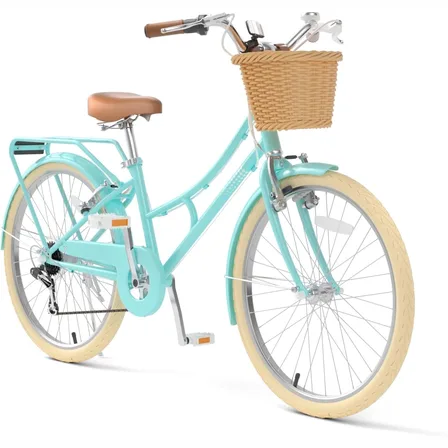
XJD Kids Beach Cruiser Bicycle, Rear Rack & V-Brakes, Mint Green
The XJD Beach Cruiser in Mint Green is a geared, multi-speed cruiser bike for ol…$179.99
$209.99 -
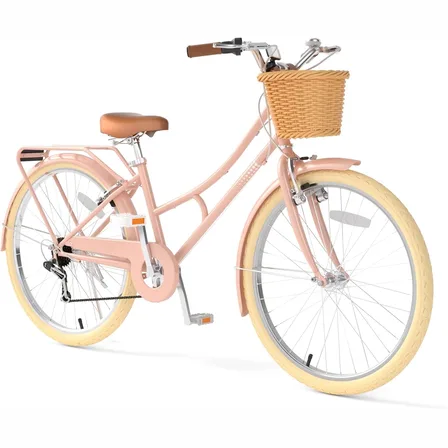
Pink XJD Beach Cruiser Bike, 24"/26", U-Brake
The XJD Pink Beach Cruiser Bike is a single-speed cruiser built for older kids a…$159.99
-
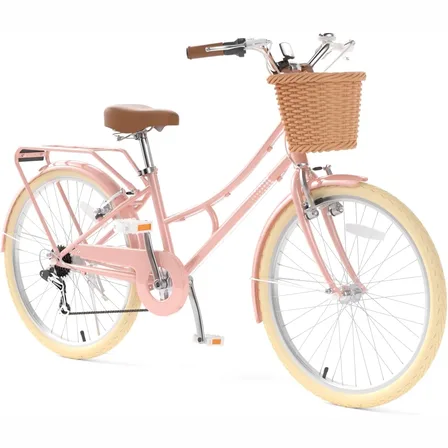
XJD Pink Beach Cruiser for Girls – Rear Rack & V-Brake
The XJD Pink Beach Cruiser for girls is the step-up bike for riders who've outgr…$179.99
$209.99