

What age do children learn to ride a bike
Most children learn to ride a bike between ages 3 and 7, but there is no single correct age. Start when your child can reach, steer, stop and feels ready.
Readiness matters more than a birthday
A child is ready to learn when they can follow simple directions, look ahead while moving, steer deliberately and keep trying after a wobble. They should also be willing to practise; pressure often makes learning harder.
Balance, coordination and confidence develop at different times. Some children begin at three or four, while others learn later. Either can be normal. Age helps narrow the wheel-size search, but it cannot confirm that a bicycle fits.
Measure before choosing a wheel size
Measure your child’s standing height without shoes. Also measure the inseam from the floor to the crotch while the child stands naturally. Compare those measurements with the bicycle itself rather than relying only on an age label.
Have the child try the bicycle. Check that they can stand over it comfortably, hold the handlebar without stretching, turn it without losing control and operate the brakes with their hands in a normal riding position. Their feet should make learning and stopping feel controlled. The American Academy of Pediatrics advises against buying an oversized bicycle simply so a child can grow into it.
XBikes wheel-size starting points
Use these ranges to identify sizes worth trying. Where ranges overlap, compare the child’s actual fit, reach, brake control and confidence on each bicycle.
| Wheel size | Age starting point | Rider height |
|---|---|---|
| 12 Inch | 3–4 | 34–40 in / 86–102 cm |
| 14 Inch | 3–6 | 37–45 in / 94–114 cm |
| 16 Inch | 4–7 | 40–48 in / 102–122 cm |
| 18 Inch | 5–9 | 43–52 in / 109–132 cm |
| 20 Inch | 7–12 | 48–60 in / 122–152 cm |
| 24 Inch | 10–14 | 54–64 in / 137–163 cm |
| 26 Inch | Youth and adults | Over 60 in / 153 cm |
These are starting points, not permission to skip a fit check. A confident six-year-old and a cautious six-year-old of the same height may need different learning setups, even when the same wheel size is worth trying.
How the supplied bikes help with comparison
The catalog options provide useful size and bicycle-type comparisons across early learning and later childhood. The two training-wheel-equipped titles offer listed 12, 14 and 16 Inch choices, while the cruiser extends the comparison to listed 20, 24 and 26 Inch choices. They help identify which products are relevant after measurement; their titles alone do not establish fit.
 XJD Light Purple Girls Bike with Basket, Training Wheels, 12/14/16/20 Inch
A Training Wheel Bike with supplied available size labels of 12, 14 and 16 Inch, relevant for comparing early learning sizes after measuring the child and checking individual fit.
 XJD Kids Beach Cruiser Bicycle, Rear Rack & V-Brakes, Mint Green
A Beach Cruiser Bike with supplied available size labels of 20, 24 and 26 Inch. It is relevant to taller or older starting points, not a substitute when measurements indicate a smaller learning size.
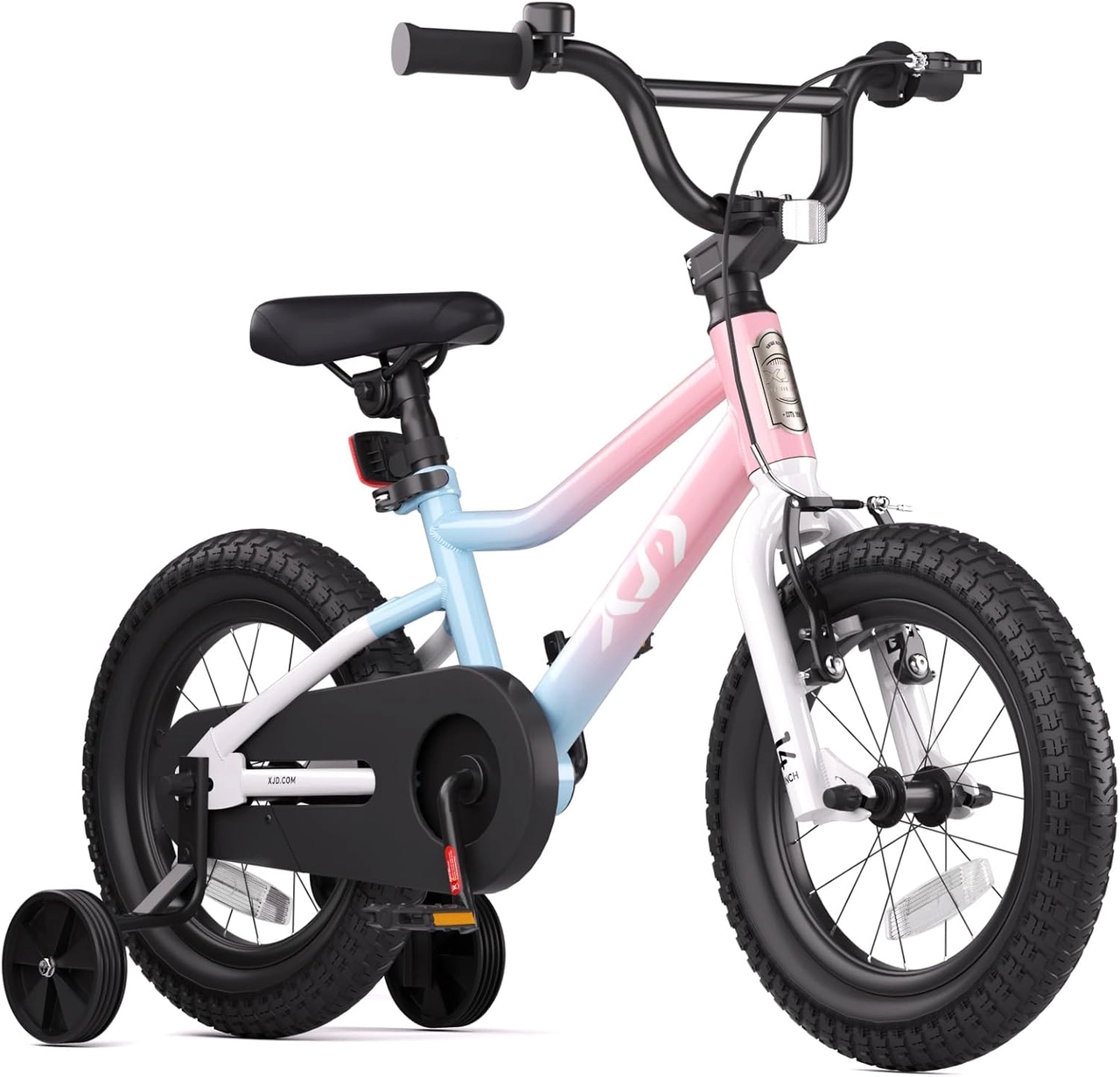 XJD Girls BMX Bike 12/14/16 Inch with Training Wheels – Pink Blue
A Kids’ BMX Bike with training wheels and supplied 12, 14 and 16 Inch available size labels. Use it as a comparison only when the rider’s height, reach, control and confidence support that size.
Options for early learning sizes
XJD Light Purple Girls Bike with Basket, Training Wheels, 12/14/16/20 Inch is categorized as a Training Wheel Bike. Its supplied available SKU labels are 12 Inch, 14 Inch and 16 Inch. Although 20 Inch appears in the exact catalog title, it is not in the supplied available-SKU list, so confirm the exact selectable size rather than assuming availability.
XJD Girls BMX Bike 12/14/16 Inch with Training Wheels – Pink Blue is categorized as a Kids’ BMX Bike and has supplied available SKU labels of 12 Inch, 14 Inch and 16 Inch. Compare the appropriate listed size only after checking the child’s measurements and control.
Options for larger riders
XJD Kids Beach Cruiser Bicycle, Rear Rack & V-Brakes, Mint Green is categorized as a Beach Cruiser Bike, with supplied available SKU labels of 20 Inch, 24 Inch and 26 Inch. Those sizes begin at older or taller starting points in the XBikes table, so this is not a substitute for a smaller learning bicycle when the child’s measurements indicate 12, 14 or 16 Inch.
None of these products supplies an available 18 Inch SKU label. If measurement points toward 18 Inch, treat the listed 16 and 20 Inch models only as nearest-size comparison points, not equivalent substitutes.
A practical way to teach riding
- Choose a flat, open area away from traffic, obstacles and steep slopes.
- Let the child become comfortable sitting, looking ahead, steering and stopping before combining every skill.
- Use short sessions and stop before frustration or fatigue erodes attention.
- Stay close enough to assist, but allow the child to develop balance rather than being pulled along.
- Practise controlled starts and stops repeatedly before adding turns or busier surroundings.
Training wheels can provide support while a child learns pedalling and steering, but their presence does not make a bicycle correctly sized. Recheck stand-over clearance, reach and brake operation whenever the setup changes. Follow the exact product manual for assembly, adjustment and maintenance, or use a qualified bicycle mechanic where needed.
Helmet and final decision
Use a bicycle helmet every ride. The U.S. Consumer Product Safety Commission advises that it fit properly, sit level and have its straps used according to the helmet manufacturer’s instructions. Replace guesswork with an actual fit check for both bicycle and helmet.
Measure your child now, shortlist the wheel sizes whose height ranges include that measurement, and have the child try them. Begin learning when they can stand over, reach, steer and brake with control—and when they are willing to practise, whether that happens at three, seven or later.
Bikes for your next adventure
-

Blue XJD Girls Bike with Training Wheels – 12/14/16 Inch
If you're shopping for a first pedal bike for a daughter roughly 3 to 8 years ol…$149
$169 -
XJD Girls BMX Bike 12/14/16 Inch with Training Wheels – Pink Blue
The XJD Girls BMX Bike in Pink/Blue is built as a first pedal bike for kids roug…$99.99
$119.99 -

Black XJD Kids Bike for Boys – 12, 14 & 16 Inch Sizes
For a son between roughly 3 and 8 years old, the XJD Kids Bike in Black covers t…$169
$199