

What age do kids learn to bike
Most kids learn to ride a bike between ages 3 and 7, but readiness matters more than a birthday. Measure height and inseam, then check balance, reach, braking and confidence on the actual bicycle.
What age is a child ready to learn?
There is no single correct age. A child may be ready when they want to try, can follow simple directions and can practice without becoming overwhelmed. Useful physical signs include walking a bicycle while seated, steering where they intend to go and stopping when asked.
Some children develop these skills around age 3 or 4; others need more time. The practical goal is controlled riding, not meeting an age deadline. A calm child on a correctly fitted bicycle has a better learning setup than an older child struggling with an oversized one.
Measure before choosing a wheel size
Measure the child without shoes against a wall for height. For inseam, have the child stand straight with feet slightly apart and measure from the floor to the crotch. Use height to identify starting sizes, then use inseam to assess stand-over clearance and whether the child can support the bicycle comfortably.
| Wheel size | Starting age | Rider height |
|---|---|---|
| 12 Inch | 3–4 | 34–40 in / 86–102 cm |
| 14 Inch | 3–6 | 37–45 in / 94–114 cm |
| 16 Inch | 4–7 | 40–48 in / 102–122 cm |
| 18 Inch | 5–9 | 43–52 in / 109–132 cm |
| 20 Inch | 7–12 | 48–60 in / 122–152 cm |
| 24 Inch | 10–14 | 54–64 in / 137–163 cm |
| 26 Inch | Youth and adults | Over 60 in / 153 cm |
These XBikes ranges are starting points, not proof of fit. Where sizes overlap, compare both on the child rather than choosing from age alone. Do not move up merely to leave growing room.
Check the bicycle on the child
Have the child try the bicycle before deciding. The American Academy of Pediatrics advises against buying an oversized bike for growth and emphasizes stand-over clearance, control and brake reach. During the fit check, confirm that the child can:
- stand over the bicycle without being forced onto tiptoes;
- sit in a stable position and reach the handlebar without stretching;
- turn the handlebar while remaining balanced;
- reach and operate the available braking controls reliably;
- start, stop and put a foot down without panic.
If any of these checks fail, the age label or height range does not make that bicycle suitable. Compare another size or configuration instead.
How the catalog option fits this decision
The Purple XJD Girls' Bike with Doll Seat & Basket is a training-wheel bike offered in 12 Inch, 14 Inch and 16 Inch labels. Those options span XBikes starting ranges from ages 3–4 through 4–7, with overlapping rider heights from 34–48 inches / 86–122 cm. They help parents compare three plausible early-learning sizes, but each still requires the individual fit checks above.

The doll seat and basket are catalog features, not evidence that the bicycle fits a particular child. Likewise, the exact product title does not establish an age recommendation. If the measured child falls outside all three supplied size ranges, this product is not the relevant comparison; use the table to identify a more appropriate wheel-size starting point.
A simple learning sequence
- Begin with control: In a flat, traffic-free area, let the child become comfortable sitting, walking the bicycle and steering.
- Practice stopping: Make sure the child can use the bicycle's available braking controls and put a foot down deliberately.
- Add short attempts: Keep practice brief and repeat starts, straight riding, gentle turns and stops.
- Change one thing at a time: If confidence drops, return to the last skill the child could perform comfortably rather than moving to a larger bicycle.
Training wheels can provide support while a child learns pedaling and steering, but their presence does not replace correct sizing or prove readiness. Follow the exact product manual for assembly, adjustments, maintenance and any limits or compatibility requirements. When instructions are missing or the setup is uncertain, use a qualified bicycle mechanic.
Helmet and final readiness check
Use a bicycle helmet every time. U.S. Consumer Product Safety Commission guidance says it must fit properly, sit level and have its straps adjusted according to the helmet manufacturer's instructions. Replace guesswork with a fresh fit check whenever the child or equipment changes.
For the next step, record the child's height and inseam, shortlist the matching wheel sizes, and have the child compare them in person. Choose only the bicycle on which they can stand over, reach, steer and brake with control; if none passes, wait or try a different size rather than buying for age or growth.
Bikes for your next adventure
-

Blue XJD Girls Bike with Training Wheels – 12/14/16 Inch
If you're shopping for a first pedal bike for a daughter roughly 3 to 8 years ol…$149
$169 -
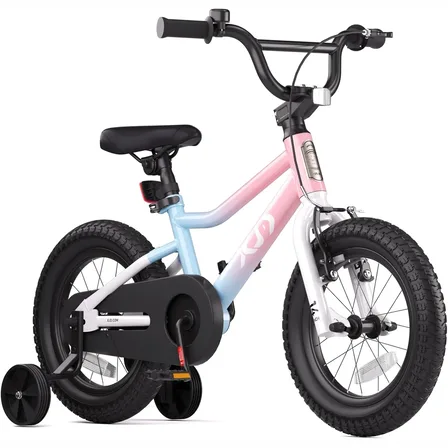
XJD Girls BMX Bike 12/14/16 Inch with Training Wheels – Pink Blue
The XJD Girls BMX Bike in Pink/Blue is built as a first pedal bike for kids roug…$99.99
$119.99 -

26-Inch XJD Beach Cruiser Bike for Girls – Purple, V-Brake
This XJD 26-inch purple beach cruiser is sized for big kids and teens — suggeste…$218.49
$229.99